What Is OpenHands? How to Turn AI Coding Agents Into Automations
Most engineers still pilot coding agents by hand, one chat at a time. OpenHands co-founder Robert Brennan shows how teams run agents automatically instead: triggered by events, limited to one job, measured, and switching models when the data says so.
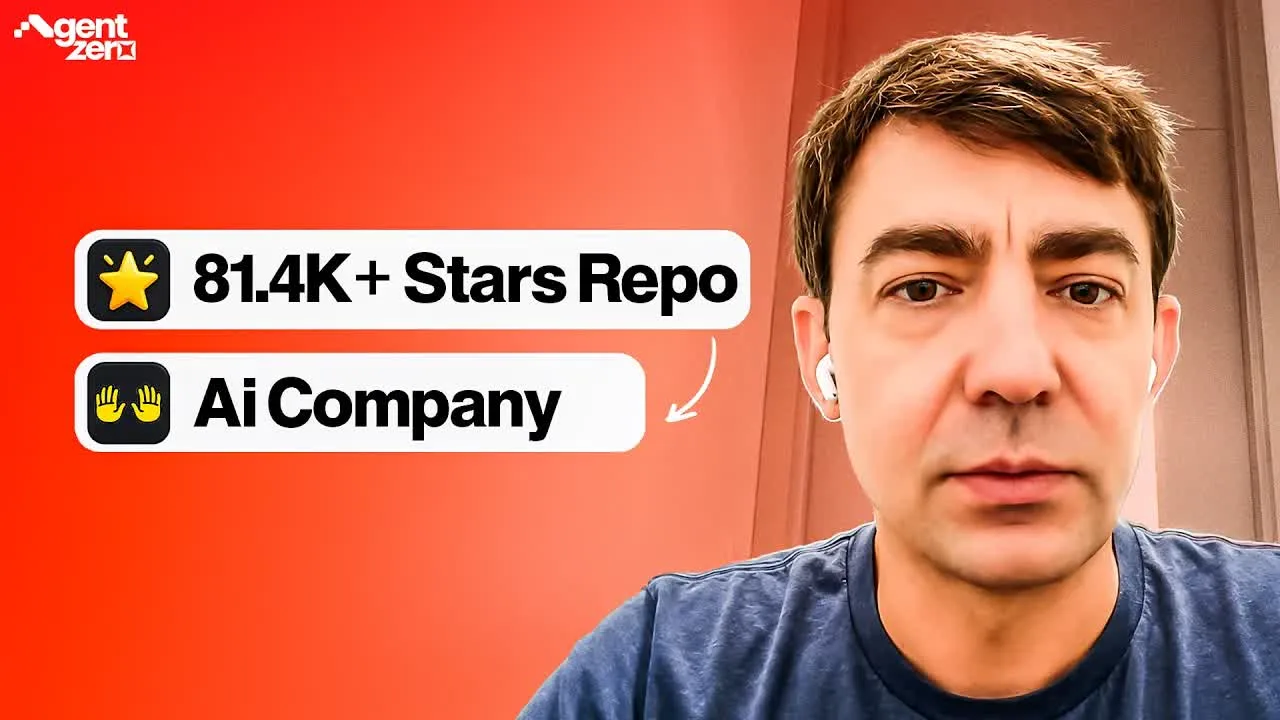
What is OpenHands?
OpenHands is an open-source AI engineering platform for running coding agents, from a single chat to fleets of automations that start on their own when something happens in GitHub, Slack, Jira, Linear or Datadog, or on a schedule.
It started as a community project to build an open alternative to Devin, the first widely seen AI software engineer. Today it has more than 81,400 stars on GitHub, and its co-founder and CEO, Robert Brennan, runs it as a company. In this episode he demos how his own team uses it, and argues that most engineering teams are still using agents the slow way.
"Every part of the software development lifecycle is ripe for this type of automation."
Robert Brennan
The episode in numbers
From one paragraph to the top of SWE-bench
When ChatGPT first came out, Robert's workflow was what everyone's was: ask for code, paste it into the editor, copy the error back, repeat. He started wiring the APIs into small agent loops. Then Cognition released its demo of Devin, an agent that could run code, read the error and search the web for a fix, all on its own.
It was impressive, and it was a closed startup talking about replacing software engineers. Robert and his co-founders thought engineers should have a say. "This needs to be done in the open." That same day they created a GitHub project called OpenDevin, with one paragraph: we're going to rebuild this demo, all open source, come with us.
The community rallied. They had a working demo within a week or two, and within about a month they were at the top of the SWE-bench leaderboard for coding agents. Robert had a vacation planned for the following week. He spent four hours a day of it triaging GitHub issues instead of sitting on the beach. The project later became OpenHands.
Piloting agents vs automating them
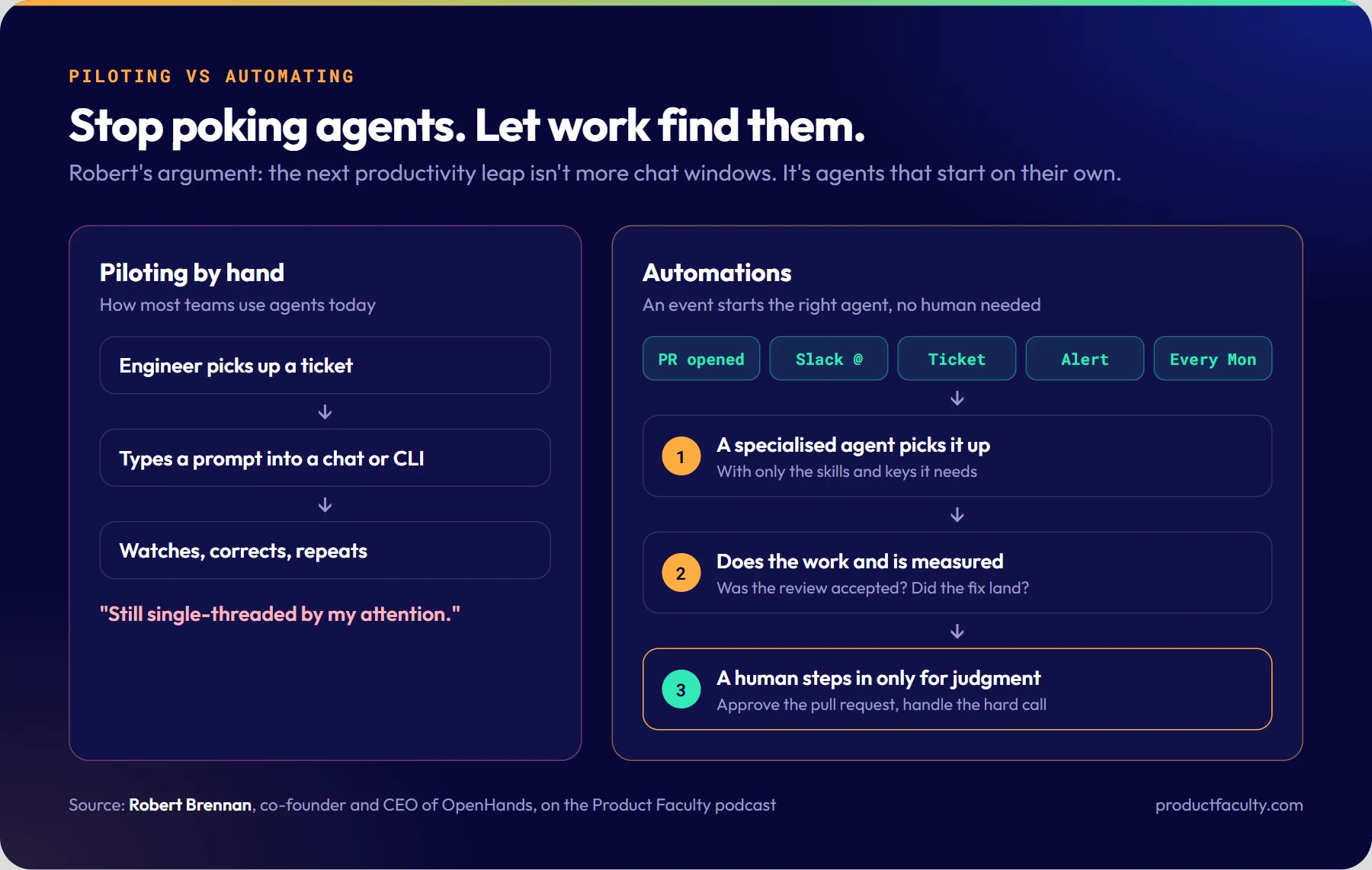
Robert's main point is about how engineers use agents today. Most work still starts with a person typing "please work on ticket 123" into a chat window or CLI, then watching. An agent makes it faster, but the engineer is still the bottleneck: "it's still kind of single-threaded by my attention."
The bigger lift comes from automations: agents that start on their own in response to an event, do the work, get measured and only reach a human when judgment is needed.
| Feature | Piloting by hand | Automations |
|---|---|---|
| How work starts | An engineer types a prompt | An event or a schedule starts it |
| Where it runs | Usually a laptop, so it stops when the lid closes | In the cloud, always on |
| Who can see it | One person | The team, with set permissions |
| Access | Whatever the person's machine has | Only the tools and keys that job needs |
| Limit | The engineer's attention | Human judgment, only where needed |
| Example | "Please review my pull request" | Every new pull request gets an agent review automatically |
One control centre for Claude Code, Codex and more
Robert's demo starts with Agent Canvas, the open-source app at the centre of OpenHands. He connects it to the Claude Code he already runs on his laptop, so the agent is the same one he uses every day. The browser just adds a better view: every past conversation, a live preview of what the agent is building and as many parallel sessions as you want, instead of a row of terminal windows.
From the same screen you manage skills, MCP connections (GitHub, Slack and others), secrets for apps without an MCP server, and model profiles, including a Codex subscription. Other harnesses like OpenCode and Pi connect too.
Then the important part: with one click he switches from agents running on his laptop to his team's shared instance in the cloud. A cloud agent keeps working when the laptop closes, and teammates can see it run. Personal always-on agents like Hermes and OpenClaw inspired that setup. The difference, he says, is the shared web interface, one-click switching between local and cloud, and, in the enterprise version, role-based access so some people can only read a conversation while others can run it or add new tools.
One agent per job, with only the keys it needs
Once Robert started spinning up a separate Agent Canvas for each type of task, things got clearer: what does this agent have access to, and why did it go wrong? His team now runs separate instances for monitoring, code review, ticket management and their go-to-market team. He even built one to manage his recipes.
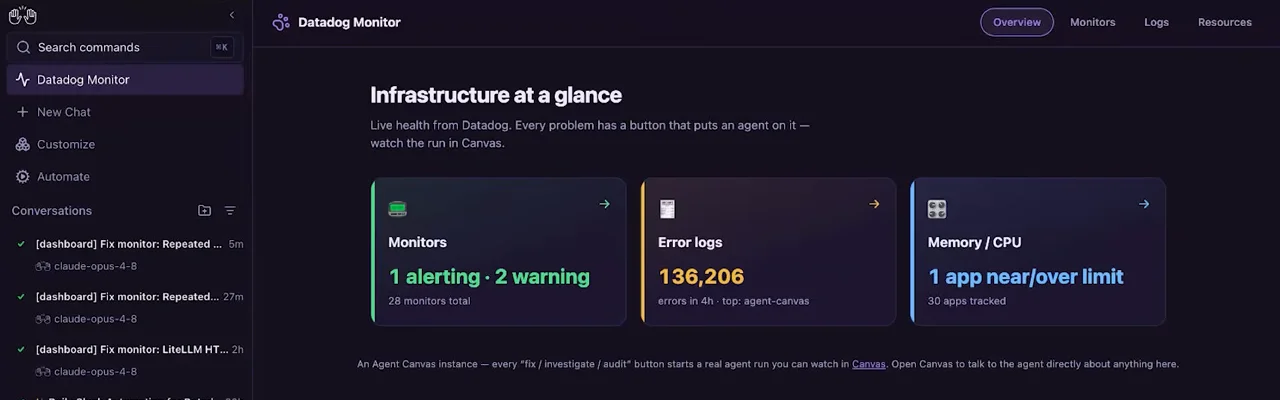
The Datadog instance has its own home page showing what is alerting. Click "fix" and an agent starts working on that alert. It has only Datadog and GitHub credentials, and only the skills for mapping Datadog errors to the right code. The platform team gets access to it; engineering managers get the Linear one.
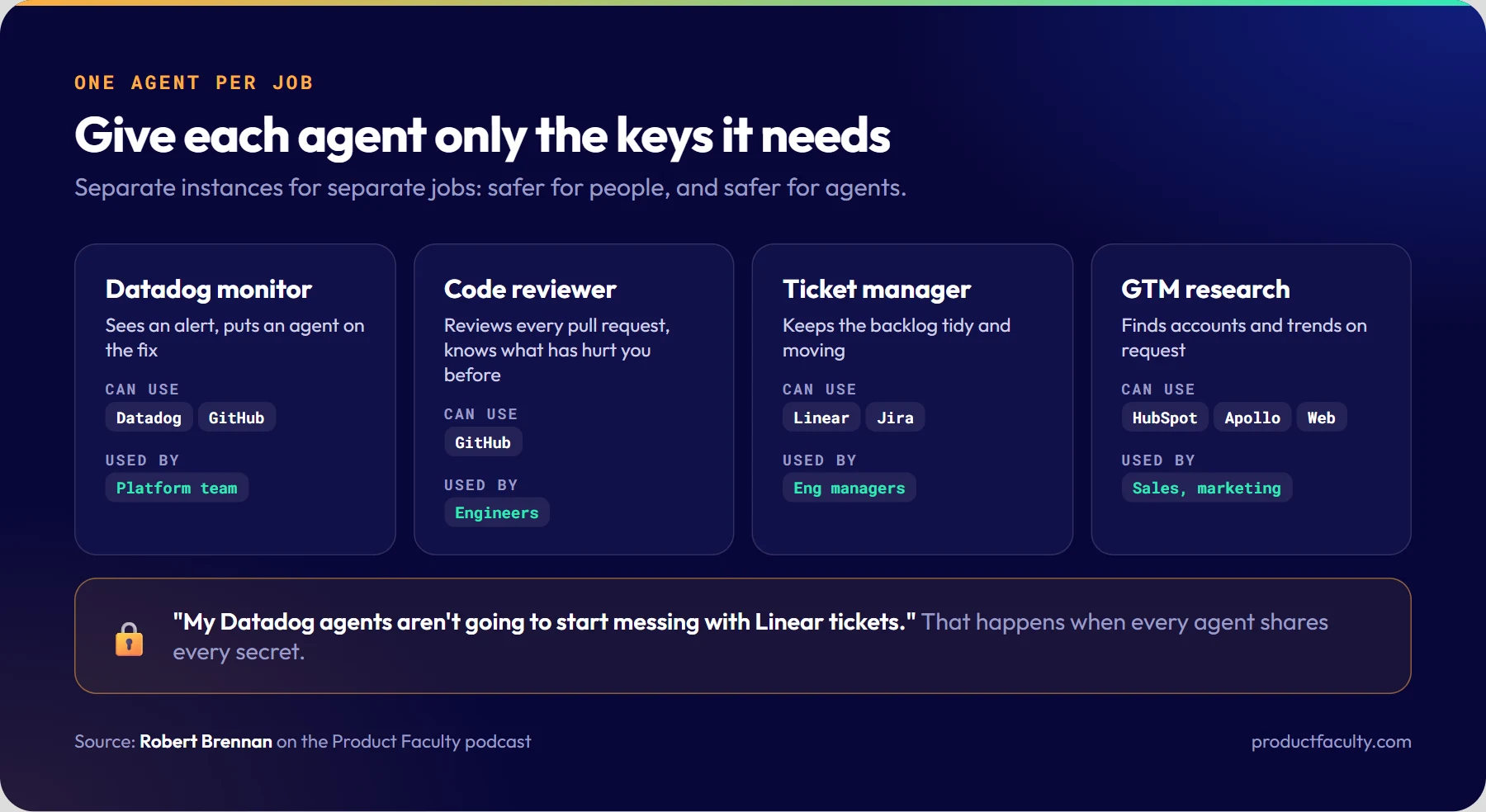
That separation works both ways: role-based access for humans and role-based access for agents. When every agent sits together with every secret, agents start "doing weird things."
Why model-agnostic matters, and how to switch with data
Robert admits he has been lazy and sending everything to the most powerful model he has, which is slow and expensive. His advice is to pick a model-agnostic setup. Claude Code is built around Anthropic's models and Codex around OpenAI's. You can hack them to use another model, but they weren't designed for it.
That matters because the labs keep leapfrogging each other, open-source models keep improving and models can be switched off. Open models are often around ten times cheaper for similar quality. OpenHands benchmarks hundreds of models against its own agent and publishes how each one scores against what it costs.
Data like this gives a CTO or CFO "some firepower": if a cheaper model barely loses quality and saves a large share of the bill, you can switch the default, with data to back it up.
OpenHands does this on its own code review agent. Every pull request gets an agent review that knows what has hurt the team before, like breaking API changes. They track how many of its comments get accepted or ignored, and what a human reviewer still caught afterwards. Right now they are A/B testing Claude Opus against MiniMax, which costs about a tenth as much.
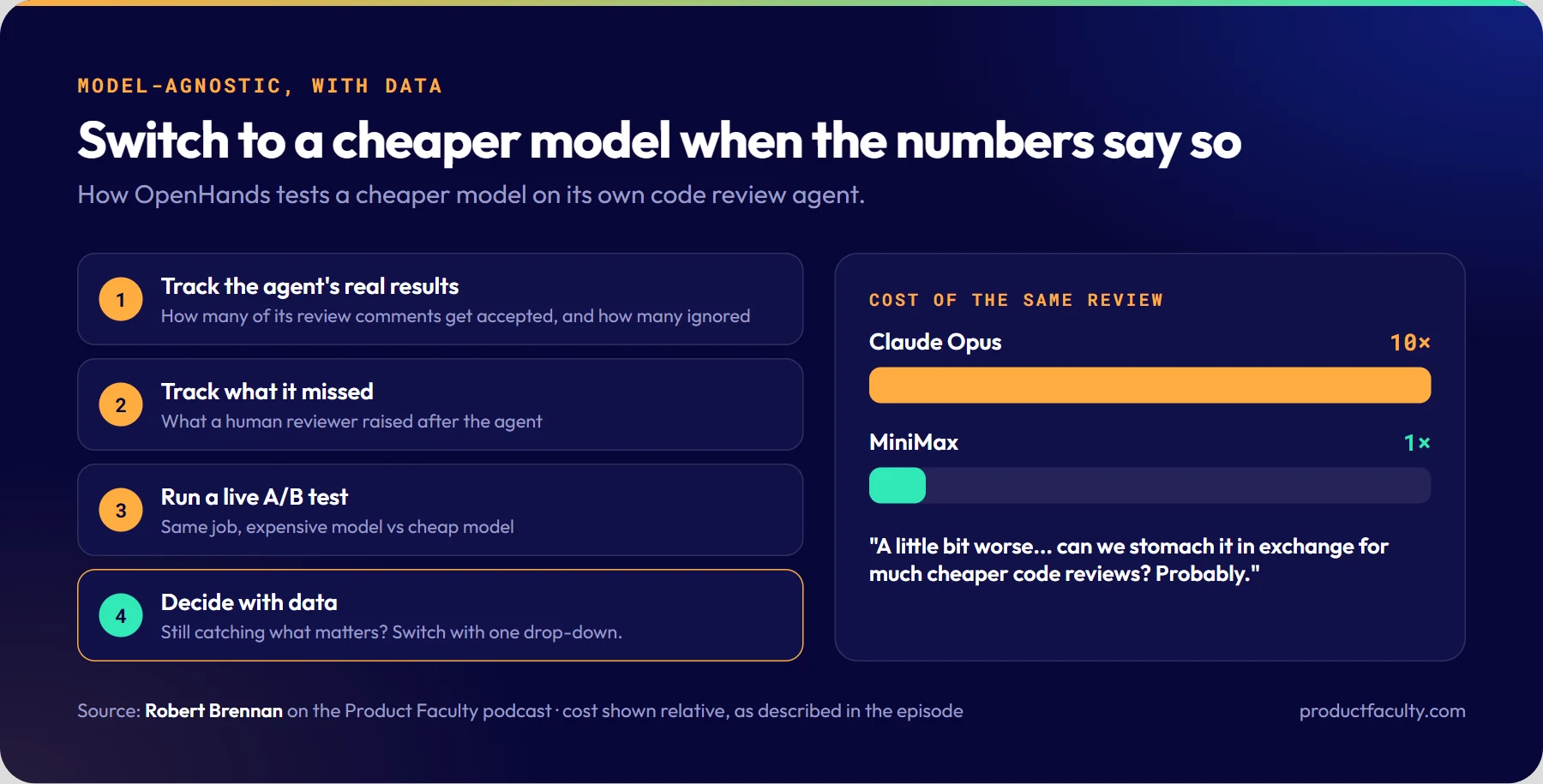
On local models, Robert is waiting. Open models hosted in the cloud are already solid for many tasks, but the ~30B models that fit on a laptop still aren't good enough for real coding work. He expects that to change within the next six months or so.
What engineering work to automate first
A lot of the work of keeping a codebase healthy is toil: no creativity, little critical thinking. Robert says agents can pick these tasks up and ship them "with 90-plus percent accuracy," with a human approving the pull request. Good first automations:
- Code review on every pull request, with a skill that says what your team should look for.
- Weekly dependency updates. Every Monday morning, update everything, but skip any package less than a week old to protect against supply chain attacks. Your team just merges the pull request.
- Test coverage. Look at last week's changes, find what is under-tested and add tests.
- Alert fixes. When a monitor fires, an agent investigates and opens a fix.
- Release notes, docs and migrations, all repeatable and easy to check.
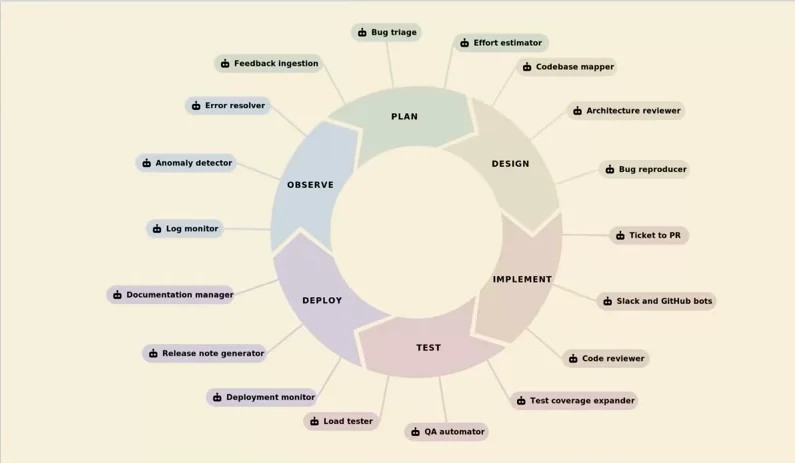
His view is that teams have barely started. Most automation so far sits in writing code and some code review. Planning, design, deployment and monitoring are still almost all manual, or done by someone telling an agent what to do. "Getting these things set up so that they're just running automatically, that's where you get the real productivity boost." Over time, he expects agents to merge more of their own work, with a last human check before production.
Beyond engineering: sales and marketing
OpenHands is built for engineers, but Robert's own company uses it elsewhere too:
- Marketing. The head of marketing asks for the industry trends of the last seven days and blog topics to jump in on. An agent searches the web in the background and reports back.
- Sales. A Slack bot connected to HubSpot answers questions like "who are the top three financial services accounts we haven't talked to in the last month?"
Own the infrastructure your agents run on
There are many ways to run automations today, such as Cursor's background agents or Anthropic's managed agents. Robert's closing advice: if you're redesigning your whole development lifecycle around agents, own where they run and what environment they have. "You don't want to be stuck in somebody else's walled garden." Being model-agnostic and owning your agent infrastructure are two halves of the same future-proof strategy.
Try this week
- List your team's toil. Write down the repeatable tasks across plan, build, test, deploy and monitor.
- Automate one trigger. Start with an agent code review on every new pull request.
- Scope it tightly. Give that agent only the repository access and skills it needs.
- Measure it. Track which comments get accepted and what humans still catch.
- Test a cheaper model on the same job, and switch only if the numbers hold.
Watch the full episode
FAQ
What is OpenHands?
OpenHands is an open-source AI engineering platform for running coding agents. You can chat with agents such as Claude Code or Codex in a browser, run them on your laptop or in the cloud, and set up automations that start agents on events from GitHub, Slack, Jira, Linear or Datadog, or on a schedule.
Is OpenHands the same as OpenDevin?
Yes. OpenHands began as OpenDevin, an open-source project started to rebuild Cognition's Devin demo in the open. Within about a month it reached the top of the SWE-bench leaderboard, and it was later renamed OpenHands.
How is OpenHands different from Claude Code?
Claude Code is an AI coding agent built around Anthropic's models. OpenHands is a model-agnostic platform that can run Claude Code, Codex and other agents, and adds a shared web interface, cloud instances that keep running, team permissions and automations triggered by events.
Why should an engineering team be model-agnostic?
AI labs keep overtaking each other, open-source models keep getting cheaper and better, and models can be retired. A model-agnostic setup lets a team switch to a better or cheaper model by changing one setting, backed by data on cost and quality.
What engineering tasks can AI agents automate?
Good first candidates are code review on every pull request, weekly dependency updates, adding tests where coverage is low, fixing monitoring alerts, writing release notes and running migrations. These are repeatable tasks where a human only needs to approve the result.
How do you measure an AI code review agent?
Track how many of the agent's review comments are accepted versus ignored, and what human reviewers still catch after the agent. Those numbers show whether changes to the agent's skills, or a switch to a cheaper model, keep quality where it needs to be.
Learn to build production agent systems
Product Faculty's Agentic Engineering course, part of the AI Builder Fellowship, teaches you to build and run production agent systems, not just demos. To measure agents the way OpenHands measures its code reviewer, see AI Evals.