What Is Grokbot? How to Build AI Agents That Work While You Sleep
Matt Van Horn runs a fleet of 15 Grokbots that plan his family's week, research any topic, make phone calls and send hundreds of DMs. Here's how he sets them up, the tools that make them useful, and the habits that keep them reliable.

What is Grokbot?
Grokbot is an AI agent app, made by a team at SpaceX according to Matt, that gives each bot its own hosted computer, lets it sign in and use your tools, run recurring jobs on a schedule and keep working while you sleep, through a simple chat interface on Mac and iPhone.
Matt Van Horn was an early user of Clawdbot (later OpenClaw) and of Hermes. He calls them game-changing, but "they were not for humans. They were for nerds like me." Grokbot is the first agent he thinks his wife, a power ChatGPT user with four kids to manage, would actually use. "It's like using iMessage, but now you're chatting with agents."
Matt is also the creator of Last 30 Days, an open-source agent skill with more than 60,000 GitHub stars, and of Printing Press, which generates command-line tools on demand. His post saying he no longer needed OpenClaw or Hermes got 800,000 views and a repost from Elon Musk. His follow-up, "Every Grokbot hack I know", reached 1.2 million views.
"Grokbot feels like the first agent experience that was designed for humans."
Matt Van Horn
The episode in numbers
Grokbot vs OpenClaw vs Hermes
All three let an agent run on its own computer and do real work. The difference, in Matt's view, is who they're built for.
| Feature | OpenClaw | Hermes | Grokbot |
|---|---|---|---|
| Built for | Technical users | Technical users | Anyone who can use a chat app |
| Getting started | Can feel technical and intimidating | Can feel technical and intimidating | Download the app; the computer is hosted |
| Phone app | No official native iOS app | Desktop app, no iOS app yet | Native Mac and iOS apps that sync |
| Strength | Changed the whole industry | Improving fast; lots to customize | Simple, and works across your devices |
That comparison reflects things at the time of recording. Hermes co-founder Teknium replied to Matt's post with "cap bro lol". Shubham jumped in with "Hermes is the goat, Grokbot makes it easy and accessible for all." Both can be true: the nerd tools keep getting more powerful, and Grokbot lowers the bar for everyone else. Matt says the sync between the Mac app, the iPhone app and the cloud computer is what really makes it work.
Getting started: the chief of staff
Setup is a download. The default bot, and still Matt's number one workhorse, is a chief of staff connected to his calendar and email. A few of the jobs it does:
- Screenshot to calendar. Someone sends a kids' birthday party invite. He screenshots it and says "add it to my calendar and my wife's." Something that should have been solved years ago, now is.
- A daily family email. Every day at 7am it emails him and his wife the kids' calendar.
- Getting things done on its own. Asked to buy a vinyl record from a UK shop, it didn't manage the purchase. But along the way it found he already had an account, reset the password through his email and logged itself in. Proactive, and a reminder to think carefully about what you give an agent access to.
His tip for anyone using Google apps: install the Gog CLI from OpenClaw founder Peter Steinberger. His bot was "very, very slow" using Google Sheets in a browser. Through the command-line tool, it's instant.
Dr. Eggbot: the bot that builds bots
The best place to start a new bot is Dr. Eggbot, a bot designer made by Lauren on the Grokbot team. You describe the bot you want in plain words, and it builds the new bot and adds it to your sidebar.
Matt made an ELI5 TL;DR bot this way in one prompt: "one job: paste an article, quote, email or link; give a tight TL;DR plus an ELI5. No extra research, no takes unless you ask." He's used it every day since. He also asked for a bot that tracks a footballer friend's goals each week with the best clips. The bot noticed the player had changed teams and updated its own routine without being asked.
During the recording, Shubham built a visual ELI5 bot the same way, and it explained compound engineering with interactive diagrams. "You learn something and you can almost at that same moment just replicate it."
One job per bot: Matt's fleet
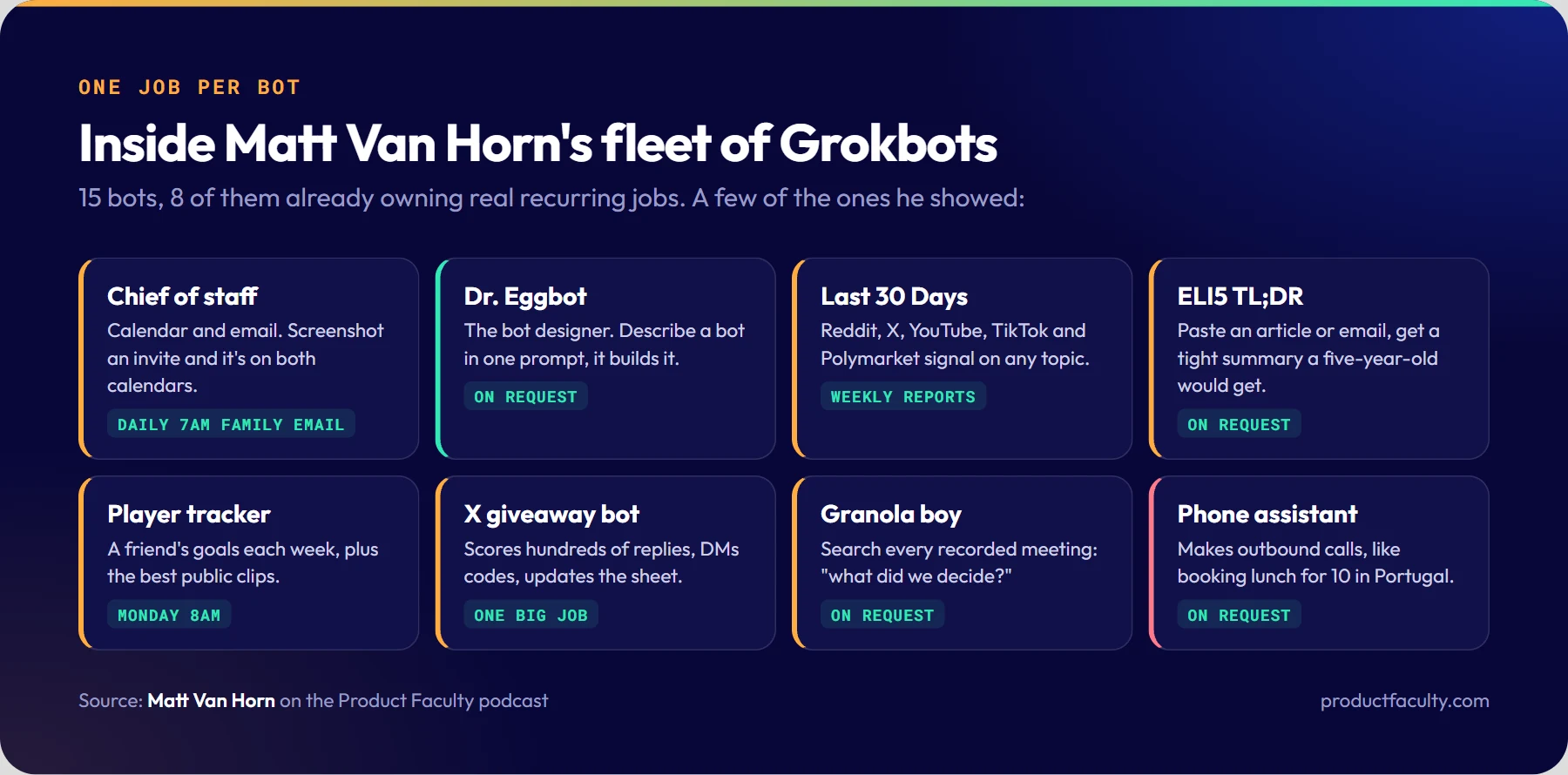
His three favourites:
- Compound engineering for any serious task (see below). "It's the difference between running basic ChatGPT and running one with thinking on."
- Last 30 Days. It pulls the last month of signal on any topic from Reddit, X, YouTube, TikTok and Polymarket into a grounded summary. He gets weekly reports on Kanye West and on Benfica, his football team. On one directory of popular bots, it ranks second, after Dr. Eggbot.
- Granola boy, a typo he kept. Connected to his recorded meetings, it answers "what were the notes from this meeting?" in seconds.
Compound engineering: plan first, then work
"Agents are inherently lazy," Matt says. They aim for the perfect ratio of making you happy while using as few tokens as possible, so they cut corners. For anything serious he uses the compound engineering skill: /ce plan to have the agent write a full plan, then /ce work to have it follow the plan.
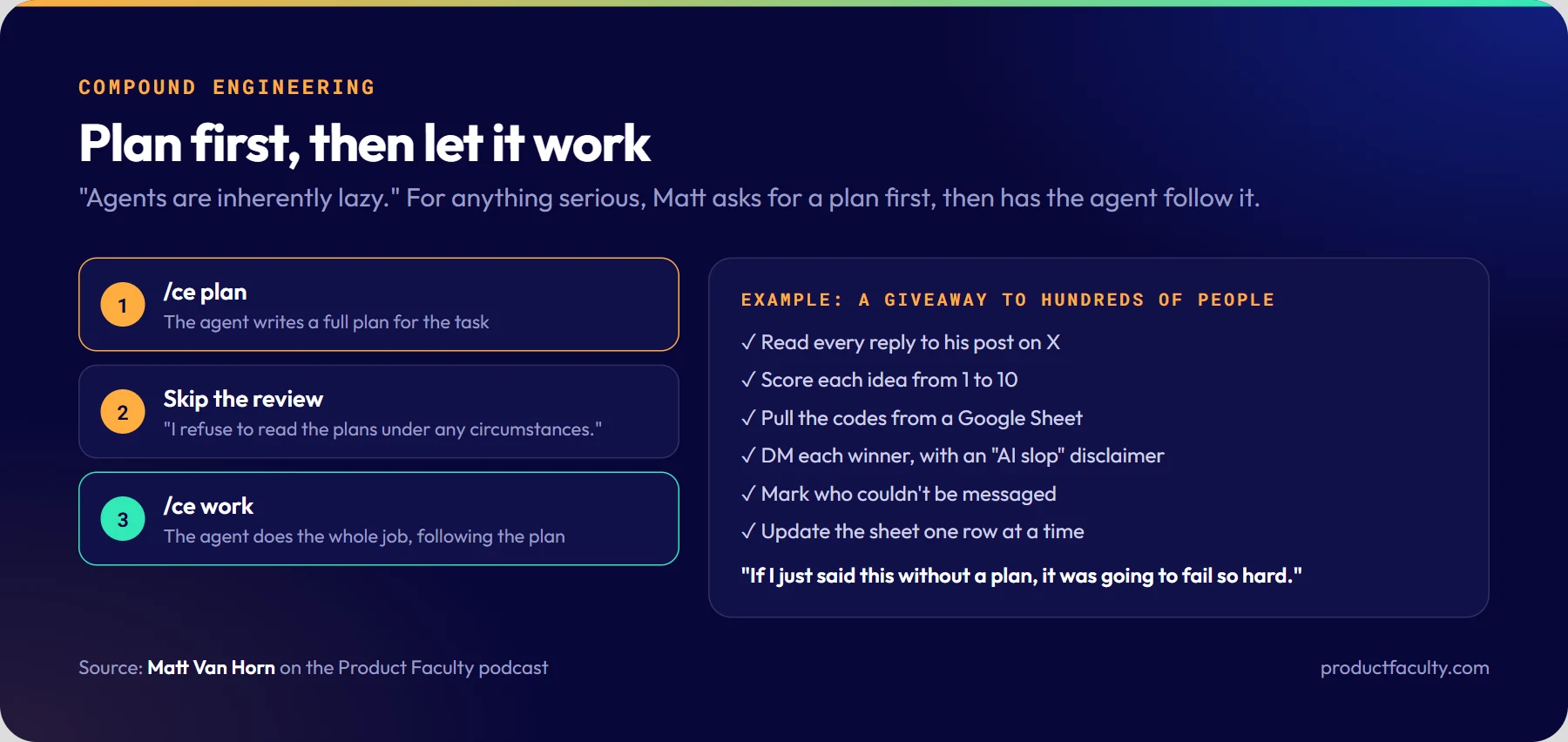
He used to read every plan. Now, "I refuse to read the plans under any circumstances." When the SpaceX team gave him credits to hand out, hundreds of people replied with ideas. He had a bot score each reply, DM the codes, mark the people it couldn't message and update the spreadsheet as it went, with "Apologies if there's AI slop" at the end of each message. "If I just said this without a plan, it was going to fail so hard."
The same move fixed his phone assistant on air. When it kept answering "Sorry, say that again", he typed /ce plan with "it's broken, fix it." The next call worked.
The kit that makes agents useful
A bot with its own computer is a good start. These additions are what make it a real assistant.
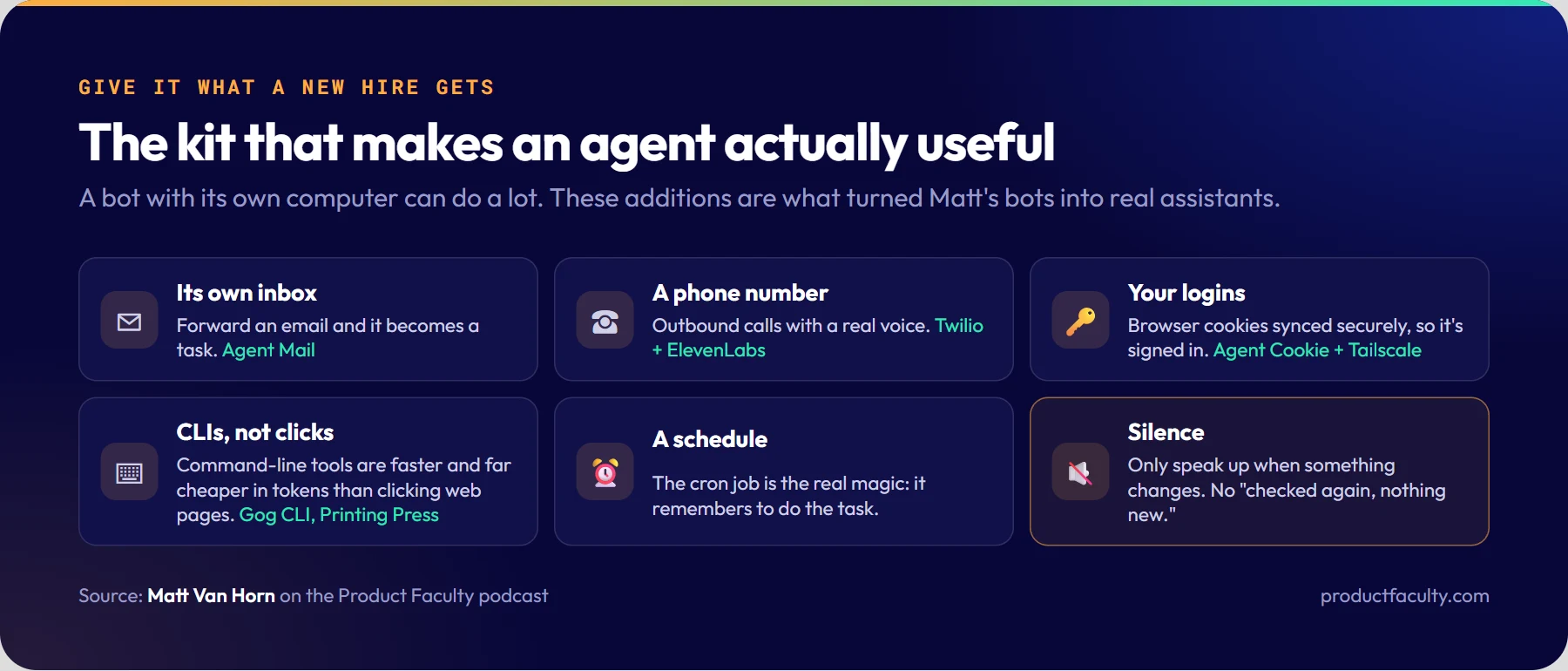
- Its own inbox. With Agent Mail (Matt is an investor, and was a fan first), forwarding an email becomes a command: "add this soccer game to our calendar" or "buy tickets to this." A separate address tells the bot which emails are tasks.
- A phone number. He wired up Twilio and ElevenLabs to book a lunch for 10 in Portugal. After some fixes the bot got through, switched to Portuguese and asked for the table, but the calls kept dropping: Pedro, who answered, was fed up with talking to a bot. When Matt met him at lunch, Pedro said, "In Portugal, we don't have robots that make reservations." For talking to your agent, he says the best voice experience is ChatGPT's, and one investor he knows built a webhook to connect it to his Grokbot.
- Your logins. Matt's Agent Cookie tool securely syncs his browser cookies to his Grokbot over Tailscale, so it's already signed in to Instacart or X. "Add Corona to Costco" just happens.
- CLIs, not clicks. An agent clicking around a web page is "very, very token inefficient." For anything he does regularly, he uses or prints a command-line tool: Google apps, ESPN, Google Flights, even World Cup ticket prices.
For coding on the go, Grokbot can hand work to a stronger model like Fable 5 using your Cursor credits, so you can text it a feature request from your phone. Matt still does his main engineering in Claude Code.
Why the schedule is the real magic, and silence is the hack
Asked what makes an agent like Grokbot different from a chat app, Matt boils it down to repeating tasks. "It's the magic of a cron job, of remembering a task." His weekly reports, the 7am family email and the Monday player digest all run without him.
The flip side is noise. With many bots on schedules you get "agent fatigue": messages every hour saying nothing changed. His fix is to tell bots to stay quiet unless a criterion is met: a price drops, a flight opens up, something interesting happens. "Silence is the hack."
The opportunity: agents as a service
Shubham has seen people make "life-changing money" setting up OpenClaw and Hermes agents for companies, some charging $3,000 to $10,000, even flying to clients' homes to do it. He thinks Grokbot creates the same opportunity with a much lower barrier, and expects a generation of vertical agent services for research, sales, operations, recruiting, content and customer support.
It's already happening. One plumbing company owner described using Grokbot to automate a big share of his office manager work, naming each bot like an employee.
Start with one bot
Shubham's closing advice: don't rush to build ten bots or a whole team. Build one bot that solves a real problem and owns a valuable outcome, and go from there. Anything you repeat is a good fit.
- Set up the chief of staff with your calendar and email, and try screenshot to calendar.
- Add one daily or weekly report you'd actually read, with a rule to stay silent when nothing changes.
- Use a bot designer like Dr. Eggbot to make your second bot from one sentence.
- Ask for a plan first on your first multi-step task.
- Swap one clicking task for a command-line tool and compare speed and cost.
Watch the full episode
FAQ
What is Grokbot?
Grokbot is an AI agent app that gives each bot its own hosted computer. Bots can sign in to your tools, run jobs on a schedule and keep working while you sleep, and you talk to them through native Mac and iPhone apps, much like a messaging app.
How is Grokbot different from OpenClaw and Hermes?
OpenClaw and Hermes are powerful but can feel technical and intimidating, and at the time of the episode neither had a native iPhone app. Grokbot is hosted, needs only a download and syncs between Mac, iPhone and its cloud computer, so non-technical people can use it.
What can you automate with Grokbot?
Examples from the episode include adding events from screenshots to calendars, a daily family schedule email, weekly research reports on any topic, summarizing articles, tracking sports results, sending hundreds of personalized DMs, searching meeting notes and making phone calls.
What is compound engineering?
Compound engineering is an agent skill that makes the agent plan before it acts. You run /ce plan so it writes a detailed plan, then /ce work so it carries the plan out, which stops agents cutting corners on multi-step tasks.
Why should AI agents use CLIs instead of browsers?
An agent clicking around web pages is slow and uses a lot of tokens. Command-line tools let it read and change data directly, which is faster, cheaper and more reliable, for example editing Google Sheets through a Google apps CLI.
How do you stop AI agents sending too many messages?
Tell scheduled bots to stay silent unless something meaningful changes, such as a price dropping or a new result appearing. This avoids agent fatigue from constant "nothing new" updates.
Learn to build AI agents
Product Faculty's Agentic Engineering course, part of the AI Builder Fellowship, teaches you to build agent systems that run reliably, not just demos. To set up your own AI workflows with Claude, see AI-Native PM with Claude.