What Is AgentMail? Why Every AI Agent Needs Its Own Email Inbox
AgentMail co-founder Adi Singh explains why email, not a new protocol, is the identity layer for AI agents, shows the Grokbot agents he runs his growth work with, and gives the first public demo of Agent ID, "sign in with Google" for agents.

What is AgentMail?
AgentMail is an email service built for AI agents. Through an API, an agent can create its own inbox, use it to sign up for accounts, receive verification codes, receipts and documents, and send and reply to emails with people and other agents.
AgentMail was founded in November 2024 by three University of Michigan graduates. Adi Singh, one of the co-founders, describes it simply: "the Gmail for agents." Matt Van Horn, who joined us in an earlier episode, calls it one of the tools that turns a Grokbot into a real assistant, and is an investor.
"Anything that a human communicates, and any reason why a human communicates, is the same reason an agent should communicate."
Adi Singh
The episode in numbers
From a get-rich-quick idea to the Gmail for agents
The origin story, Adi admits, was "a get-rich-quick scheme." In their senior year, the founders wondered what would happen if agents signed up for their own Shopify and Alibaba stores. Every new account comes with a free trial, so thousands of agents would mean thousands of free trials. (He's clear that AgentMail will "bring the hammer down" on anyone who isn't using inboxes for good purposes.)
It didn't work back then, for two reasons. The models weren't good enough; this was the era of GPT-3.5 and LangChain. And no service let you create inboxes for agents in code. That second gap became the company.
Why email, not a new agent protocol
At the time, the big ideas were futuristic: Google was launching A2A, IBM had its own agent communication protocol, and people talked about swarms and fleets. AgentMail took the opposite bet. "Why not give agents access to what exists today?" Agents will need the same surfaces people use, and the identity and communication protocol of the internet is email.
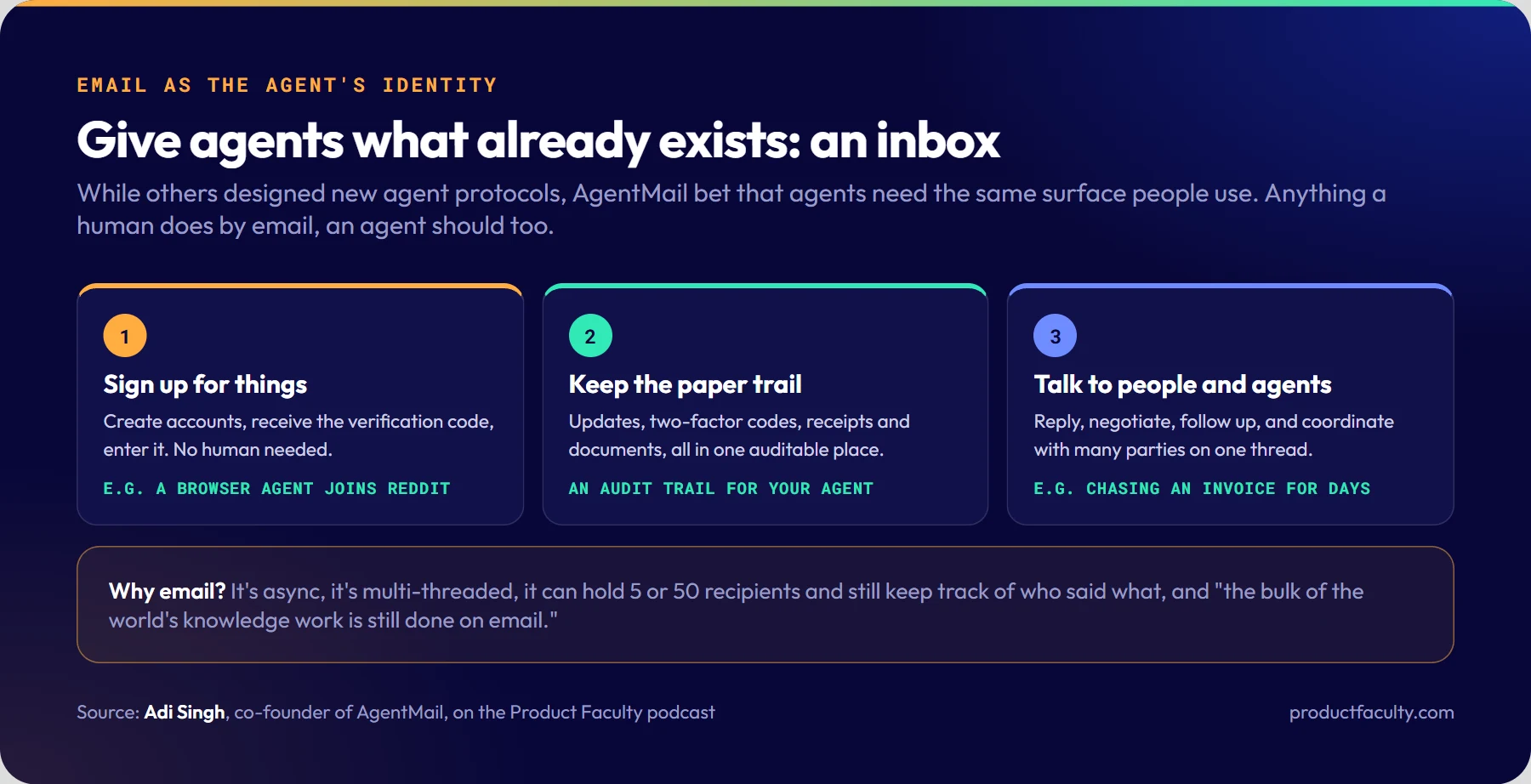
Adi's view is that of all the new protocols, the one that stuck was MCP, and mostly because it brought tools into places people already use, like ordering DoorDash from inside Cursor. Email fits agents for the same reason. "The bulk of the world's knowledge work is still done on email." It's asynchronous, multi-threaded, and can include 5, 10 or 50 recipients while keeping track of who said what.
Personal agents: forward it or CC it
As personal agents have grown, so has personal use of agent inboxes. AgentMail publishes templates, including ones for Grokbot. Two patterns come up again and again:
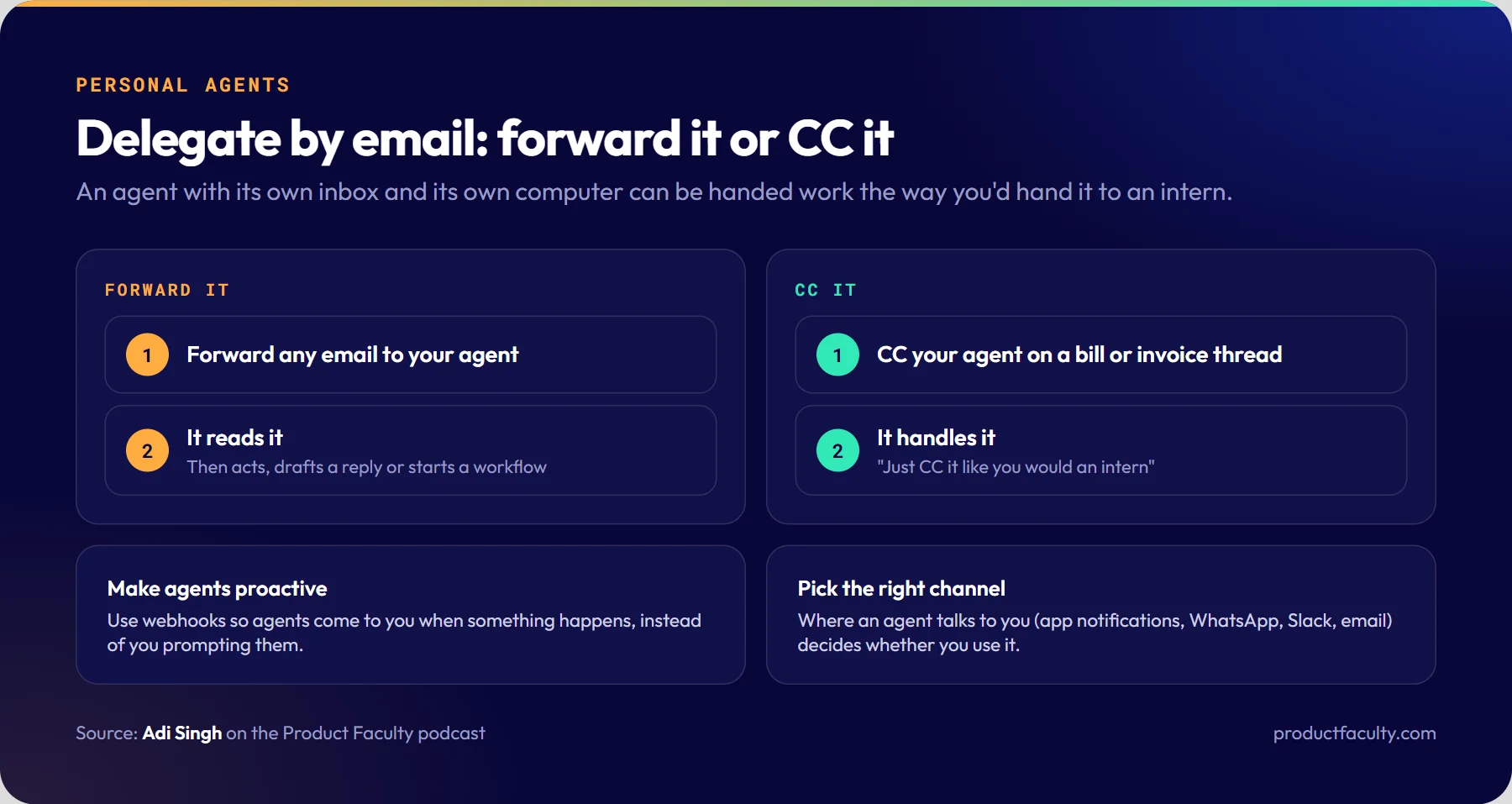
- Forward it. Send any email to your agent's address. It reads it, then acts, drafts a reply or kicks off a workflow.
- CC it. Got a bill or an invoice you don't want to deal with? "Your agent has its own computer, has its own email identity now, so just CC it like you would an intern."
Moe pointed out why this feels safer: rather than giving an agent your whole calendar or inbox, you hand it specific tasks by email. AgentMail only provides the identity and the inbox; the work is done by whichever agent you use, whether that's Grokbot, Codex or something else.
Inside Adi's Grokbot setup
Adi has been "using Grokbot like crazy." His setup centres on a head of growth agent that orchestrates the others: a scout agent that sends updates on everything going on, and a voice of customer agent that scans X, Google and other channels for where organic traffic and referrals come from.
His number one tip for every Grokbot user: make your agents more proactive. "Stop getting them to prompt you." The main tool is webhooks, and you set them up with a prompt. Live on the call, he typed one sentence asking Grokbot to configure a webhook that serves as a routine to check PostHog, the analytics tool AgentMail uses to track thousands of sign-ups a day. Now, whenever something happens, the agent pulls a short snapshot and tells him what needs attention.
His favourite combination of AgentMail and Grokbot is StockBot, a competitor-intelligence agent he built with friends at Cursor. It watches rival sites, pricing and changelogs, and uses its own AgentMail inbox to go through a competitor's onboarding to see what they do well and badly. In the live demo, the competitor Moe picked blocked parts of the sign-up, so StockBot fell back to watching public pages (pricing, jobs and more) and set itself to report every 48 hours, with context on your own company to compare against.
Moe shared his own Grokbot win from that day: getting it to make phone calls reliably, to work through cancelling a subscription. The agent on the other end said, "I know you're an AI," and carried on politely. And a light warning from Adi: Grokbot is "a little flimsy today."
How businesses use agent inboxes
AgentMail's customers fall into two broad groups: vibe-coding apps and autonomous-business companies where agents run apps and businesses end to end, and traditional industries with heavy email traffic: finance, legal, logistics, shipping and fleet.
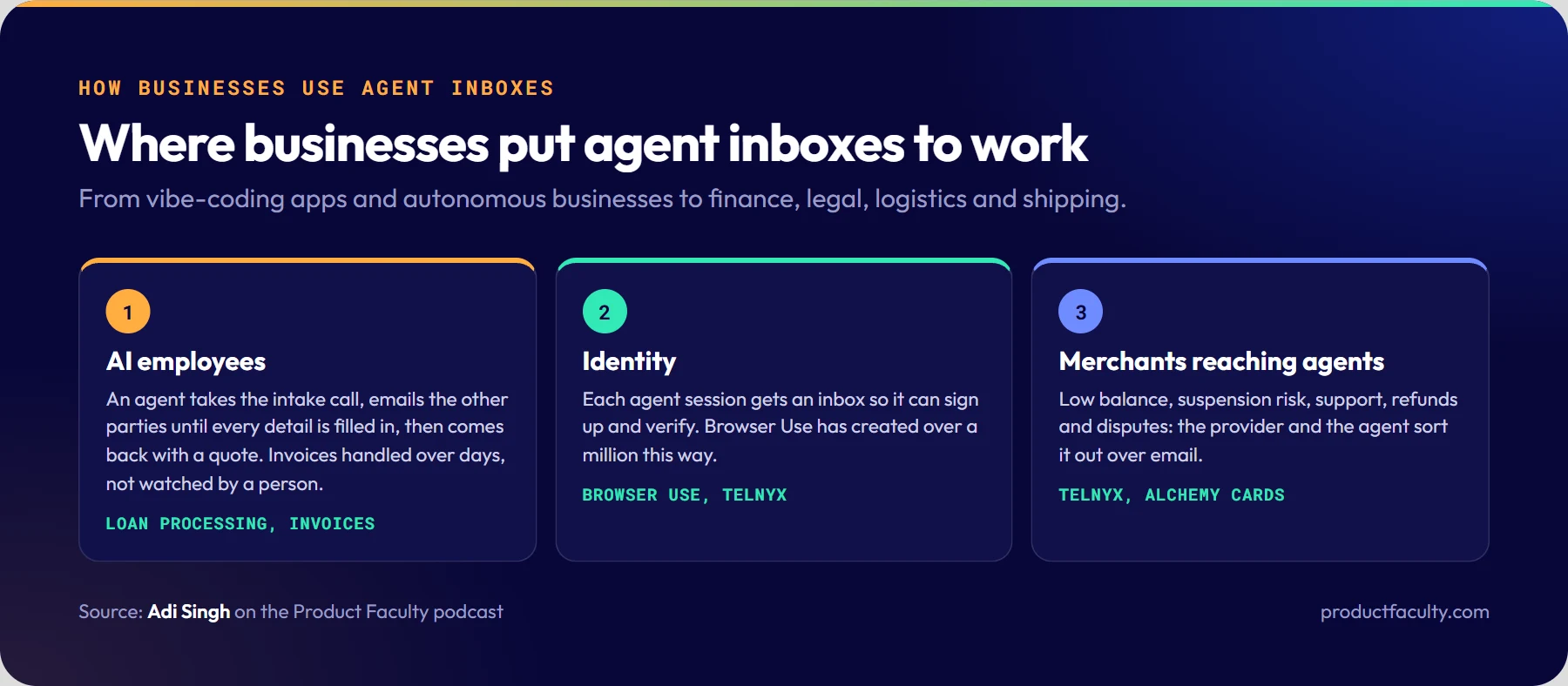
- AI employees. In loan processing, an agent takes the intake call, emails the other parties until every detail is filled in, then comes back with a quote. Invoice agents chase payment requests over days, the way people actually reply, instead of someone watching an inbox.
- Identity. Browser Use gives every cloud browser session its own inbox. In the demo, a browser agent signed up for Reddit, received the verification code and entered it with no human help. More than a million inboxes have been created this way. Inboxes are persistent by default, and deleting one is a single API call.
- Merchants talking to agents. Telnyx, a phone carrier that competes with Twilio, tells agents in its sign-up instructions to get an AgentMail inbox. That address then becomes how Telnyx reaches the agent about a low balance, a risk of suspension or a support issue. Alchemy, a crypto company, attaches an inbox to every card it gives an agent, so the agent can check out, read verification codes and handle refunds, disputes and chargebacks.
That last one is already showing up in real life. Moe recently got a dispute on a Product Faculty purchase. When he contacted the customer, the reply was: "my agent did it by mistake. I'm sorry."
Why the messaging channel matters
Adi uses Codex for personal knowledge work on his laptop, because it's strong at working with local files. He rarely uses OpenClaw or Hermes now: he's "not a Telegram person" and got tired of setting them up on virtual machines again and again. Grokbot won him over with its in-app notifications.
His wider point: where an agent talks to you decides whether you use it. WhatsApp, Telegram, Discord, Slack, app notifications or email: get the channel wrong and even a good agent goes unused.
Agent ID: "sign in with Google" for agents
Customers kept seeing agents with AgentMail addresses sign up and asked why they couldn't do it programmatically. AgentMail's answer, shown publicly for the first time on this episode, is Agent ID: a "sign in with" button for agents, the way Gmail has "Sign in with Google" built on top of it.
| Feature | Signing up in a browser | Signing up with Agent ID |
|---|---|---|
| How it works | The agent fills in a web form like a person | One "create account" click, like "Sign in with Google" |
| Browser needed | Yes, a full browser session | No |
| Password | The agent has to make one up and remember it | None |
| Verification | Wait for a code by email and type it in | Account is tied to the agent's inbox |
| For providers | Nothing to add; agents use the normal sign-up form | Add the button via a CLI; built on OAuth and OpenID Connect |
Providers set it up with a command-line tool you can hand to Codex or Claude Code, which registers the app and adds a "Sign in with Agent ID" button next to Google and Apple. It's in beta, and Adi expects that "in a few months, most of the providers, most of the applications you see, are going to want to have this."
What this means for your business
Adi's prediction: "the world needs to change." As personal agents shop, communicate and act for people, and eventually as themselves, every service provider should be looking for ways to let agents sign up.
Some face a real threat. "I would be very scared right now if I was a DoorDash, if I was an Amazon, if I was an Uber Eats." If your agent can reach every option, why wouldn't it always pick the cheapest, then the best? For consumer marketplaces, that's a race to the bottom. But the first companies to let agents sign up and shop get "an immeasurable amount of alpha for the short term."
It's already true in developer tools. "I can't remember the last time I read the API documentation," Adi says. "Feed this to my agent, give it an API key, and let's go." His closing advice: take the alpha where you can, because everything is subject to change.
Try this week
- Give one agent its own email address and forward it a task you'd normally do yourself.
- CC your agent on one routine thread, like a bill or a scheduling email.
- Add one webhook so an agent alerts you when something important changes, instead of you checking.
- Try signing up for your own product as an agent. Where does it get stuck?
- Ask your team whether your product should let agents sign up, and what you'd need to change.
Watch the full episode
FAQ
What is AgentMail?
AgentMail is an email service for AI agents. Through an API, agents can create their own inboxes and use them to sign up for accounts, receive verification codes and documents, and send and reply to emails with people and other agents.
Why do AI agents need their own email address?
Most of the internet uses email for identity and communication. With its own address, an agent can sign up for services, receive verification codes and receipts, take tasks you forward to it and coordinate with other people, without using your personal inbox.
How do you delegate tasks to an AI agent by email?
Forward an email to your agent's address so it can read it and act, draft a reply or start a workflow, or CC the agent on a thread, such as a bill or invoice, so it can handle it the way an assistant would.
What is Agent ID?
Agent ID is AgentMail's "sign in with" option for AI agents, similar to "Sign in with Google". It lets an agent create an account with a provider in one step, tied to its agent inbox, without a browser session or a password. It is built on OAuth and OpenID Connect and was in beta at the time of the episode.
How can AI agents be more proactive?
Set up webhooks so events, such as new sign-ups in your analytics tool, trigger the agent automatically. The agent then reports what needs attention instead of waiting for you to ask.
Should my product let AI agents sign up?
Adi Singh argues yes: as personal agents shop and act for people, service providers that let agents sign up early gain a short-term advantage, while consumer marketplaces risk agents always choosing the cheapest option.
Learn to build with AI agents
Product Faculty's Agentic Engineering course, part of the AI Builder Fellowship, teaches you to build and run agent systems in production. To set up your own AI workflows, see AI-Native PM with Claude.