How to Take a Vibe-Coded App to Production: Paweł Huryn's 4-Step Checklist
A three-word prompt can build something that looks amazing. Making it reliable for real users is a different job. Paweł Huryn, founder of The Product Compass, shows the four things he does to harden his apps: separate environments, app-specific limits, checks before shipping and monitoring.

Why a vibe-coded prototype isn't a product
To take a vibe-coded app to production, you need four things: separate development and production environments, limits that stop abuse, agent-run tests and reviews based on documented intent, and monitoring that tells you when something breaks or confuses users.
Moe opened the episode with a problem he faces himself: in class, a three-word prompt like "clone Airbnb site" builds a prototype in Codex that looks great, "but that is not hardened, it's not reliable." Paweł Huryn has closed that gap twice. He built Grok Build for VS Code, an extension for working with coding agents that has about 150,000 downloads across registries, and AskOne, a live Q&A tool with AI moderation.
Grok Build is 230,000 lines of code with 7,000 tests. Paweł didn't write the tests. Agents did, over a few months, because he documented the intent first and reviewed it before a single test existed.
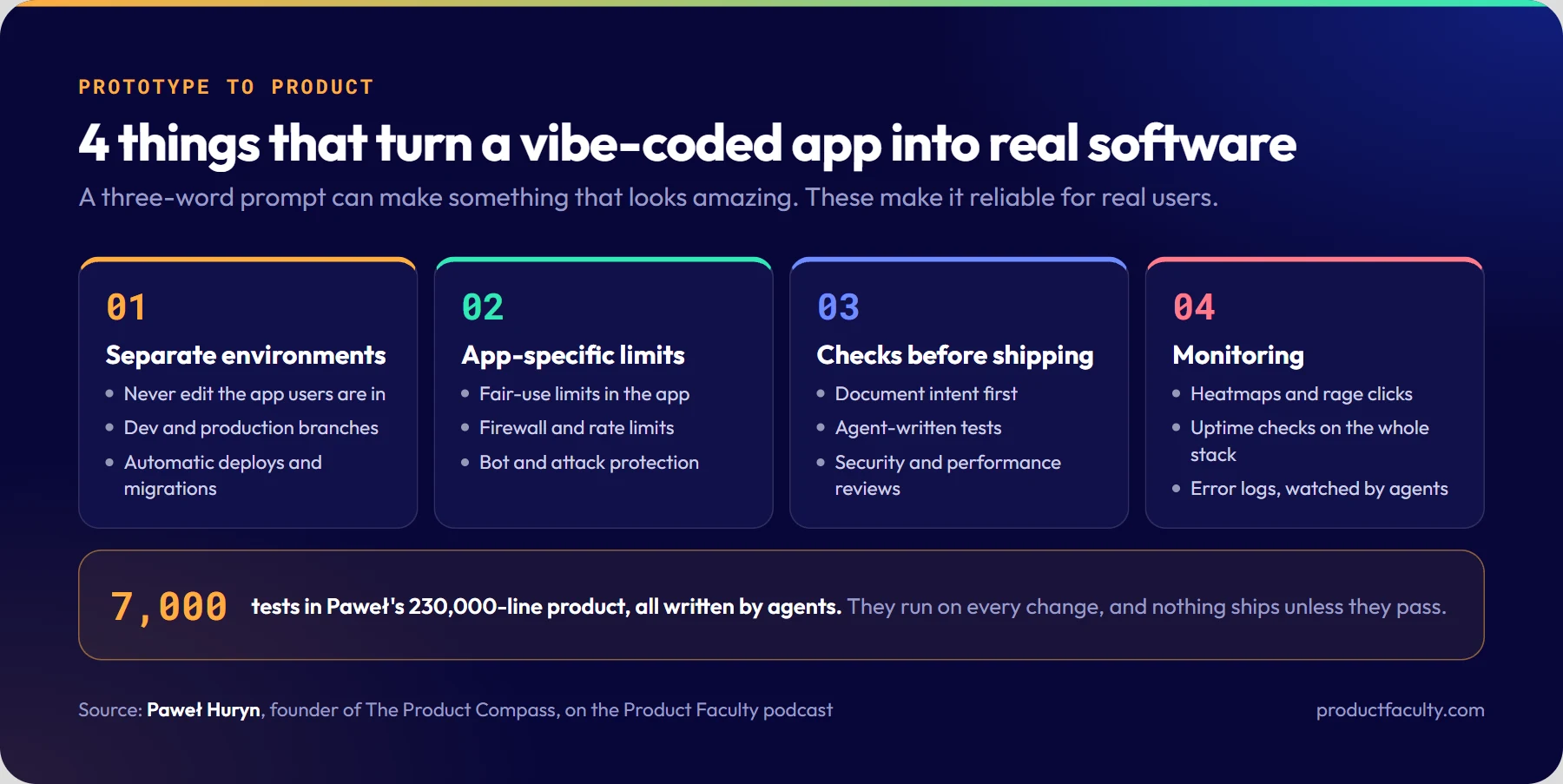
"The quality is much higher than if you only relied on the human team, because no human team would write so many tests."
Paweł Huryn
The episode in numbers
1. Separate environments: never edit what users are using
Software isn't static. As you learn from customers, you add features, refine them and add integrations, and "every time we add those changes to our products, there is a risk that something can stop working." Any bug you introduce directly in production hits your customers. So the minimum, even working alone, is two environments: development for testing changes, and production where users are. Enterprises often add testing and pre-production too.
Changes come in two kinds. Logic changes alter how the app behaves ("what should happen after I click this button"). Data changes alter its structure, such as a new description field on a room or a new survey object. Both need to travel safely to production.
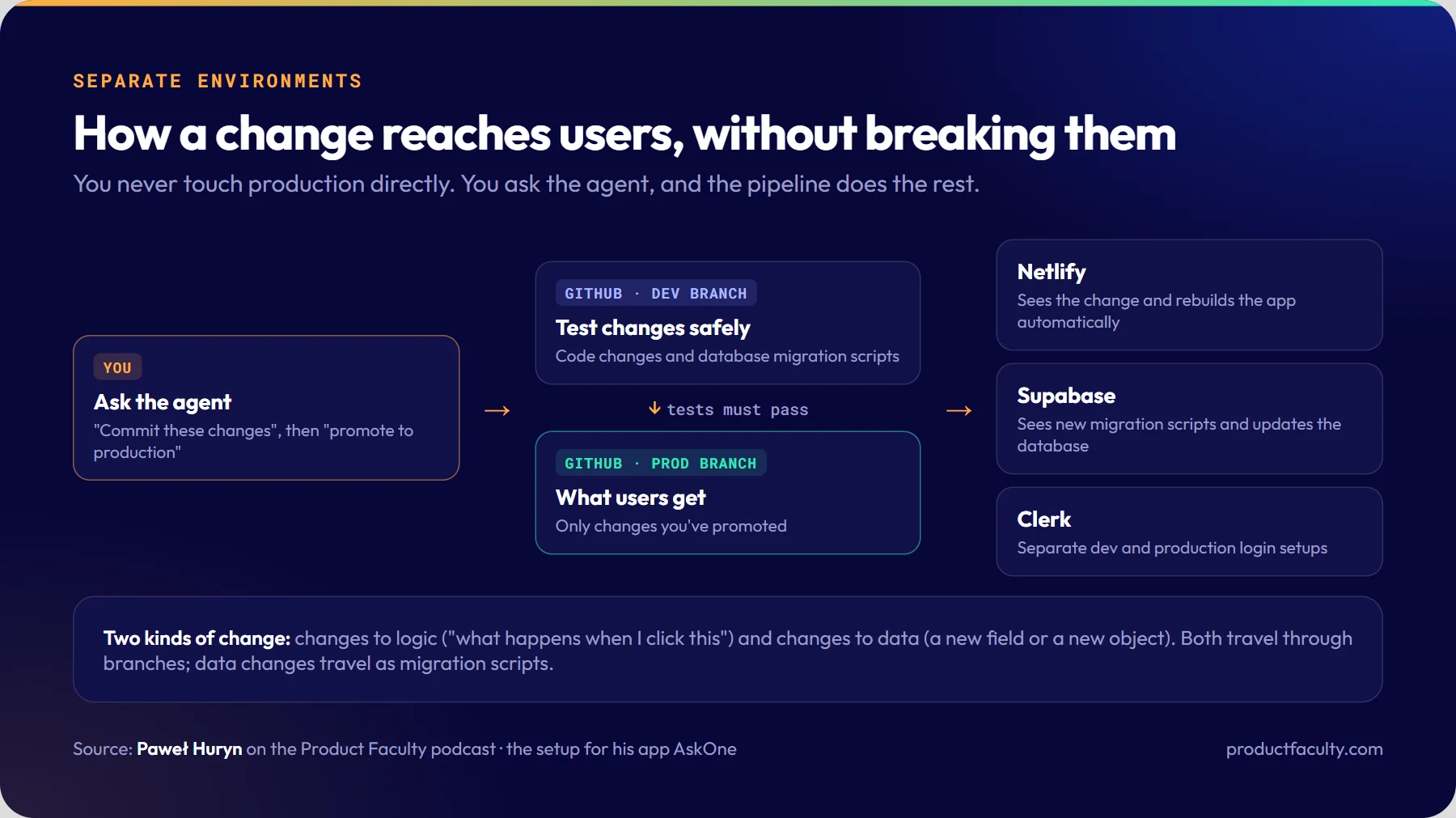
Here's how Paweł does it for AskOne:
- Code lives on GitHub, in two branches, one per environment. Claude works on the development branch; production is untouched.
- Data changes become migration scripts. Every time the database needs to change, the coding agent writes a script and stores it with the code. "I don't look inside. I don't really have to."
- Netlify (free) watches the production branch and automatically rebuilds the app when it changes.
- Supabase watches for new migration scripts and runs them on the production database automatically.
- Clerk has separate development and production setups, so login and subscription changes can be tested with test accounts first.
This is continuous deployment. And day to day there's nothing to memorize: ask the agent to commit your changes, then ask it to "promote those changes to production," and it moves the right files to the right branch. For Grok Build, Paweł uses Railway instead of Netlify, with the same rule: each environment is tied to its own GitHub branch, and deployments can wait until tests pass.
2. App-specific limits: plan for abuse
Everyone thinks about plan limits, like what's free and what's premium. AskOne's free plan allows one active room with up to 100 participants. But "what stops the user" from creating and closing a room 100 times a second? Nothing in the subscription logic. Paweł covers this in two layers.
Limits inside the app. Fair-use rules that stop anything no human would do, such as no more than 10 or 20 new rooms an hour, or 10 questions a minute in an anonymous Q&A. They matter most for actions that create data, which can hurt performance. You don't need to show them to users, and you can brainstorm them with your agent. When a product says "unlimited," it still won't let you create millions of records.
Limits from your host. Some attacks you can't handle yourself, like floods of traffic that overwhelm your server. Netlify includes a web application firewall by default; AskOne had 35 blocked requests in seven days. You can block regions or IP ranges, and set rate limits, such as no more than 1,000 requests from one IP in a time window, just by asking your agent. Cloudflare, Paweł's preferred option for his other product, adds bot detection and protection against exploits, denial-of-service attacks, API abuse and fraud, much of it free.
One caution: people at a conference or in the same company may share one IP address. Without real usage data, start less restrictive.
3. Checks before you ship
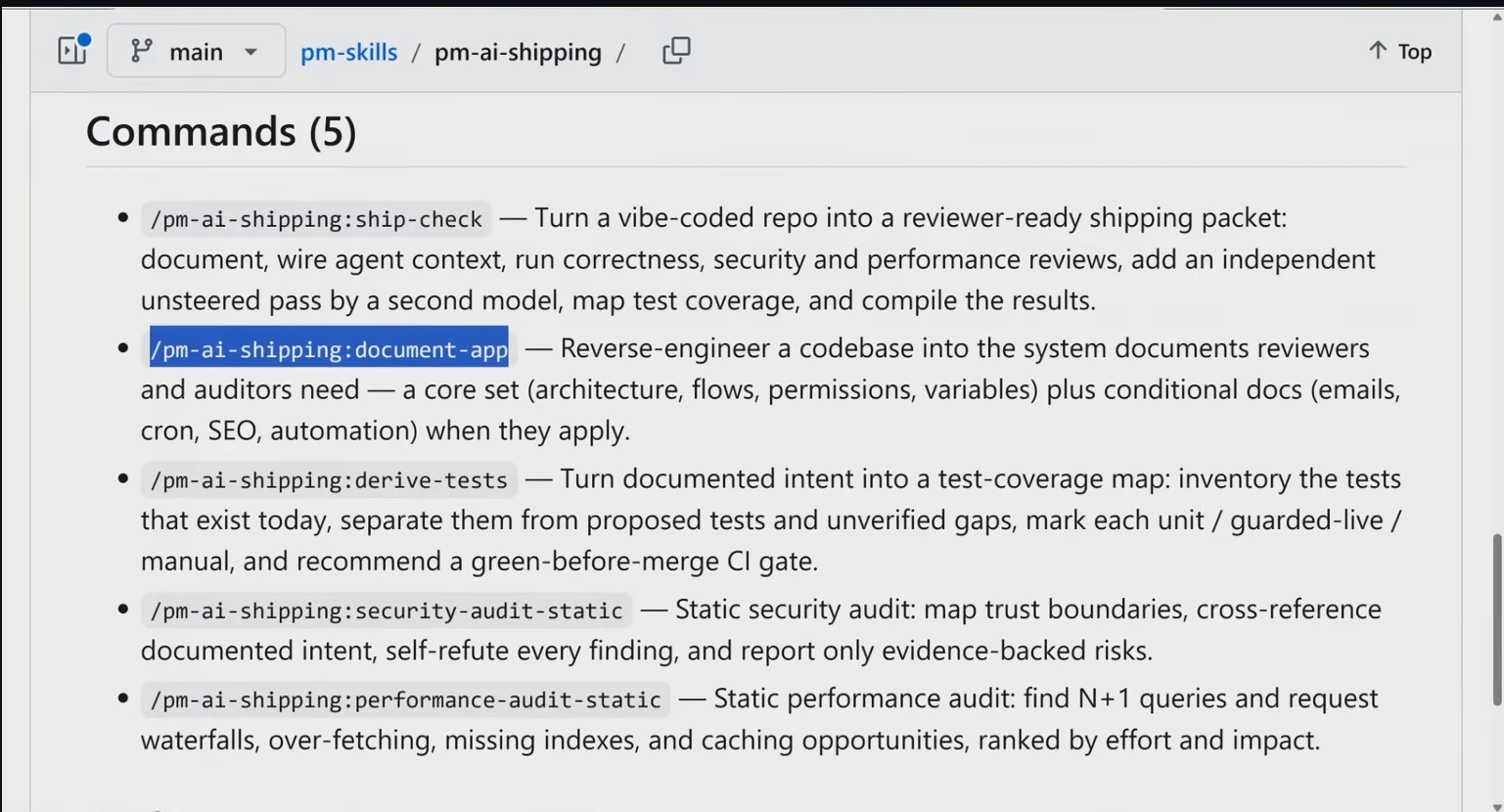
This is where Paweł's free PM AI shipping skills come in. You can run one command that does everything, but he walks through the process so you understand it.
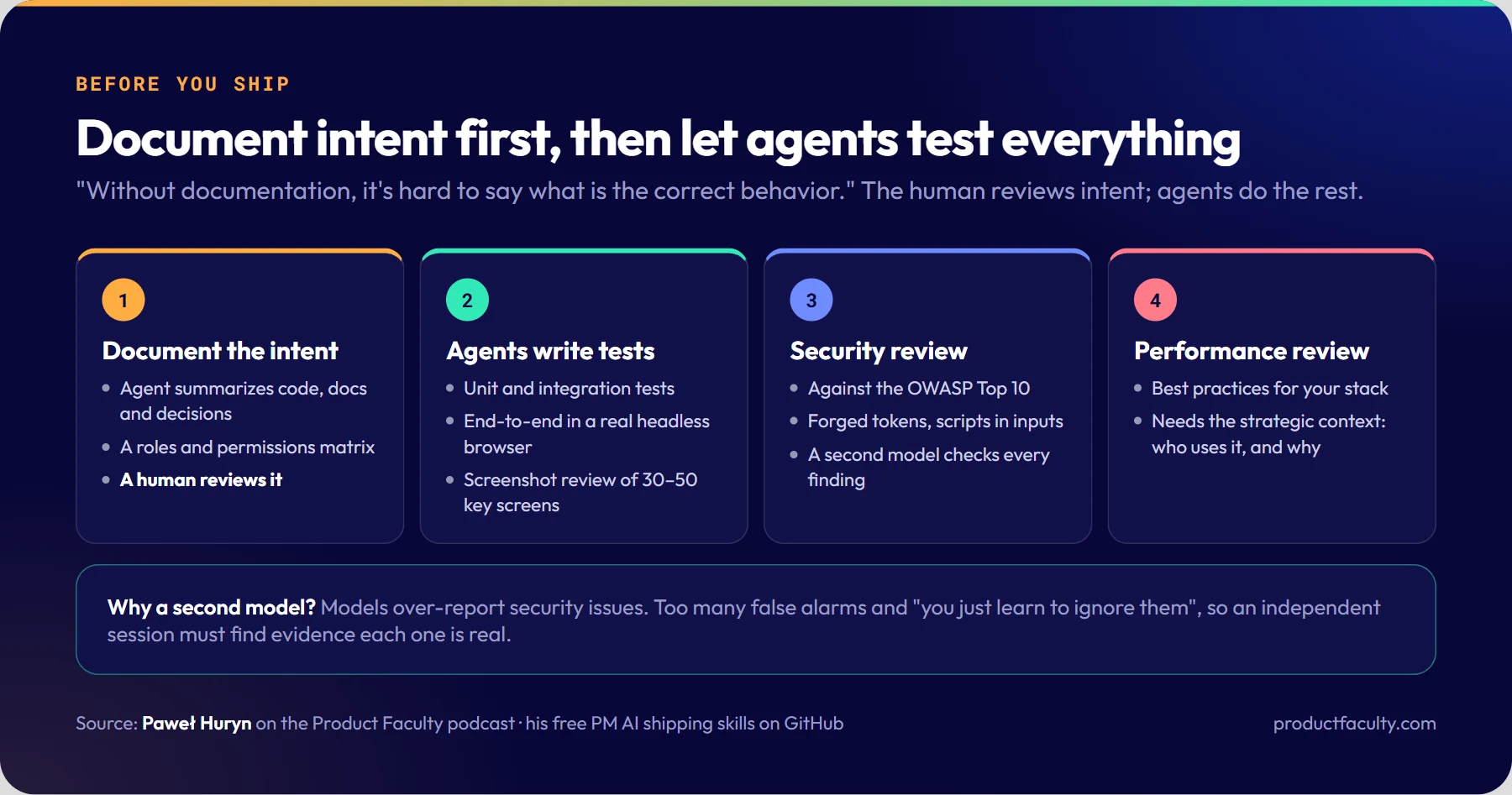
- Document the intent. Ask the agent to summarize your code, discussions and strategy docs into documentation a human can review. "Without documentation, it's hard to say what is the correct behavior." Can a moderator create rooms, or only moderate the ones they're invited to? A key piece is a roles and permissions matrix: one row per role, one column per action, so anyone can see what each person can do.
- Let agents write the tests. From that documentation, agents write unit and integration tests well on their own. What Paweł pushes for is end-to-end tests in a real headless browser for critical user journeys, and an exploratory screenshot review of 30 to 50 key screens, where the agent looks at each screen with no expected answer and flags anything odd. That catches breakages you couldn't predict.
- Run a security review. Frontier models know what security testing involves. Paweł's skill adds a pass against the OWASP Top 10, the standard list of common web threats, plus checks like forged login tokens or code typed into an input. Live, he typed a script into AskOne and it was shown as plain text, not run.
- Have a second model check every finding. Models over-report security problems, and if you get too many, "you just learn to ignore them." So an independent session must find evidence each finding can really be exploited. The idea is inspired by Anthropic's security review for pull requests, applied to the whole codebase.
- Run a performance review, with strategic context: who the users are and what the app is for.
For Grok Build, the full suite runs in 10 to 15 minutes, mostly waiting on live responses from coding agents; a standard app might take 30 seconds to a minute. Tests run on every change in GitHub, and nothing reaches production without passing. And to understand what's happening, Paweł doesn't read code. He reviews the documentation and asks the agent for interactive artifacts and prototypes that summarize its findings.
4. Monitoring and observability
"Even if you did everything perfect," something can still break, or people can struggle with the app, which Paweł treats as a kind of bug too.
- Product analytics with Microsoft Clarity. It's free and gives anonymized heatmaps and session recordings, plus rage clicks, dead clicks and Paweł's favourite, quick-backs: someone goes to a section, doesn't find what they wanted and comes straight back. That points to something unintuitive. PostHog is the natural next step; Paweł likes that it can answer new questions using data it already collected, though session recordings cost extra.
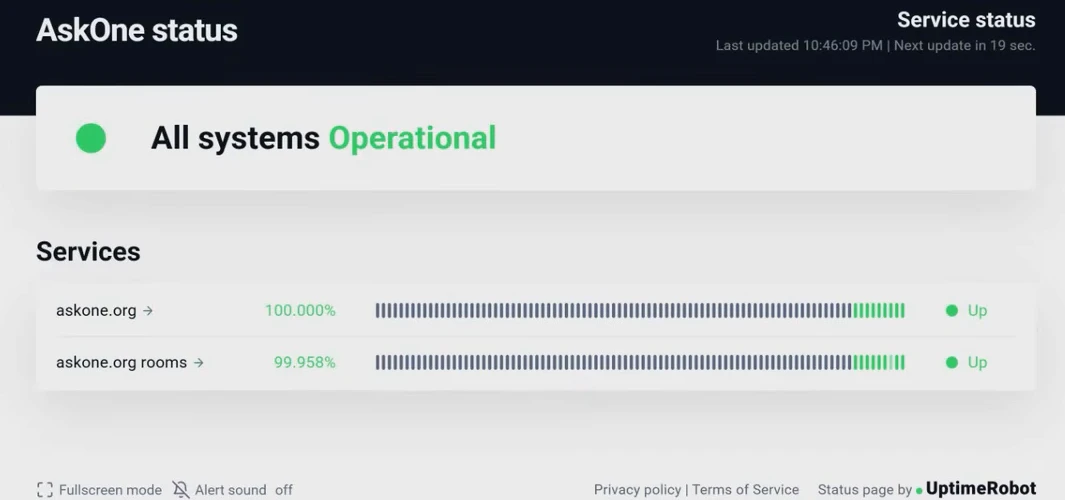
- Uptime monitoring with UptimeRobot. Also free. It pings your app on a schedule and emails or texts you when something stops. For AskOne he checks the landing page and opens the demo room every 30 minutes, which tests the whole stack, because the room needs data from the database.
- Logs and error tracking. Netlify and Supabase already keep logs, and both can be read by agents, including through MCP, so an agent can alert you when errors appear. Sentry is the professional option for error tracking.
The free tool stack
| Tool | What it does | Cost, as described |
|---|---|---|
| GitHub | Stores code; one branch per environment; runs tests on every change | Free |
| Netlify | Hosts and rebuilds the app; firewall and rate limits | Free tier |
| Supabase | Database; applies migration scripts automatically | Not covered in the episode |
| Cloudflare | Bot detection, exploit, DoS and API-abuse protection | Many tools free; more on paid plans |
| Microsoft Clarity | Heatmaps, recordings, rage clicks, quick-backs | Free |
| UptimeRobot | Pings the app and alerts you when it's down | Free |
| PostHog / Sentry | Deeper product analytics / professional error tracking | The next step when you outgrow the free tools |
Paweł has written up the whole AskOne build step by step in a three-part series, Product Engineering for PMs (part 2, part 3). You can try AskOne itself at askone.org.
Try this week
- Put your app on GitHub and ask your agent to set up a development and a production branch.
- Connect your host (Netlify, Railway or similar) so production rebuilds only from the production branch.
- List three ways someone could abuse your app and ask your agent to add limits for them.
- Ask your agent to document the app, including a roles and permissions matrix, and review it yourself.
- Add Microsoft Clarity and an UptimeRobot check. Both are free and take minutes.
Watch the full episode
FAQ
How do you take a vibe-coded app to production?
Set up separate development and production environments with automatic deployments, add limits that prevent abuse, have agents test the app against documented intent and review its security and performance, then monitor it with analytics, uptime checks and error logs.
Why do you need separate development and production environments?
Every change to an app can break something. A separate development environment lets you test changes safely, so bugs never reach the production app your users are using.
What is a database migration script?
A migration script is a file that changes the structure of a database, such as adding a field or a table. Coding agents can write these scripts, and tools like Supabase can apply them to the production database automatically when they are released.
Can AI agents write tests for an app?
Yes, if they know what the app is supposed to do. Paweł Huryn's agents wrote all 7,000 tests for his 230,000-line product, based on documented intent that a human reviewed first, including end-to-end tests in a real headless browser.
How do you rate limit a web app?
Add fair-use limits in the app itself, such as a maximum number of rooms or messages per minute, and use your host's firewall and rate-limiting rules, for example on Netlify or Cloudflare, to cap requests from a single IP address over a time window.
What are the best free tools to monitor an app?
Microsoft Clarity gives free heatmaps, session recordings and signals like rage clicks and quick-backs. UptimeRobot checks that the app is up and alerts you if it goes down. Hosting and database logs, which agents can read, help catch errors.
Learn to build and ship with AI
Product Faculty's AI Builder Fellowship teaches product people to build real products with AI, not just prototypes. To build production agent systems, see Agentic Engineering, and to set up your own workflows with Claude, take AI-Native PM with Claude.