How to Replace SaaS With AI: How an 8-Person Company Cut $40K a Month
MindStudio CEO Dmitry Shapiro replaced HubSpot, Notion, Webflow and Looker with tools his team built by talking to an AI agent. Here's how they did it, why the savings are the smaller win, and what it takes to make AI-built apps safe for a company.
Build vs buy software in the AI era
With AI agents that can build production apps from plain-English requests, a company can now replace much of its SaaS with internal tools made exactly for how it works, and own them, as long as those tools run on a platform that handles security, login and compliance.
Dmitry Shapiro has built companies through several eras of software. He was CTO of MySpace, led product at Google, founded Veoh and Koji (acquired by Linktree), and now runs MindStudio, a venture-backed AI platform. On this episode he shows how his eight-person team rebuilt the tools it runs on with Remy, MindStudio's newest product, and argues the old build-vs-buy rule has flipped.
"This idea of building your own application used to be absurd. Now I propose it's absurd not to."
Dmitry Shapiro
The episode in numbers
What they replaced, and how
MindStudio's tools now live in an internal portal. None were written by a developer at a keyboard. Non-technical team members built them by going back and forth with an AI builder agent: describe what you want (typed or spoken), answer its questions, approve its plan and watch it build.
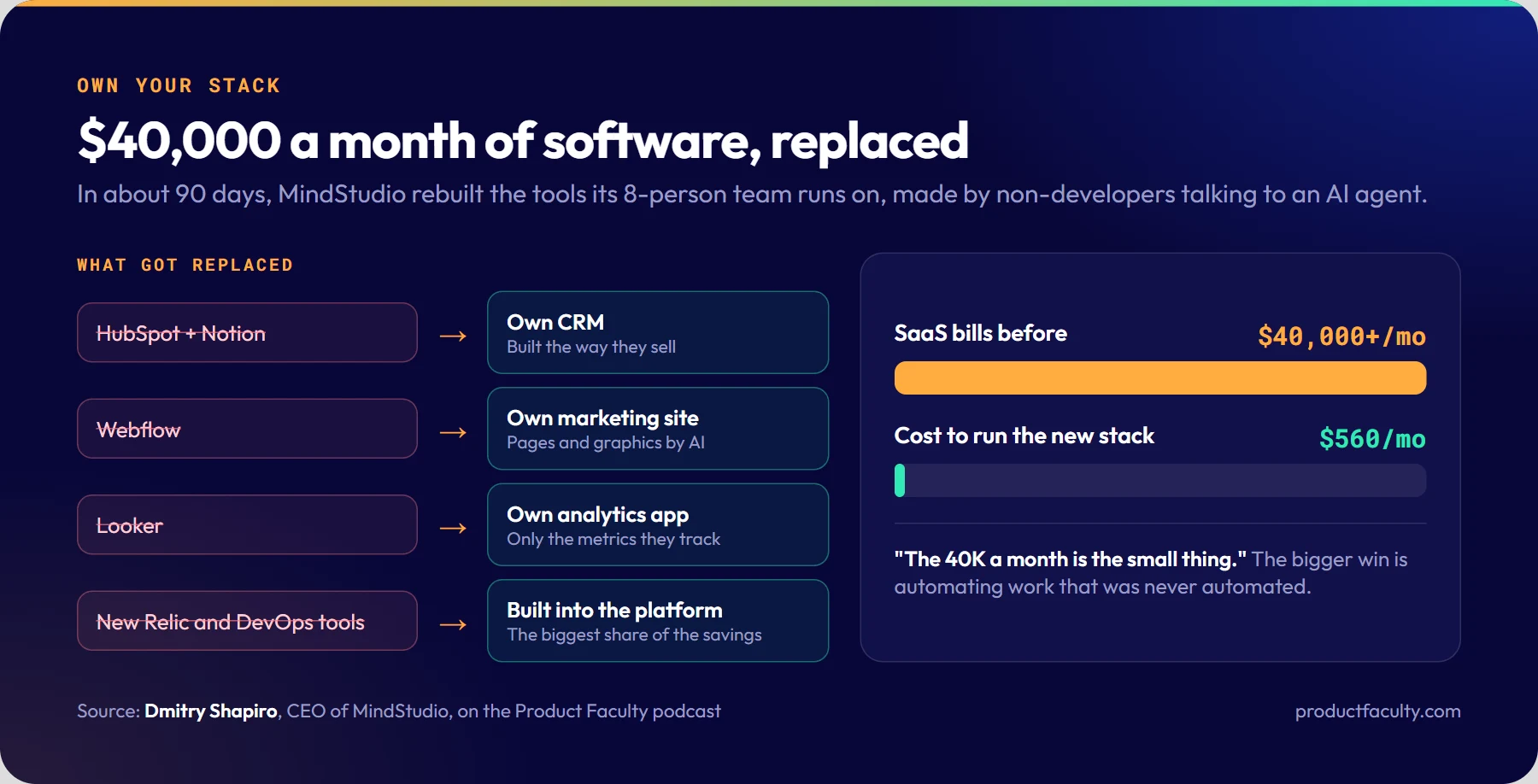
- CRM (replaced HubSpot and Notion). Built around the way they sell, with features no off-the-shelf CRM had, like a one-click "obscure" mode that scrambles customer names so they can demo it with real data.
- Marketing site (replaced Webflow). Every page, graphic and visualization is made by the AI agent. The company has no designer. "It's extraordinarily liberating."
- Analytics (replaced Looker). An app that shows exactly the numbers they track, and nothing else.
- Small custom tools, like an inbox for product feedback and a bug tracker, each built to fit their own process.
The point is fit. Most teams use around 5% of any SaaS product, but they still pay for, learn and work around the other 95%. When you build your own, you get exactly the features you need and change them the day your needs change.
Why the savings are the smaller win
Going from $40,000 to $560 a month is a huge drop, but Dmitry says it isn't the main point. "The 40K arguably a month is the small thing as compared to our ability to be able to operate and compete."
The real return comes from automating work that was never automated, fully or partly, and from tools that work together instead of a "Frankenstein" stack of separate products. His analogy: we've all worn shoes that weren't made for us. Once you get shoes molded to your feet, "you become dramatically faster," with less effort and insights you couldn't get before.
It also changes the old SaaS split, where one company builds for marketers and another for sales. With AI-built apps, those lines matter less. You build whatever app the work needs.
The governance gap: prototypes vs enterprise apps
In the last couple of years, people in finance, marketing, sales and HR have realized they can use coding agents to build the tools they always wanted. Dmitry thinks that's great: these are the people who know where the organization has gaps. But for the company, it can be "a huge disaster."
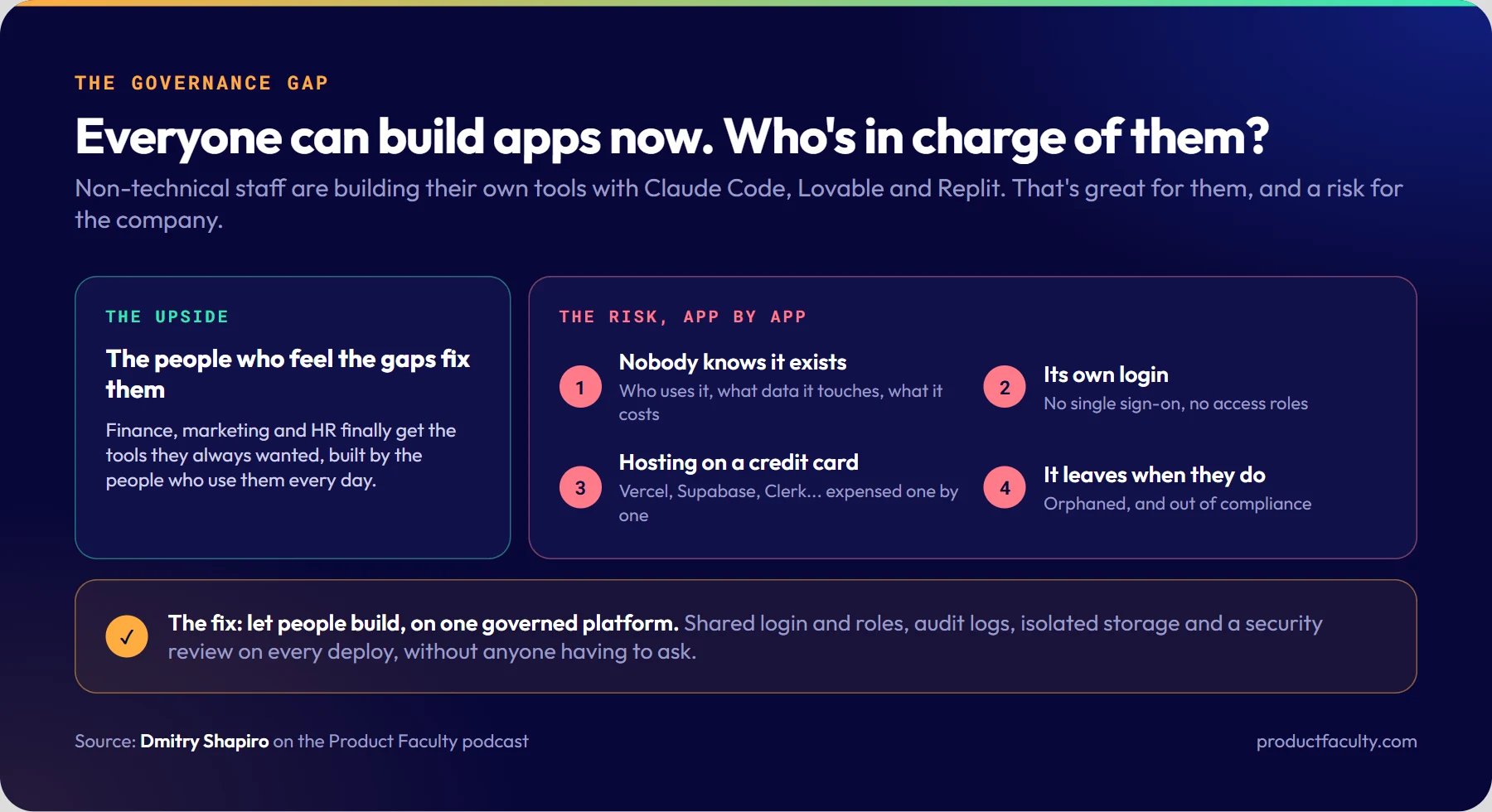
"All of the things people are building with Lovable and Replit are, I will call them, prototypes." Valuable prototypes, and often running in production, but not enterprise apps. The company doesn't know they exist, who uses them or what data they touch. One team he spoke to had six people building apps, each with its own separate login. Builders expense hosting, database and login services on personal cards, and when someone leaves, their app is orphaned and out of compliance.
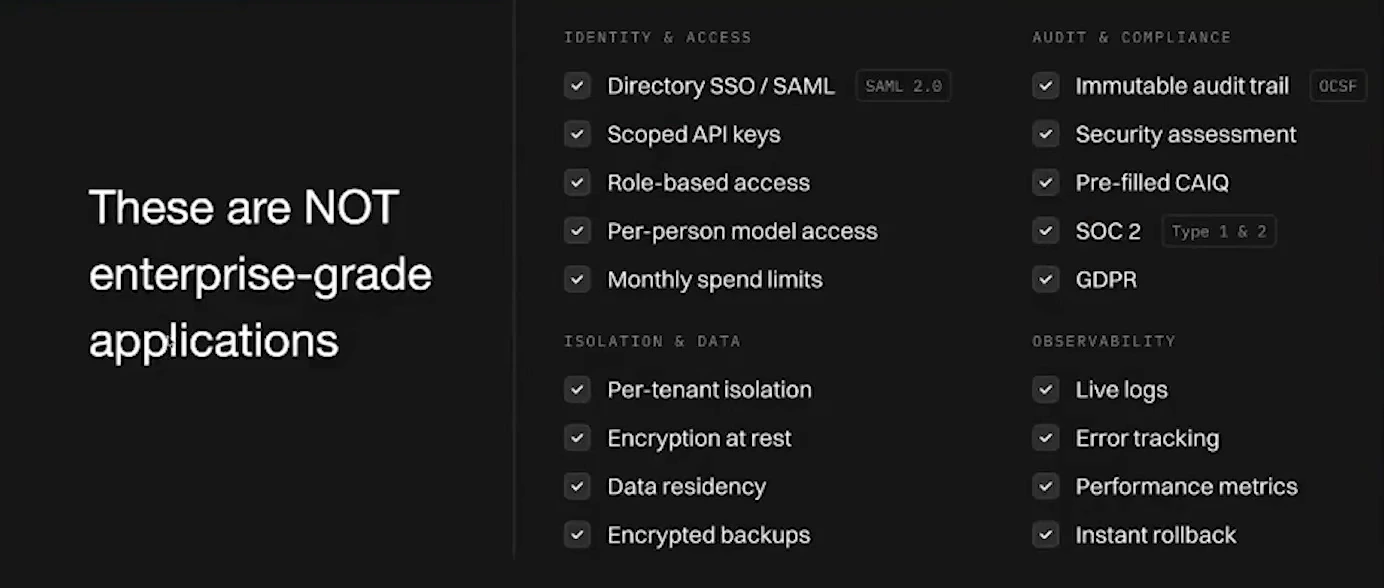
Some of it most builders would never think to ask for. If your app accepts file uploads and stores them on the same domain as the app, that's a security hole, but "if you don't know that, you're never going to ask Claude Code to do it." Immutable audit logging is required for compliance and "really hard to do by vibe coding." Dmitry's answer, and the reason Remy exists, is a platform where every app gets these by default: hosting, single sign-on and access roles, isolated databases and file storage, error tracking and logging, without the builder having to ask.
SaaS vs vibe-coded apps vs governed in-house tools
| Feature | Off-the-shelf SaaS | Vibe-coded apps | Governed in-house tools |
|---|---|---|---|
| Fit | Made for everyone; you adapt to it | Made for you | Made for you |
| Who owns it | The vendor; you rent it per seat | Often the one person who built it | The company |
| Changes | When the vendor ships them | Whenever you ask the agent | Whenever you ask the agent |
| Login and access | Usually single sign-on, often at a higher price | Often a separate login per app | Single sign-on and roles for every app |
| Security and compliance | The vendor's responsibility | Usually missing | Built in, checked on every deploy |
| Cost | Rising per-seat fees | Scattered across personal cards | Usage you can see and cap |
Security that happens on every deploy
The part Dmitry calls "where all the magic is" sits behind the scenes. Every time an app changes, it automatically gets a security and governance review: what changed since the last release, a risk level, findings such as how much personal information the app gathers, and a data-flow diagram showing which AI models get which data and where it leaves the company.
That means an admin, IT or security person can understand any app in minutes, even one they didn't build. They also get an inventory of every app, usage and cost per app and per team, monthly spending limits and live performance data. Rolling it out is mostly connecting the company's existing single sign-on, such as Okta. "Roll out is dummies. It can be done in less than five to 15 minutes."
Pick the right model for each job
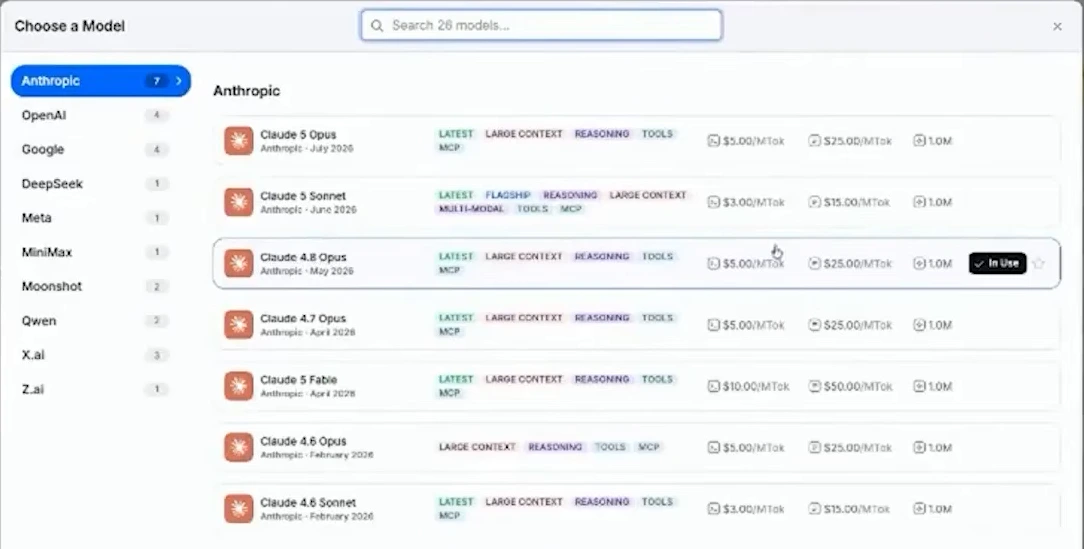
Building with AI isn't free, but it is controllable. Dmitry showed one app he'd built for $14.31 in model costs. Inside the builder you can choose which model powers each agent, from the main builder to design, QA and architecture.
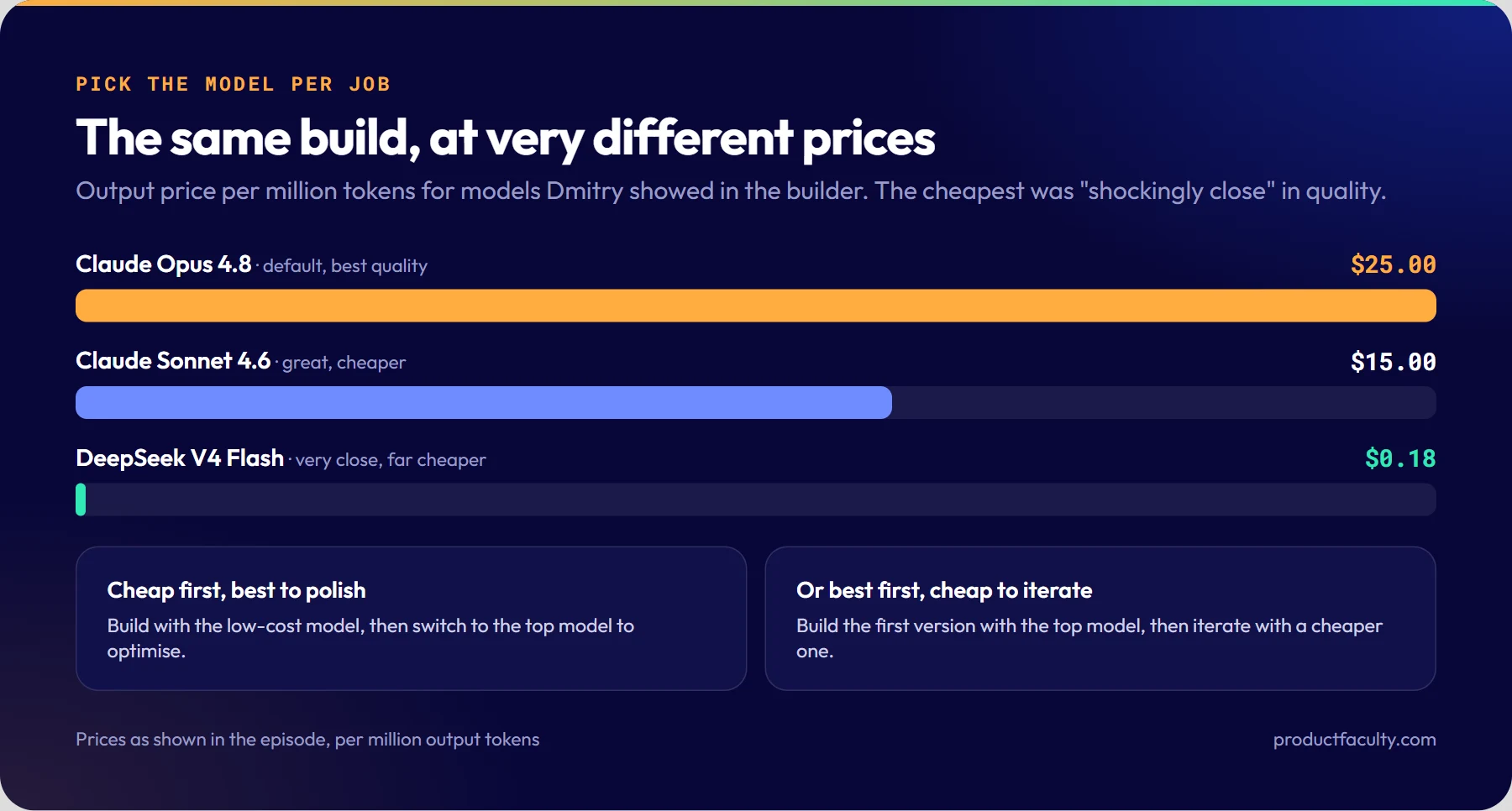
The default, Claude Opus 4.8, costs $5 per million input tokens and $25 per million output tokens. Claude Sonnet 4.6 is meaningfully cheaper at $3 and $15. DeepSeek V4 Flash costs 18 cents per million output tokens, and Dmitry says it is "shockingly close" to Opus. "It's not as good, but it's very close." Teams are mixing them: some build cheaply and use the top model to optimize, others build the first version with the top model and iterate with a cheaper one.
Next: software that learns to run itself
Dmitry's newest idea goes a step further. For decades, software was built for humans to operate. He argues a company's most valuable asset is the knowledge in its employees' heads: how to run the work, in the company's way.
Some vendors offer to build AI agents to automate functions like customer service. The catch, he says, is that you don't own those agents or the data that trains them. MindStudio's new feature, called Jewels, takes a different route. As people use an app, a shadow process watches each action and trains a small model the company owns and can download. Over time you can see how close each model is to taking over, then let it run while you supervise. He calls it "self-driving for software", built in from the start rather than bolted on.
From boxed software to owning your stack
In August 1995, Dmitry stood in line for eight hours in Los Angeles to buy Windows 95 at midnight. Software came in a box and you owned it. Then it was downloaded. Then vendors realized they could lease it per user, forever. Three decades later, that's still how most companies get software.
His view is that AI puts us back on track. You don't own SaaS, prices keep rising, products keep bloating and they don't fit you. Now organizations can "build their own software in less time than it would take them to go to the store," and keep evolving it every day. Some people are also using the same tools to build new SaaS products to sell.
Try this week
- List your SaaS bills and, for each one, the few features your team actually uses.
- Pick one small tool where you use under 10% of the product, and sketch the version that would fit your team exactly.
- Find the tools people already built. Ask each team what apps they've made with AI coding tools, who uses them and where they're hosted.
- Check them against the basics: shared login, access roles, audit logs, an owner if the builder leaves.
- Price your builds by model. Try a cheaper model for routine work and compare the result.
Watch the full episode
FAQ
Can AI-built tools replace SaaS?
For many internal tools, yes. MindStudio replaced HubSpot, Notion, Webflow and Looker with apps its non-technical team built by talking to an AI agent, cutting more than $40,000 a month in SaaS bills to about $560 a month in running costs. The apps need a platform that provides security, login and compliance.
Should companies build or buy software now?
AI has shifted the balance toward building. Off-the-shelf software is made for everyone, and teams often use only a small part of it. With AI agents, a company can build tools that fit its own process and change them whenever it needs to, as long as they are owned and governed by the company.
What is shadow AI in app building?
It is when employees build their own apps with AI coding tools outside the company's control. The company may not know the apps exist, who uses them, what data they touch or what they cost, and an app can be left without an owner when its builder leaves.
What makes an AI-built app enterprise-grade?
Single sign-on and role-based access, isolated data and file storage, encryption and backups, immutable audit logs, security reviews, error tracking and performance monitoring, plus spending limits and clear company ownership. Most apps built with general AI coding tools lack these by default.
How do you lower the cost of building apps with AI?
Choose the model per task. In the episode, Claude Opus 4.8 cost 25 dollars per million output tokens, Claude Sonnet 4.6 cost 15 dollars and DeepSeek V4 Flash cost 18 cents while coming close in quality. Many teams mix a top model and a cheaper one at different stages.
What is self-driving software?
It is software that learns to operate itself. In Dmitry Shapiro's approach, a shadow process watches how people use each part of an app and trains small models the company owns, which can gradually take over the work while people supervise.
Learn to build with AI agents
Product Faculty's AI Builder Fellowship teaches product and business people to build real tools with AI. To build your own workflows with Claude, see AI-Native PM with Claude. To design and run production agent systems, take Agentic Engineering.