The MVP Is the New PRD: How a Google AI PM Builds Working Prototypes Without Coding
Shubham Saboo, Senior AI PM at Google, builds a live multimodal insurance claim agent on camera, one that listens, sees, takes its own notes and politely tells him he's wrong. Here's his workflow, the free resources behind it and where a PM's job ends and engineering begins.

Why the MVP is the new PRD
For AI product managers, the main deliverable is shifting from a written PRD to a working MVP: a simple version of the idea, built with a coding agent, that stakeholders can actually test before engineers turn it into a real product.
AI PM work, Shubham says, "is becoming more builder first." That doesn't mean every PM must become an engineer. It means: "As a PM, can you crystallize your ideas into the simplest MVP that someone can actually test, verify, experience before that becomes a real product?" As a manager himself, he doesn't have time to review a hundred docs. Hand him something he can try in his own time, and he can give real feedback.
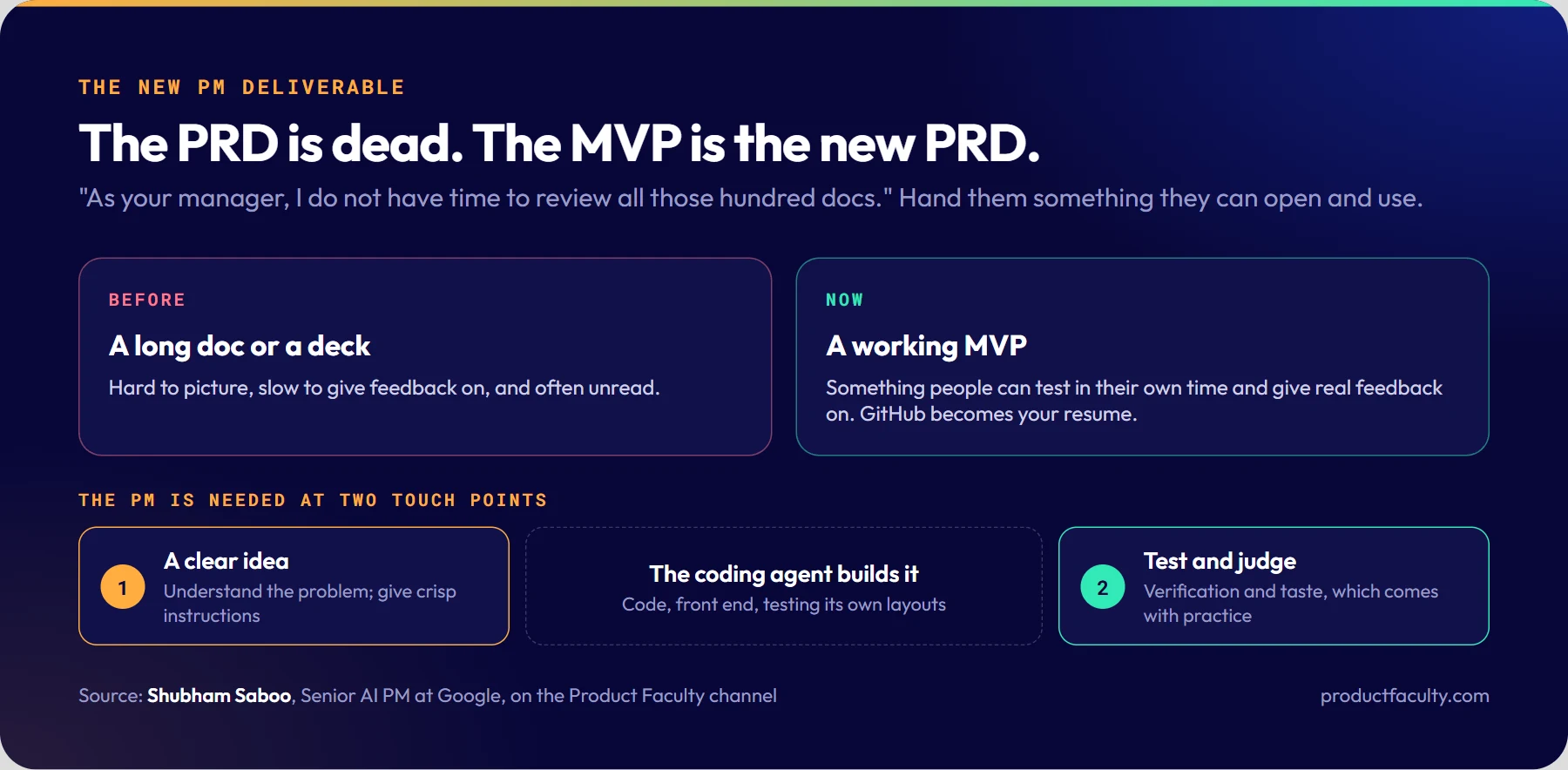
Your job is two touch points. First, a clear understanding of the problem and crisp instructions for the coding agent. Then, at the end, testing, verification and judgment, "which a lot of people refer to as taste. And taste comes with practice."
"You don't need to be an engineer to build today."
Shubham Saboo
The session in numbers
GitHub is the new resume
Shubham describes GitHub as "a repository of your living artifacts", where your working ideas live as code you can share. His own Awesome LLM Apps repo has more than 120 example AI apps and agents, each with a README and the code.
If you don't know where to start, you don't even need to read it. Paste the repo link into your coding agent and ask: "Give me an overview of this app and tell me what I can do with it." "The easiest way to get started with anything you don't know today is to put it in your coding agent and ask it the right questions."
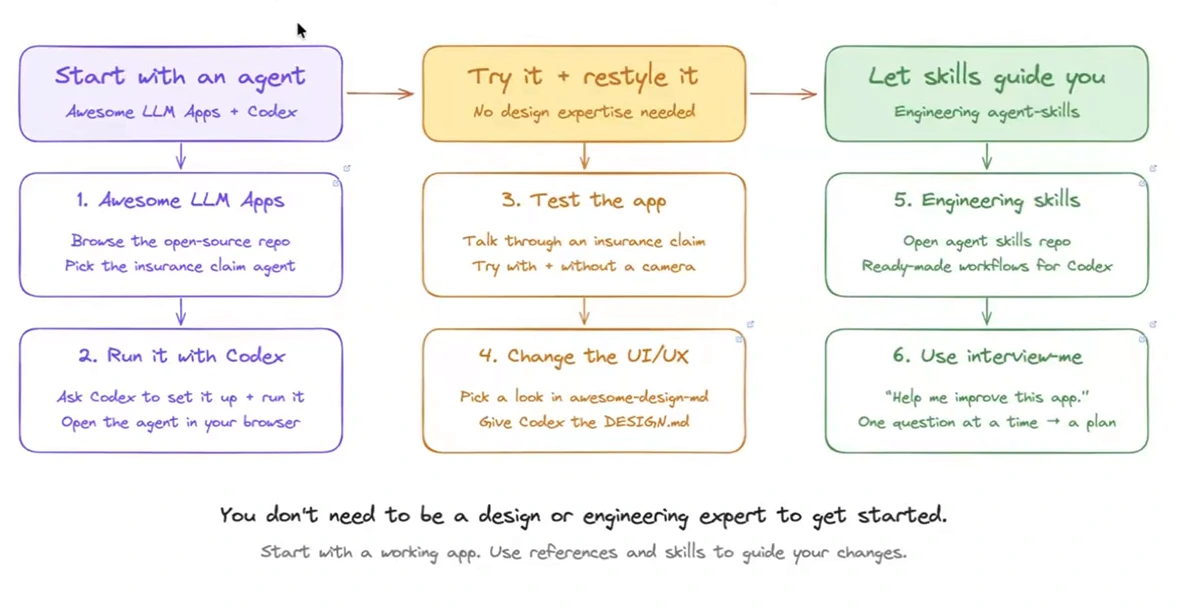
Run a demo without touching the terminal
Normally you'd clone a repo by typing commands in a terminal. Shubham skips that. "I don't know how to use a terminal. I've never heard about it before. I'll just stick to my coding agent." He asks Codex to clone the repo (make a copy on his machine) and then: "Can you run this app for me and start a local dev server?" The agent runs the commands, finds the API keys, and a minute or two later the app is live in a browser.
The live demo: a multimodal claim agent that pushes back
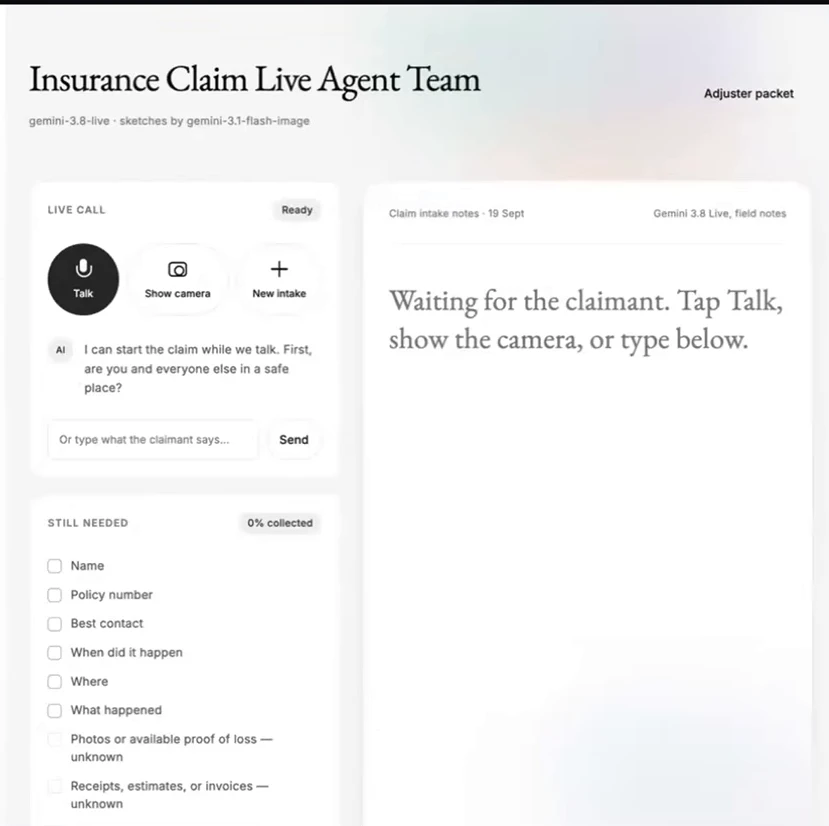
The app is an insurance claim live agent team, built on Google's Gemini 3.8 Live model, which can see, hear and talk at the same time, and the Agent Development Kit. Shubham reported a "crack" in his apartment wall and pointed his camera at it.
The agent looked and disagreed: "It appears more like a small scratch or scuff rather than a deep structural crack in the wall itself." When he asked it to note it anyway, it did, and was careful to say it had only prepared a packet for review and hadn't contacted an adjuster.
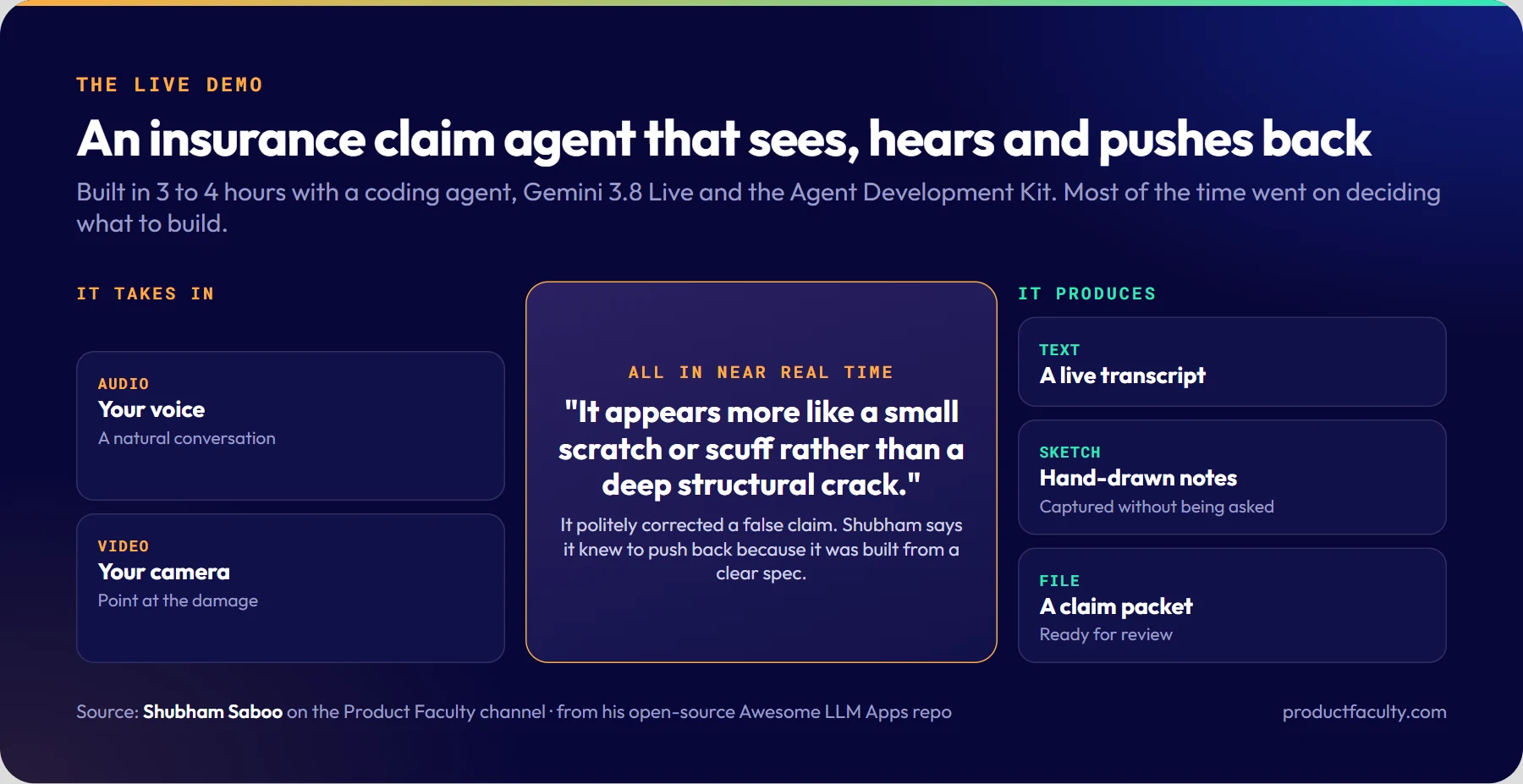
A lot happened at once: voice in, camera in, a text transcript, and handwritten-style notes sketched in near real time. When he pointed at the wall, it captured the picture and made notes without being asked, "just like a live agent would." It took 3 to 4 hours to build, and most of that went on deciding what to build, not building it. Shubham is clear that it isn't production software. It's what he'd bring to a meeting with his engineers instead of a PRD or slides: "the art of the possible."
Make it look professional with a design file
Shubham isn't a designer and doesn't write much front-end code. His shortcut is a design.md file, a set of design instructions for a coding agent (theme, structure, colours and palette), a concept Google introduced. A free open-source collection called Awesome Design.md has ready-made files modelled on well-known brands, put together by UX experts.
He copied the ElevenLabs-style file into Codex: "Change the look and feel of the app using the following design file. Don't change anything else." While he kept talking, the agent restyled the app, then tested it itself, checking the mobile, tablet and desktop layouts to make sure nothing broke. Building a financial product? Pick the Stripe-style file instead.
From a rough idea to a spec: the Interview Me skill
Changing a working app strategically is where engineering skills help, and you can use them without being an engineer. Shubham points to a set of agent skills, starting with Interview Me. If you only have rough ideas, ask your coding agent to use it, and it asks you questions one at a time, with a hypothesis and follow-ups, until your thinking is clear. Your answers become the spec.
Why not just ask the agent to build? "That's a one-shot way of doing it. But then you're not really building a muscle for a real product. You're building a demo." He also recommends opening the skills and reading them: "Skills is again no rocket science. This is a text file," instructions for your coding agent. Good skills also come with their own evals.
Vibe coding vs agentic engineering
| Feature | Vibe coding | Agentic engineering |
|---|---|---|
| Starting point | "I have an idea, build me something" | A rough idea refined through questions |
| Plan | None; you follow the vibes | A clear spec, then spec-driven development |
| Result | Something that works, until it doesn't | Something built strategically and logically |
| After building | "Looks good, let's ship it" | Test, review and simplify the code |
| Best for | A quick demo | Something you'll build on |
The claim agent pushed back on the "crack" because it wasn't just vibe coded, Shubham says. It knew when to push back because it was built from a clear spec. He adds that agents often write more complex code than needed, so a simplification pass belongs in the process too.
Should a PM push to production?
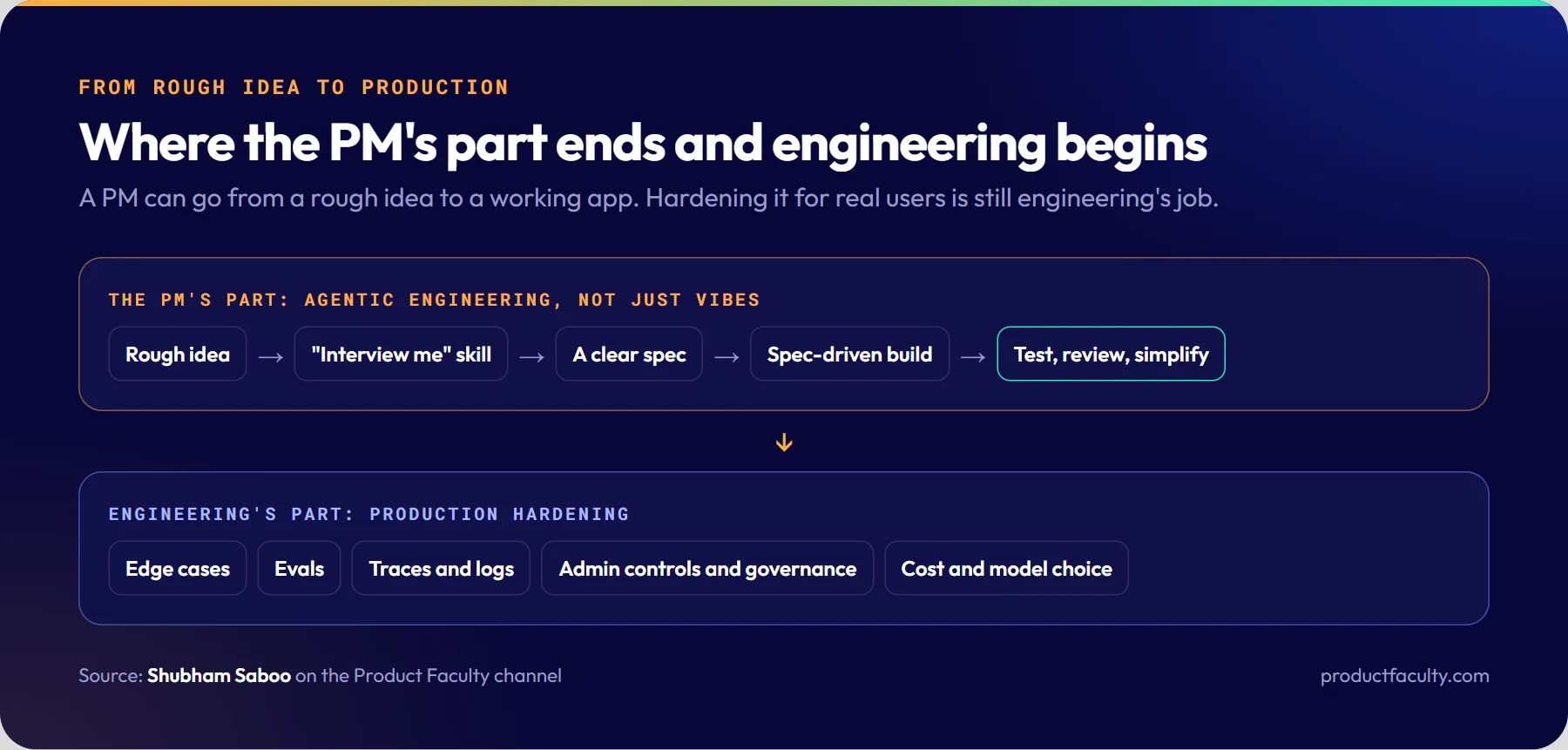
"Nothing is really stopping you" from going the last mile, Shubham says. It depends on your organization. Many startups let everyone, from marketing to PMs, commit to production. At Google, he doesn't want to be responsible for "a single line of code that touches billions of users," so engineers review, test and approve what ships. On his side projects, he takes things all the way himself.
Either way, he'd still have engineers harden it, because "it's very easy to miss the edge cases" if you're not one. His boundary: "The engineering part starts where the product part ends." That means rigorous testing, edge cases, evals (AI is non-deterministic, so unit tests aren't enough), traces and observability, admin controls and governance. Then come the "day two" questions: cost, and which model and API to use.
Try this week
- Paste a repo link into your coding agent, such as Awesome LLM Apps, and ask what you can build with it.
- Ask it to run one demo on a local dev server, with no terminal needed.
- Restyle it with a design.md file and ask the agent to test mobile, tablet and desktop.
- Use an Interview Me-style skill on one rough idea until you have a spec.
- Bring the MVP, not the doc, to your next review, and note what engineering would need to harden.
Watch the full session
FAQ
Is the PRD dead for AI product managers?
Shubham Saboo argues the working MVP is becoming the new PRD: instead of long documents few people read, PMs build a simple version of the idea with a coding agent that stakeholders can test and give real feedback on.
Can a PM build an AI prototype without coding?
Yes. With a coding agent, a PM can clone an example app, run it, change it and restyle it using plain-English prompts, without using a terminal or writing front-end code. The PM's job is a clear idea at the start and testing and judgment at the end.
What is a multimodal AI agent?
A multimodal AI agent can work with several kinds of input and output at once, such as voice, camera video, text and images. Shubham Saboo's claim agent listens, sees through the camera, writes a transcript and sketches notes in near real time.
What is design.md?
A design.md file is a set of design instructions for a coding agent, covering theme, structure, colours and palette. Giving one to a coding agent lets it restyle an app to a consistent, professional look without design or front-end skills.
What is the difference between vibe coding and agentic engineering?
Vibe coding means asking an agent to build an idea with no plan and shipping what looks fine. Agentic engineering refines the idea into a clear spec, builds from that spec, then tests, reviews and simplifies the result.
Should product managers push code to production?
It depends on the organization. Some startups let anyone commit to production, while large companies require engineering review. Shubham Saboo recommends engineers harden AI prototypes with edge-case testing, evals, traces, governance and cost control before release.
Learn to build as an AI PM
Shubham teaches Agentic Engineering in Product Faculty's AI Builder Fellowship. For the product side, see AI Product Management, and to go deeper on evals, take AI Evals.