How to Use AI as a Product Manager: Teresa Torres on Automating Prep, Not Judgment
The author of Continuous Discovery Habits shares what survived six months of daily AI use: an AI chief of staff that prepares her day, the evals that make AI output trustworthy, and why synthetic users can't replace talking to customers.
Automate preparation, not judgment
The best way to use AI as a product manager is to let it do the preparation (gathering, sorting, researching and drafting) while you keep the judgment: what to build, what matters and what the evidence really says.
Teresa Torres is the author of Continuous Discovery Habits and one of the most influential product thinkers working today. She has also become one of the most AI-native. She builds production AI products, runs her days through Claude Code and has written evals for her own tools. When we asked what had survived six months of real use, the answer surprised us: very little has changed. The value is in the simplicity.
"If we're going to make decisions about what to build on this, we want it to be the highest quality possible."
Teresa Torres
The episode in numbers
The /today command: an AI chief of staff
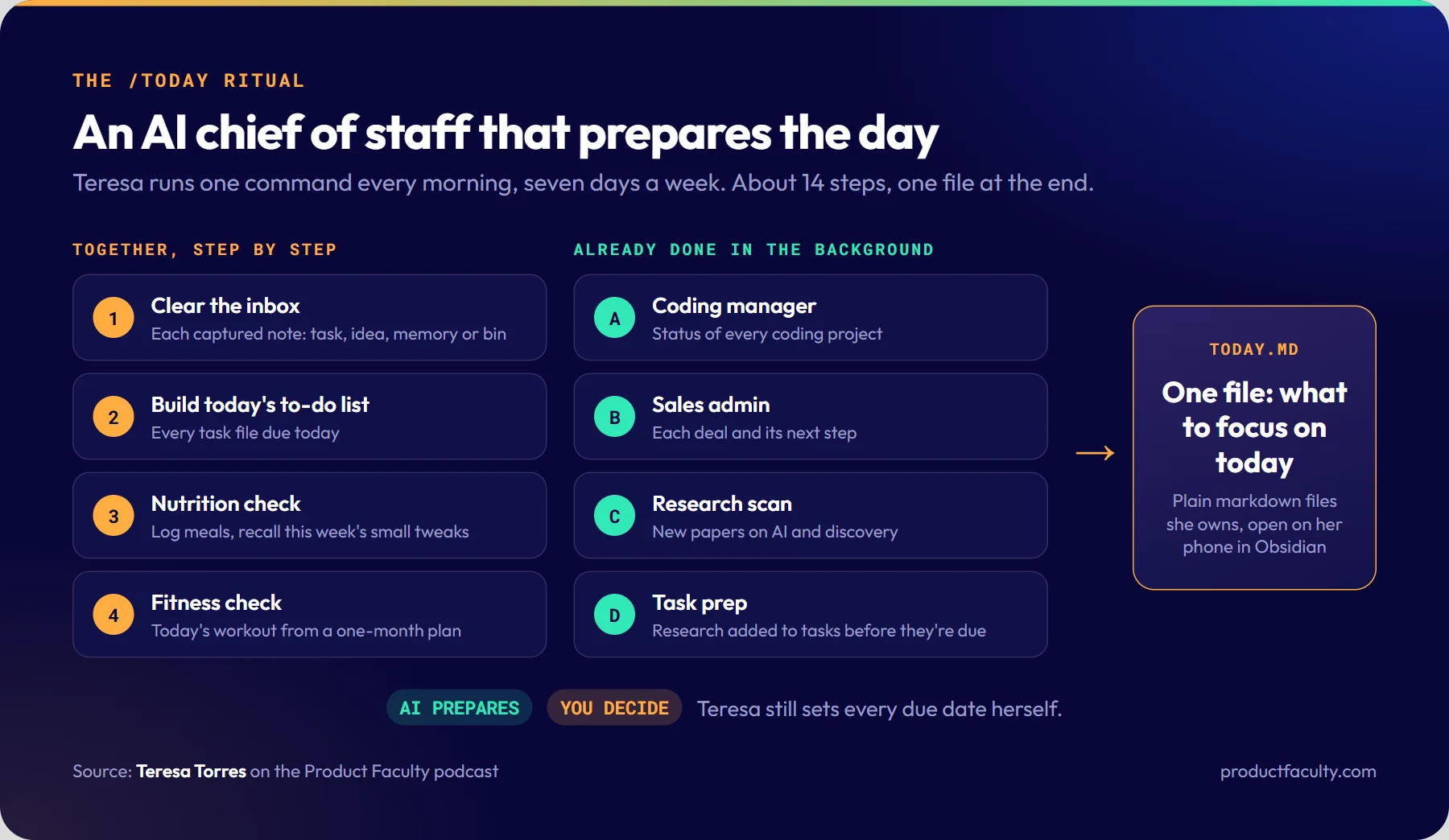
About a year ago, one of the first things Teresa built in Claude Code was a task system. Each task is a markdown file with a due date, some tags and a "completed" value. Every morning she types one command, /today, and Claude builds her to-do list from every task due that day.
That small hook grew into what she calls a chief of staff: someone who walks over each morning with a folder and says, "here's what needs your attention today." It now runs about 14 steps, including:
- Clear the inbox. Ideas she captured on her phone used to "die quietly in an infinite inbox." Now Claude walks her through each one: make it a task, an idea, a memory, or throw it away.
- Nutrition check. She logs yesterday's meals, and each week they pick a few small tweaks, like beans or lentils three times a week, instead of a diet.
- Fitness check. Claude plans a month of training with her and puts today's workout on the list. When she strained a calf muscle, she just told it, and it adjusted the plan.
- Background reports. A coding manager agent reports on every coding project she has started (and forgotten). A sales admin lists each deal and its next step. A research agent adds new papers on AI and discovery.
The most useful trick is preparing tasks before they're due. When she creates a task, she tells Claude how it can help. For a task called "learn about open source models", she asked it to do the research. A few days later, when she opened the task, it already held what she could run on her own hardware, what was available in the cloud and how the costs compared to her current setup. She read it, added five more questions and handed it back.
She also chose to keep /today as a command she runs, not a scheduled job. Each morning she first goes through yesterday's unfinished tasks and gives each one a realistic new date. If it ran on its own, "my overdue list would just grow infinitely."
Why the simple system survived
It is tempting to imagine a system like this reading your strategy and nudging your priorities. Teresa's is deliberately not that smart. "My today command is literally just doing a grep in my tasks folder for anything that's due today." She still decides what is due when.
That is why it has lasted. Everything lives in plain markdown files that she owns, can search and can open in Obsidian on her phone, and that Claude can read. In six months she has added only two things: the chief-of-staff steps, and a second workspace so she can share household tasks with her husband.
The ladder of evidence: not all customer feedback is equal
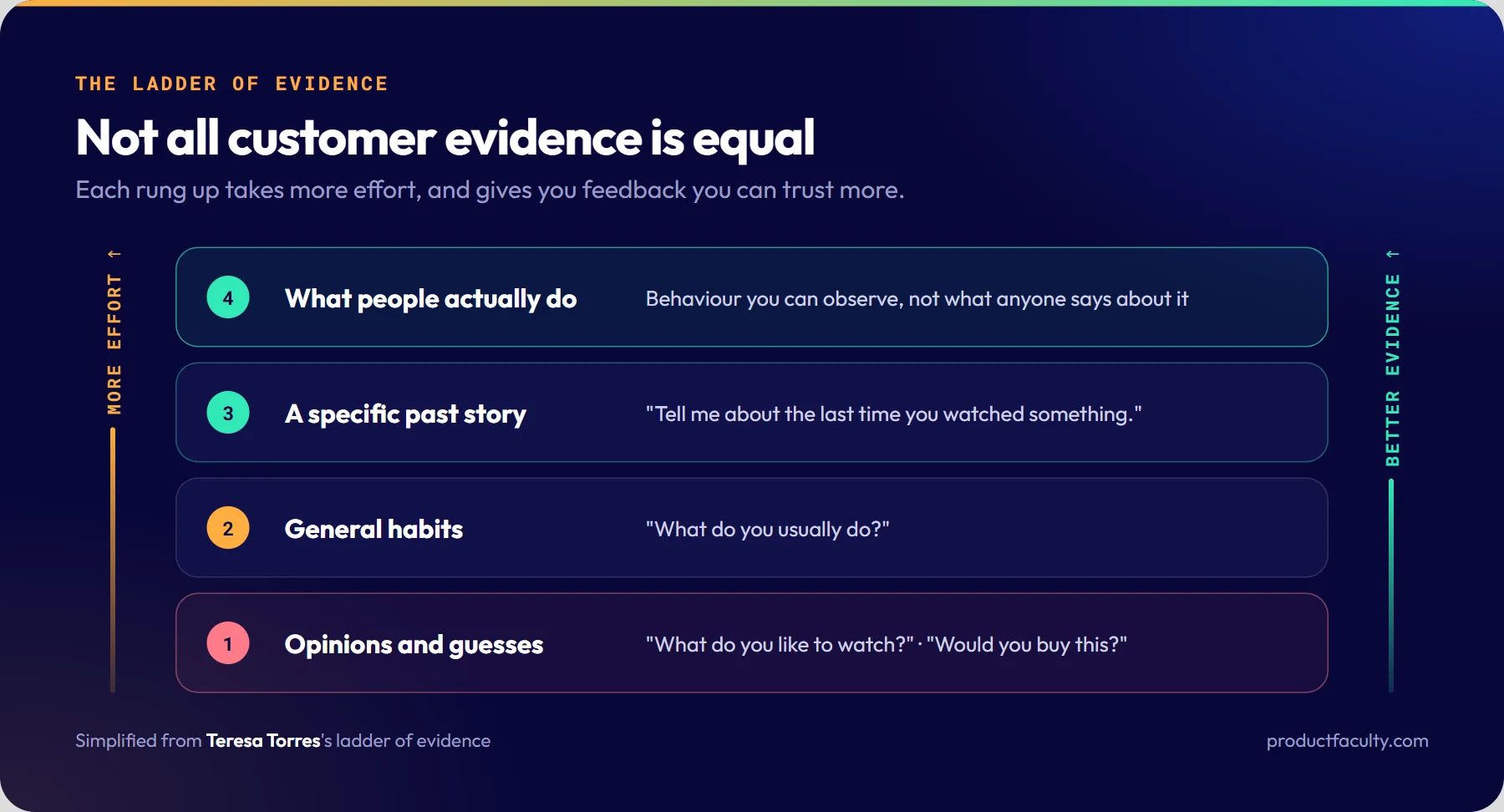
Product teams talk to customers, but most of us are not trained researchers. We ask questions that feel natural and give unreliable answers. Teresa's example: at Netflix, you might ask "what do you like to watch?" But what people say they like doesn't reliably match what they actually watch.
The ladder of evidence is her visual for this. As you climb, each rung takes more effort, and the quality of what you learn goes up.
The idea is from 2011, but AI brought it back. Teresa is building AI-generated interview snapshots and opportunity solution trees with Vistaly. More than 400 teams applied for the beta, each sending three "interviews". What arrived was sales demos, stakeholder meetings, usability chats and real customer interviews, all called the same thing.
If an AI pulls opportunities from all of these and shows them as equal, it does those teams a disservice. So the tool now tells you what kind of evidence you uploaded and what you can safely conclude from it, and coaches you to ask better questions next time.
How to make AI output reliable: error analysis and evals
People ask Teresa why she builds these tools when "Claude just helps me with my interviews." Her answer: she has looked at a lot of AI synthesis, and out of the box it isn't reliable. It overreaches, invents opportunities that aren't grounded in the transcript and frames things badly.
Her tools started as simple pipelines: fixed steps, each one an LLM call, such as "find the key moments" and "find the opportunities." Some became agentic steps: do this hard task, check it against criteria, get feedback on the mistakes and loop until it passes. Either way, the work that makes them reliable is the same.
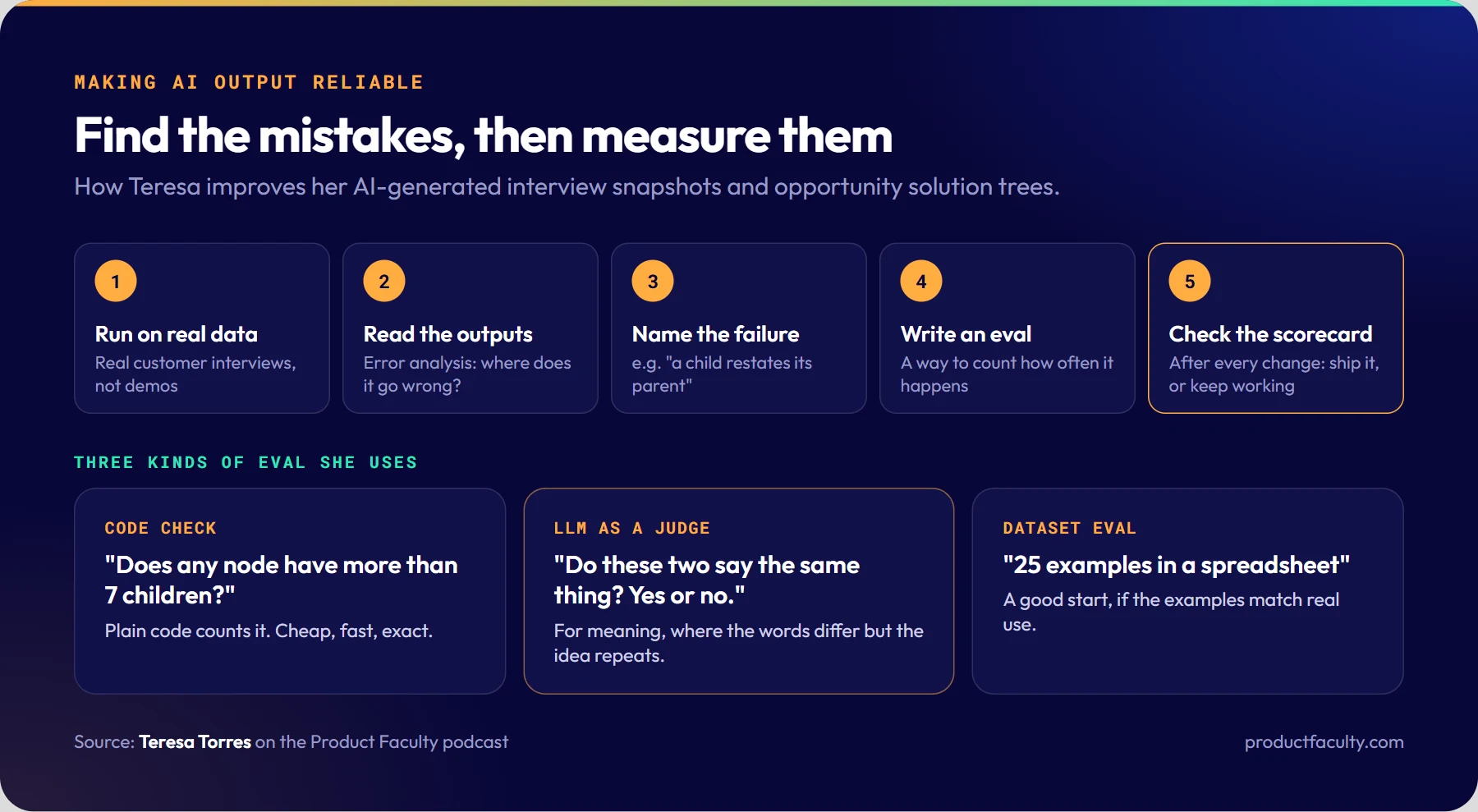
- Code checks. In a good opportunity solution tree, a node with more than about seven children usually needs subgroups. Plain code can count that.
- LLM as a judge. Sometimes a child just restates its parent in different words. Code can't spot that, so a second model gets a tiny prompt: do these two statements say the same thing? Yes or no.
- Dataset evals. A spreadsheet of, say, 25 examples. It is a fine start, but only if the examples match what you really see in production.
After every prompt or orchestration change, she generates a batch of trees, runs the evals and gets a scorecard: this error went down, that one went up a little. Then she makes the call. Ship it, or keep working.
Faster delivery, and its hidden cost
AI makes building any one feature faster. That is universally true. But Teresa warns that if teams go from two features a week to thirty, the codebase grows, and every bigger codebase gets harder to change.
"We're falling into this trap of shiny object syndrome. Let's just rush to add them to the codebase, and this is going to bite us."
Teresa Torres
Coding agents are not yet as good as your best engineers at fitting new work into an existing system. So good architecture and data model design matter more now, not less. Teams that skip them should expect to rewrite later.
Build to learn: prototypes instead of long PRDs
On the discovery side, the clearest win is that anyone can now prototype. Instead of writing a long PRD, a PM, designer or marketer can describe an idea to Lovable or Claude Code and see it. Marty Cagan calls this building to learn, as opposed to building to earn.
Cognitive psychologist Barbara Tversky has a phrase for why it works: when we can see our ideas, they talk back to us. A prototype takes the idea out of your head so you can examine it critically, a benefit that used to belong to designers and engineers. Teresa's old advice for a stakeholder with an idea that won't work was to story-map it together until they saw the holes. Now you can say, "go ahead and prototype that."
The one caution: a prototype is not production software. PMs submitting code is fine, as long as an engineer reviews it for maintainability, scale and reliability.
Don't just ask AI "what's interesting?"
Many teams paste a pile of interview transcripts into Claude or NotebookLM and ask what's interesting. Teresa sees two problems.
- No point of view. Expert researchers set learning goals first and design the research to match. "Tell me what's interesting" gives the model none of that. Give it your research goal and it does much better.
- It still makes mistakes. Even with good goals and context, it hallucinates, frames things poorly and overreaches. Without evals or error analysis, "you're trusting unreliable data."
Underneath is an expertise gap. Most product managers don't work with a researcher, and many have never seen what good synthesis looks like. "If you've never seen what good looks like, how are you supposed to evaluate the output from your LLM?" That is why she chose to focus on tooling rather than training.
Synthetic users vs real customers
The newest pitch goes further: you don't need to talk to customers at all, because an LLM can tell you how they behave. Teresa watches this space closely and calls much of it "the snake oil of our current generation." There are two main kinds of synthetic user, and they are not equal.
| Feature | Synthetic users | Digital twins | Real customer interviews |
|---|---|---|---|
| What it is | An LLM imitates how a whole population behaves on average | A profile built from one person's real behaviour, used to predict them | Talking to real people about what they actually did |
| Based on | The model's training data | Analytics, support tickets, past interviews | Specific stories from real customers |
| What research shows | No proof it matches what real people do | Promising, but still low at predicting real behaviour | Reliable when you ask about specific past events |
| Main risk | Builds for the average and leaves people out | Privacy: what's collected and how it's used | Takes time, and the skill to ask good questions |
| Teresa's verdict | Don't use it to decide what to build | Worth watching, not ready yet | Still essential. Every team should do it |
She dislikes the population approach on principle. Every person is different, and designing for the average leaves out small businesses and underrepresented groups. The research behind it is weak too. Vendors often cite a paper where an LLM predicted answers to a purchase intent survey with 85% accuracy.
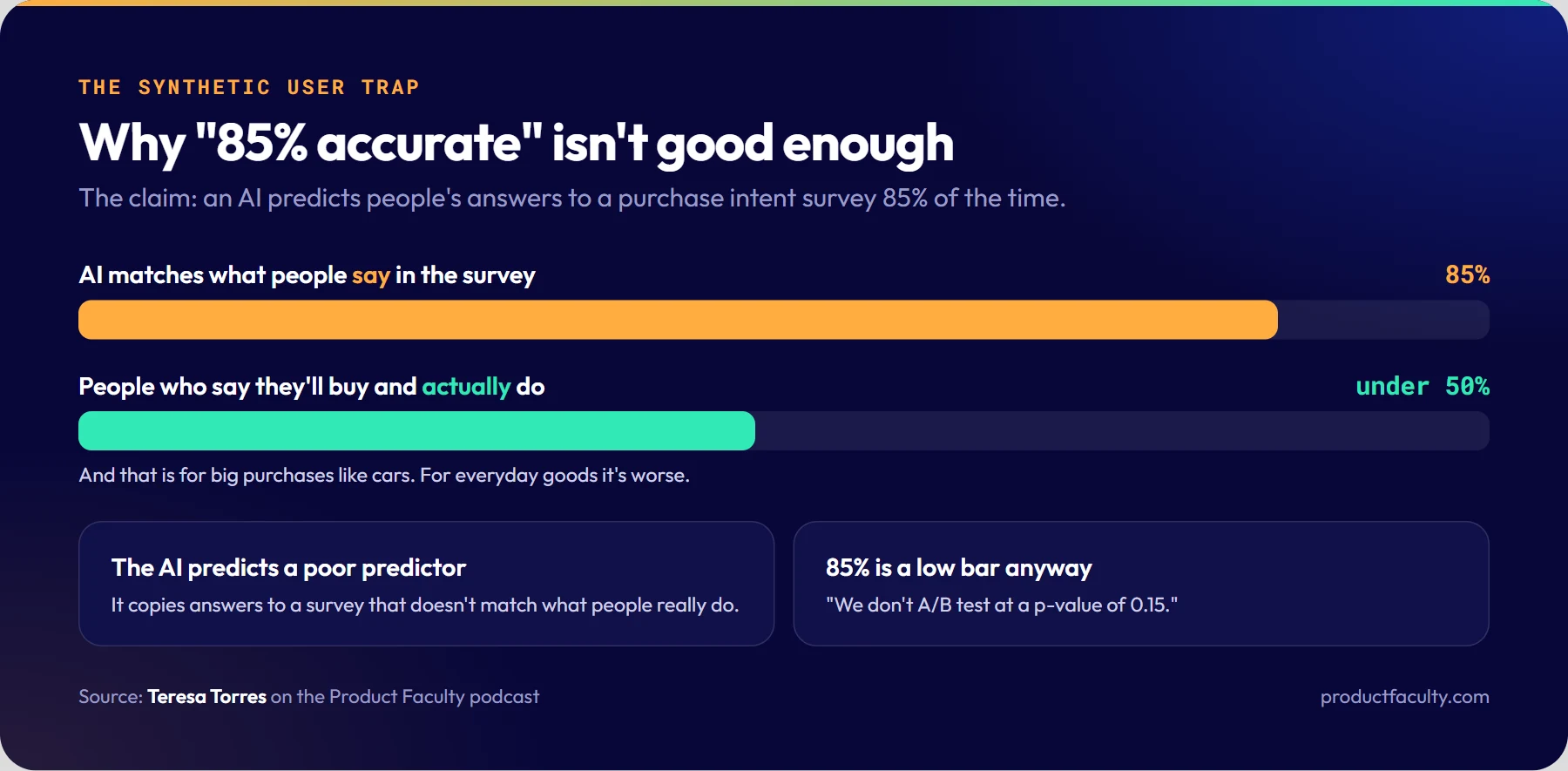
That sounds impressive until you look closer. 85% is a low bar: "We don't A/B test at a p-value of 0.15." And the survey itself is unreliable. Fewer than half the people who say they'll buy something actually do, even for big purchases like cars. "That's garbage. Why would we use this to make decisions?"
Raise the floor, then raise the ceiling
Research is starting to show that AI raises the floor. A well-built AI can do synthesis better than the average untrained person. That is what convinced Teresa to build these tools. The same research shows that an expert working with AI raises the ceiling.
Her prediction: as AI lifts everyone's baseline, the teams that stand out will be the ones that build their own discovery and synthesis skills, so they can be expert collaborators with the AI rather than passengers. And if AI saves you ten hours a week, don't build ten more features. Talk to more customers.
"I really think that every product team needs to be talking to their customers. I will probably think that until the day I die."
Teresa Torres
Try this week
- Move your tasks into plain files your AI can read, and write one morning command that builds today's list.
- Give each new task a prep job. When you create it, tell the AI what research to do before it's due.
- Rewrite one interview question from "what do you like…" to "tell me about the last time you…".
- Read 20 outputs of any AI workflow you rely on, name the most common mistake and find one way to count it.
- Spend saved time with customers. Book one more conversation this week.
Watch the full episode
FAQ
How should a product manager use AI?
Use AI to automate preparation, such as sorting your inbox, building your to-do list, researching tasks before they are due and drafting prototypes. Keep the judgment calls yourself: what to build, which evidence to trust and when work is good enough to ship.
What is Teresa Torres's /today command?
It is a Claude Code command she runs every morning. It reads her markdown task files and, in about 14 steps, clears her inbox, builds the day's to-do list, checks in on nutrition and fitness, and adds background reports on coding projects, sales and new research into one file of what to focus on today.
What is the ladder of evidence?
The ladder of evidence is Teresa Torres's model for judging customer feedback. Opinions and predictions sit at the bottom, general habits in the middle, and specific stories about past behaviour and observed real behaviour at the top. Each rung takes more effort but gives more reliable evidence.
Can AI create an opportunity solution tree?
Yes, but out of the box it is not reliable. It can overreach, invent opportunities and frame them poorly. Reliable AI-generated trees need good interview evidence, error analysis and evals that measure common mistakes, such as a child node that just restates its parent.
What is LLM as a judge?
LLM as a judge means using a second language model with a short, specific prompt to grade an output, usually with a yes-or-no answer. It is used for checks that plain code can't do, such as whether two differently worded statements mean the same thing.
Can synthetic users replace customer interviews?
Not yet. Synthetic users that imitate a population's average behaviour aren't supported by research and leave people out. Digital twins built from real behaviour show some promise but are still poor at predicting what people actually do. Talking to real customers remains essential.
Become an AI-native product manager
Product Faculty's AI Product Management course teaches the skills behind this episode, with practitioners from frontier AI companies. To build a Claude Code workflow like Teresa's, see AI-Native PM with Claude. To learn how to measure and improve AI output, take AI Evals.