Data vs Intuition in Product Management: Lessons From Former Google VP Bradley Horowitz
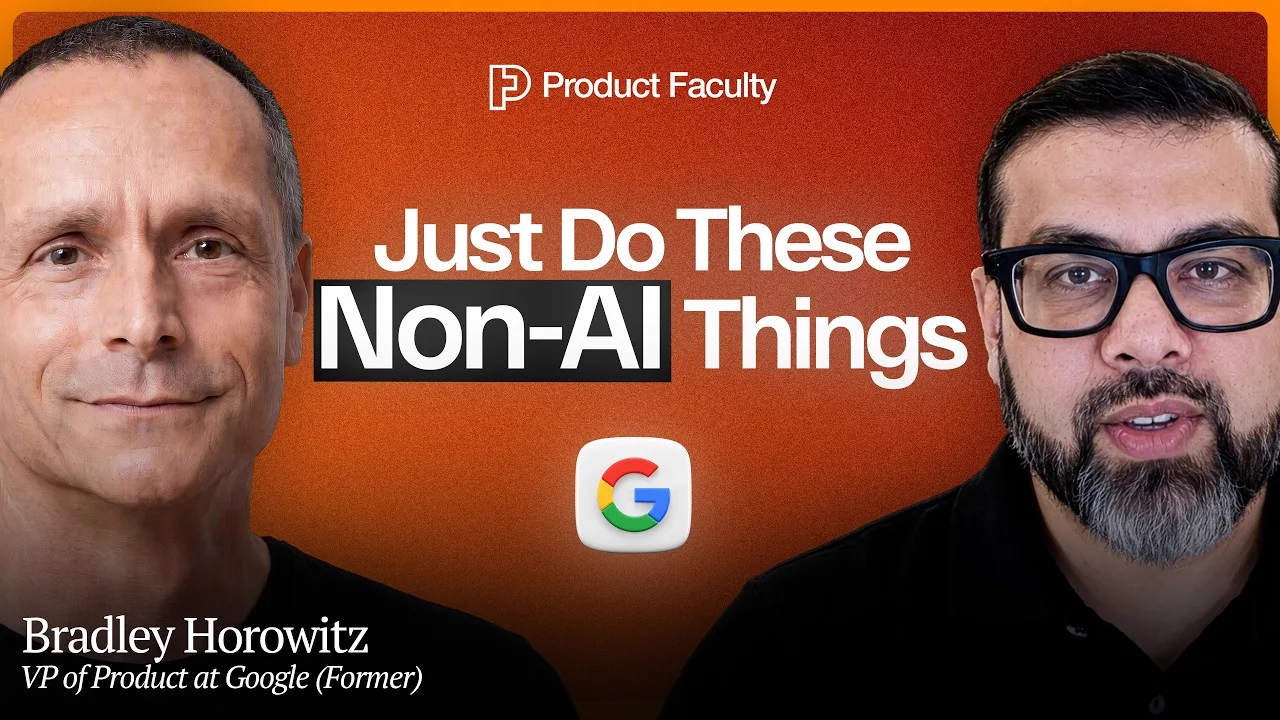
Bradley Horowitz led Gmail, Google Docs, Google Photos and more over 15 years at Google. He explains when to trust data and when to trust your gut, how Google tested products before launch, why teams go snow blind, and where AI creates real value first.
Data vs intuition: which should a product manager trust?
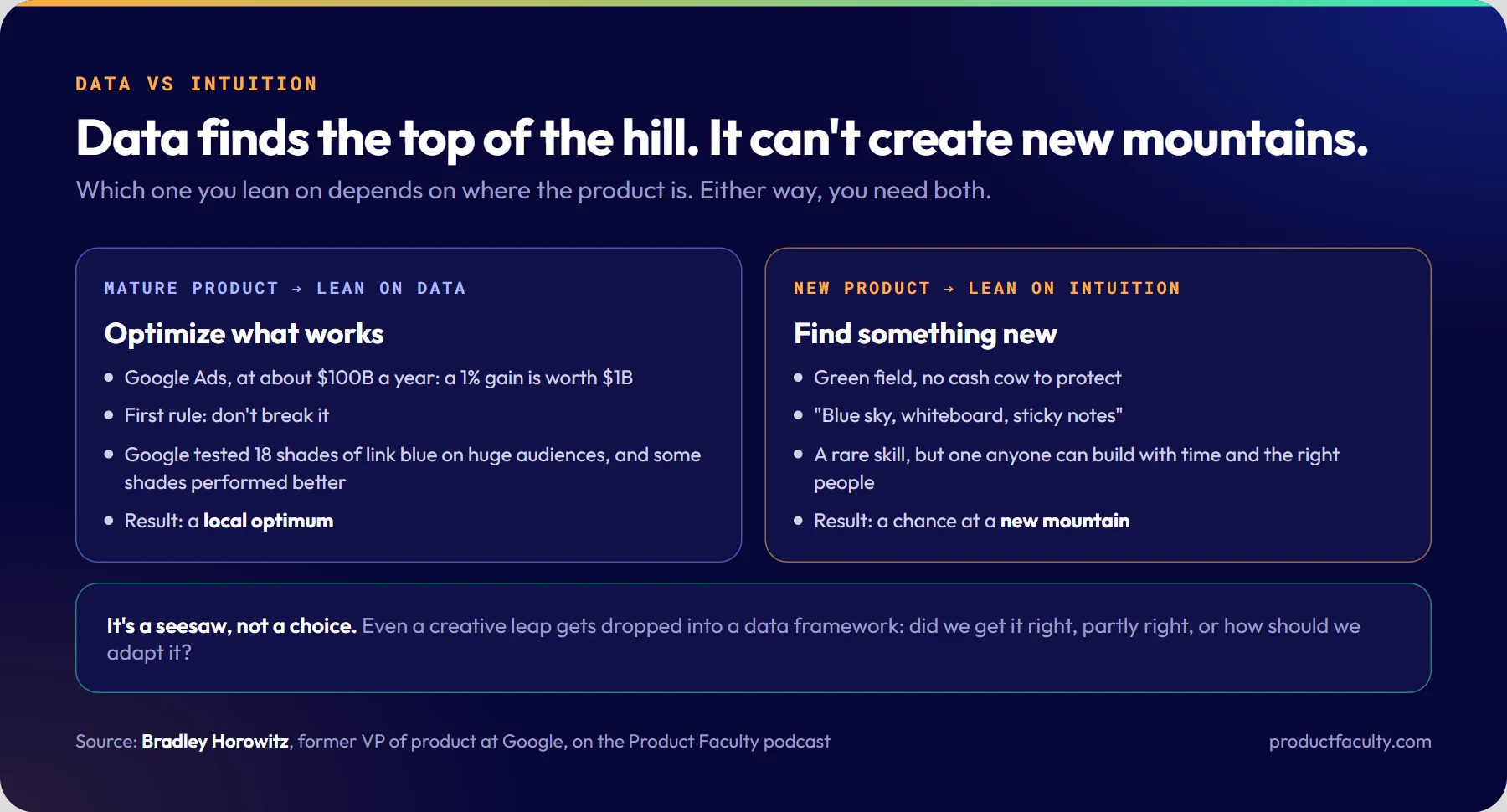
Use data to optimize a mature product and intuition to find something new. Data-driven testing can take you to the top of the current hill, but it can't discover new mountains. Even an intuitive leap should then be tested against real-world data.
Bradley Horowitz has seen both sides. He co-founded Virage as CTO and took it public, drove Yahoo's acquisition of Flickr, then spent 15 years at Google running products including Gmail, Google Docs, Google Drive, Google Photos and Google News, and co-founding Area 120, Google's internal incubator. He now co-runs Wisdom Ventures, a seed fund that has invested in both OpenAI and Anthropic.
His answer to "data or gut?" is that it depends on where the product is, and that you need the fundamentals first. Learning data-driven product work is like learning scales and theory before playing music: how to instrument a product, collect data, build funnels and put guardrails on it. "There's no way you'll be successful without it."
"If we've got data, we'll use data. If we're going to go with opinion, we'll use mine."
An old Google joke Bradley shares, unsure who said it first
The episode in numbers
| Feature | Data-driven | Intuition-led |
|---|---|---|
| Best for | Mature products with a large user base | New products and green-field ideas |
| Example | Google Ads, where a 1% gain is worth B | Creating a product that doesn't exist yet |
| What it finds | The top of the current hill: a local optimum | A chance at a new mountain |
| Main risk | It can't create new mountains | A great idea celebrated in a vacuum |
| How it's checked | Tests on real users, at statistical scale | Dropped into a data framework once it exists |
Build what the customer actually needs
At Virage in 1995, Bradley's team built what he calls "YouTube 17.0": face recognition, text recognition and speaker identification that made video searchable. The problem was that the world didn't yet have YouTube 1.0; you couldn't even reliably click and play video.
At ABC News, after an hour-long pitch, the lead engineer told him, "I love what you're doing. It's amazing, and we don't need it." What they did need was a script to upload a file to their content network every night at midnight. Bradley wrote it in five minutes and walked out with a check. "It doesn't matter if it's interesting or hard. You just have to do what the customer wants." He spent the rest of his time there pulling the team toward customer problems, acting like a VP of product before he had the title.
The blue links test: data finds local optima
Bradley says nobody let him near Google's money, "and it's a good thing, because the last thing Google Ads needs at a hundred billion dollar annual run rate is another great idea." When a 1% improvement means $1 billion, careful data-driven optimization is exactly right, and the first rule is don't break it.
His wife's favourite example is the shade of blue in Google's search links. Google tested 18 shades, putting huge numbers of users through each, and found that some performed better than others. Google switched to the winner, without fully knowing why it won. "That's what data-driven approaches can do. They can take you to local optima." Finding something genuinely new takes different skills: product creativity and intuition, which he says are rare but can be learned by spending time with the right people.
The two work together. "Even the intuitive creative bursts are dropped into a data-driven framework." You don't celebrate a great idea in a vacuum; you test whether you got it right.
How Google tested products before launch
To test a product idea, Google used what Bradley calls concentric rings, each a tougher, wider audience.
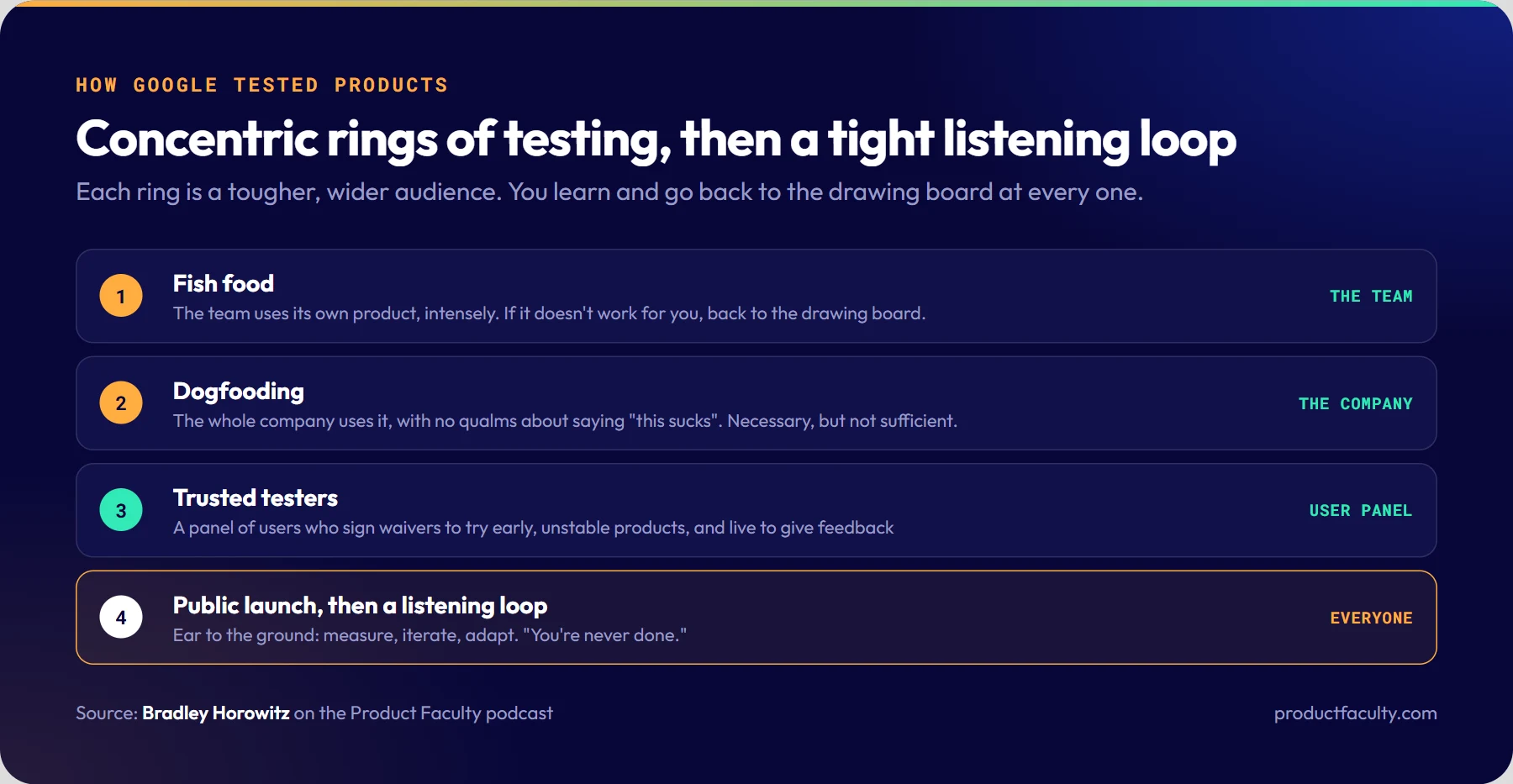
- Fish food. The team itself uses the product, intensely, from engineers and designers to the CEO. Bradley calls engineers who don't use their own product "tragic". If it doesn't work for you, go back to the drawing board.
- Dogfooding. The rest of the company uses it. These are your harshest critics, with no reason to be polite. But Google's employees aren't the general public, so dogfooding is "necessary and valuable, but not sufficient."
- Trusted testers. A panel of people who sign waivers to try early, experimental products, knowing they may disappear tomorrow. "These people live to give feedback."
- Public launch, then a listening loop. No amount of preparation predicts what happens after launch. Gather data, iterate and adapt. Gmail has been in market for around 20 years and still runs experiments. "You're never done."
Snow blindness, and refusing the excuses
Bradley believes product leaders usually know when they're on to something. The problem is that teams become "snow blind." A newcomer asks why something doesn't work, and gets beaten down with legacy, history, databases and org boundaries. But users don't know your org chart. "They just want it to work."
That's why fresh rotations help, and why he admired Larry Page, who "wouldn't abide an excuse." He pushed teams like Android and Maps, or YouTube and Gmail, to fix problems across organizational boundaries, then celebrated them at all-hands meetings: "What used to be 17 clicks is now two clicks." Moe's advice to senior PMs: if fresh eyes show you a problem, fight for the fix. Bradley's caution: be constructive, not obstructionist.
Ask for the resources the opportunity deserves
At a nonprofit, Bradley was asked to "build a skyscraper with toothpicks and Elmer's glue", and found himself shrinking to fit the shoebox of resources he'd been handed. His partner, arriving late, pounded the table: to do this properly, we need steel, girders and engineers. They got more.
His lesson: most people shrink into the box they're given. Part of a product leader's job is to say "that's an absurd ask" and make the case that a real opportunity deserves more. You won't always get it, but you shouldn't accept the problem as delivered.
Why even Google products fail
Google has huge resources, talent, infrastructure, marketing and users, and still products like Hangouts have struggled. Bradley's answer is simple: "At the end of the day, you have to build a great product that actually solves a problem for users." Without that, "you can't market your way to success. You can't bluff your way to success. You can't bully your way to success. You can't bundle your way to success."
He still sees public failure as positive: a willingness to take risks. He points to Apple's Vision Pro as a bold bet that only a company with Apple's resources and staying power could afford.
Where AI creates lasting value
Bradley has worked on AI since his university days in the 1980s, saw Google Photos become what he calls the first billion-user mass-appeal use of computer vision, and invests in AI through Wisdom Ventures. Every product manager, he says, should be asking how AI matters to their product, and the only way to find its limits is trying, failing, learning and iterating, responsibly.
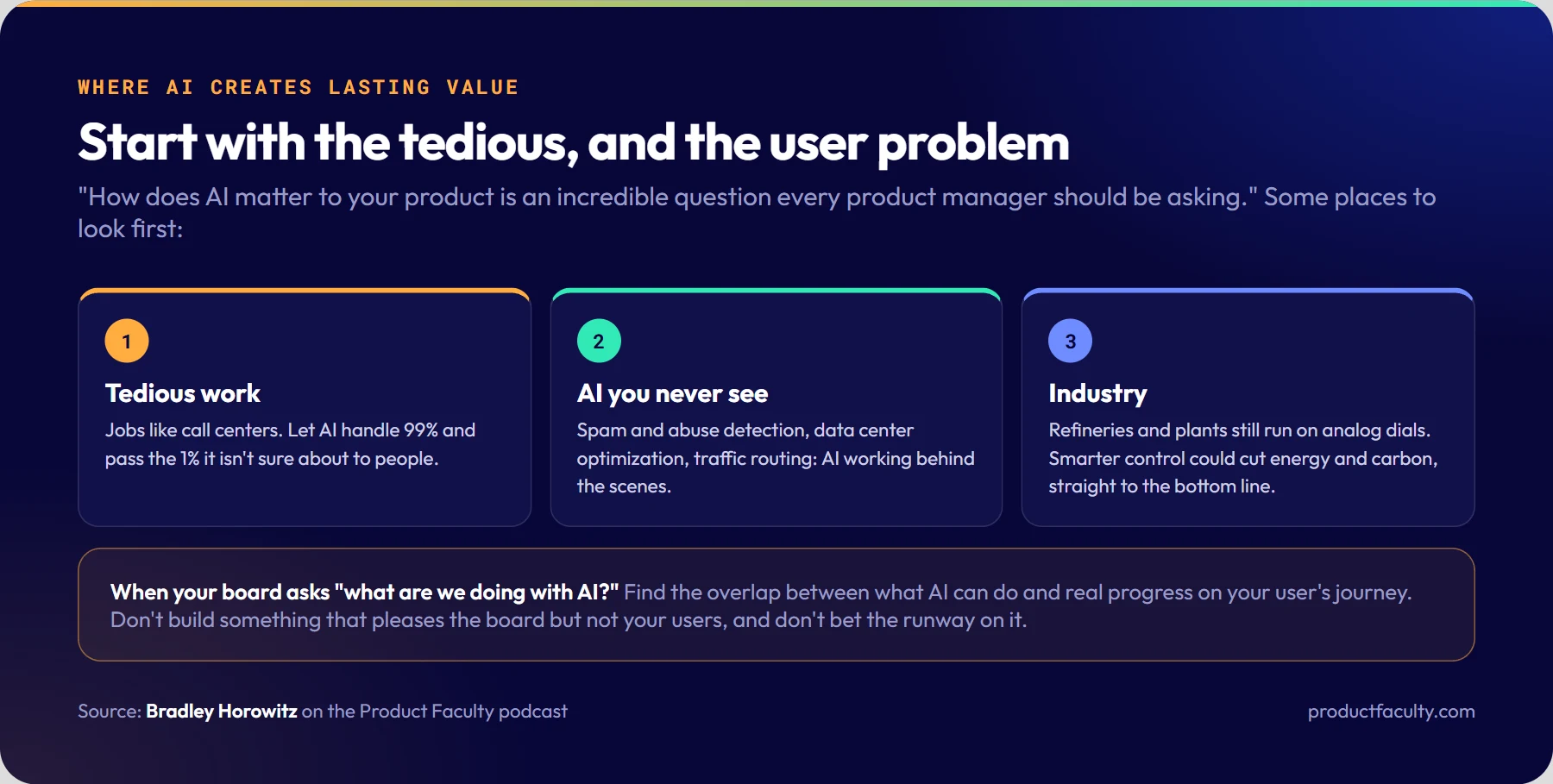
- Tedious work first. Places where companies hired "armies of people in call centers that have the most boring job in the world." Even if AI can't fully automate it, it can do 99% and know enough to pass the other 1% to people.
- AI you never see. Much of AI's impact is invisible: spam and abuse detection, data center optimization, internet traffic routing, drug discovery. "That is the part of the iceberg that is fun, but underneath are entire industries that are getting transformed."
- Industry. A stealth team he's met is applying AI to refineries and smelting, where operators still watch analog dials. Better control could mean double-digit efficiency gains, with carbon savings that also drop straight to the bottom line.
What to tell your board about AI
A small startup, a short runway, and a board asking "what are we doing with AI?" Bradley's advice is to be sober. If you have 16 months of runway, don't start a three-year AI project. AI ideas might live as "appetizers and teasers" of where the product can go after the next funding round.
Don't ignore the question, because the board is right to ask it. But "you should not create a solution that pleases the board and is irrelevant to your users." Look for the overlap between what AI can do and real progress on your user's journey. Sometimes it takes backbone to say the right thing now is closing the big contract, so you live to build the AI roadmap.
The lesson he wishes he'd learned sooner
For Bradley, the product journey has been "all about people," and it took him a long time to see that. At Virage, and earlier at MIT, he stayed inside his own bubble instead of engaging with the ecosystem around him. Even at Google, it's easy to become insular. Job titles and companies change, but relationships last. He'd focus on people first: learning from them, connecting with them and giving back, "not in a transactional way."
Watch the full episode
FAQ
Should product managers trust data or intuition?
Both, depending on the product. Data-driven optimization works best for mature products, where small gains matter, while intuition and creativity are needed to find new products. Even intuitive ideas should then be tested against real-world data.
What does "data finds local optima" mean?
Data-driven testing, like Google comparing 18 shades of blue for its links, can find the best option among the ones you test, the top of the current hill. It can't invent a fundamentally new direction, which Bradley Horowitz calls creating new mountains.
What is the difference between fish food and dogfooding?
At Google, fish food meant the product team using its own product. Dogfooding meant the whole company using it. Both come before trusted testers, a panel of users who sign waivers to try early products, and before a public launch.
Why do products from big companies fail?
Because resources can't replace a product that solves a real user problem. Bradley Horowitz says you can't market, bluff, bully or bundle your way to success if the product itself isn't great.
Where should companies start with AI?
Start with tedious, high-volume work such as call centers, where AI can handle most of the work and pass uncertain cases to people. Also look at less visible uses like spam detection, infrastructure optimization and industrial operations.
How should a product leader answer the board about AI?
Take the question seriously, but don't build something that pleases the board without helping users or that risks the company's runway. Focus on where AI overlaps with real progress for users, and be honest when the priority right now is something else.
Grow as a product leader
Product Faculty's AI Product Leadership course is built for leaders shaping strategy, teams and roadmaps in the AI era. For product strategy, see AI Product Strategy for Leaders, or start with AI Product Management.