Claude Opus 5.5 vs GPT-6 Codex: Which Wins on Real Work?
Most model comparisons use made-up tasks. Product Faculty CEO Moe Ali ran Claude Opus 5.5 and GPT-6 in Codex on ten real jobs from his own work, from a to-scale basement renovation to editing a Demo Day video. Here's what each did better, and when he reaches for which.

Claude Opus 5.5 vs GPT-6 Codex: the short answer
On ten real tasks, GPT-6 in Codex won six and Claude Opus 5.5 won four. Claude did better on visual and product work, such as 3D layouts, interfaces and design; Codex did better on long, thorough jobs such as video editing and developer handoffs. Opus also cost about 60% less for the same number of tokens.
Moe Ali, CEO of Product Faculty, made the comparison because most he'd seen weren't "tied to real work." His tests are tasks he actually does: some for his home, most for running Product Faculty. He's also a heavy user, with about 78,000 interactions, which he estimates would take 4.2 years on a single normal subscription.
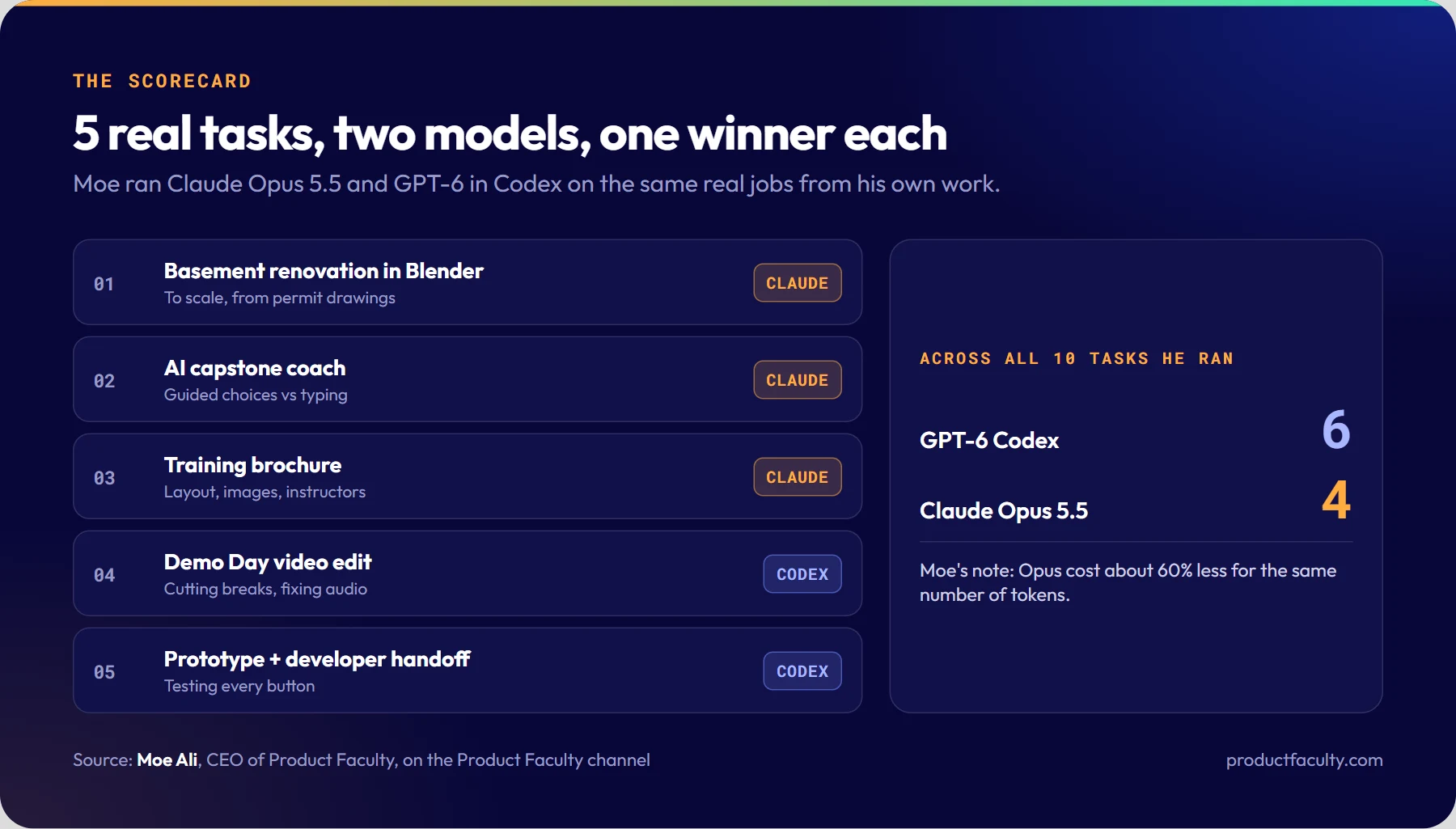
The test in numbers
How the test worked
Moe gave both models the same jobs and compared the outputs side by side. For the renovation, for example, he ran Claude Opus 5.5 on high effort and GPT-6 in Codex on extra high. He ran the Claude tasks through Codex too: he asked Codex to take his ten most intensive tasks and have Claude Code produce the output, because he prefers Codex as the harness for long jobs. "It's just so powerful and manages these long, long tasks really well."
Results at a glance
| Task | Claude Opus 5.5 | GPT-6 Codex | Winner |
|---|---|---|---|
| Basement renovation in Blender | Accurate, to scale, down to the plywood | Random, no real rendering | Claude |
| AI capstone coach | Pick from options, then confirm each step | Type everything out | Claude |
| Training brochure | Refined, better images, lists instructors | Small, grainy images; no instructors | Claude |
| Demo Day video edit | Kept more of each talk, but more interruptions and no audio | Logo up front, cleaner cuts, better volume | Codex |
| Prototype + developer handoff | Complete, with a video | Tested every button, more exhaustive | Codex |
1. Basement renovation in Blender: Claude wins
Moe is planning a basement renovation and wanted to picture it as a rentable retreat. Ask an image generator for that and you get something beautiful and "totally impractical," because it isn't to scale. Real rooms, measured from permit drawings, look very different.
So he had each model build the space in Blender, the free open-source 3D tool. Opus 5.5 was "significantly more accurate and realistic": real measurements, and when he hid layers, it had even modelled the plywood and dimensioned it properly. Codex's version had no rendering and no wood, and was "very random."
His tip works for anyone: you don't need to know Blender. Give a coding agent your permit drawings and ask it to build the space to spec. Then ask an image model to render from the Blender model, and the images come out "way more accurate and proportioned."
2. An AI capstone coach: Claude wins
Product Faculty is experimenting with a coach for its capstone projects. Both versions were "fairly similar," and neither was connected to live APIs yet. The difference was the experience: Codex's version made learners type everything out, while Claude's offered three options to pick from, then a step to confirm. Moe preferred the guided flow and called Claude the winner.
3. A training brochure: Claude wins
With one prompt, "come up with a brochure for our trainings," and the exact same prompt for both, Claude's brochure was clearly better to Moe. Codex's images were small and grainy and it was "missing a little bit of finesse." Claude's felt more refined, from the pictures to the quote. And Codex left out who teaches each course, which Moe calls very important; Claude listed the instructors. "I don't think this is a personal preference thing."
4. Editing a Demo Day video: Codex wins
At Cohort 11 Demo Day, the top students presented their agentic AI products and PRDs to judges from HubSpot, OpenAI and Google. Editing it is complicated: cut the breaks, trim anything unnecessary, enhance the audio and add a Product Faculty intro.
Codex added the logo up front, kept the edit to around 76 minutes and handled the volume better. Claude kept more of each presentation, but with more interruptions, and its version ended up with no audio. Moe: "I would definitely say Codex won the task here."
5. Prototype and developer handoff: Codex wins
The capstone project runs over several weeks: build a prototype, put it on GitHub, write a PRD. Moe had both models complete the whole thing, with a request to students not to try this themselves. For a developer handoff, every button has to work and the logic has to make sense. Both made a demo video, but Codex went further: it tested every single button and was more exhaustive, so it won.
Which model should you use?
Across all ten tasks, Codex won six and Claude four. But Moe points out that Opus cost about 60% less for the same number of tokens, and calls it "a workhorse that you can rely on." His working rule:
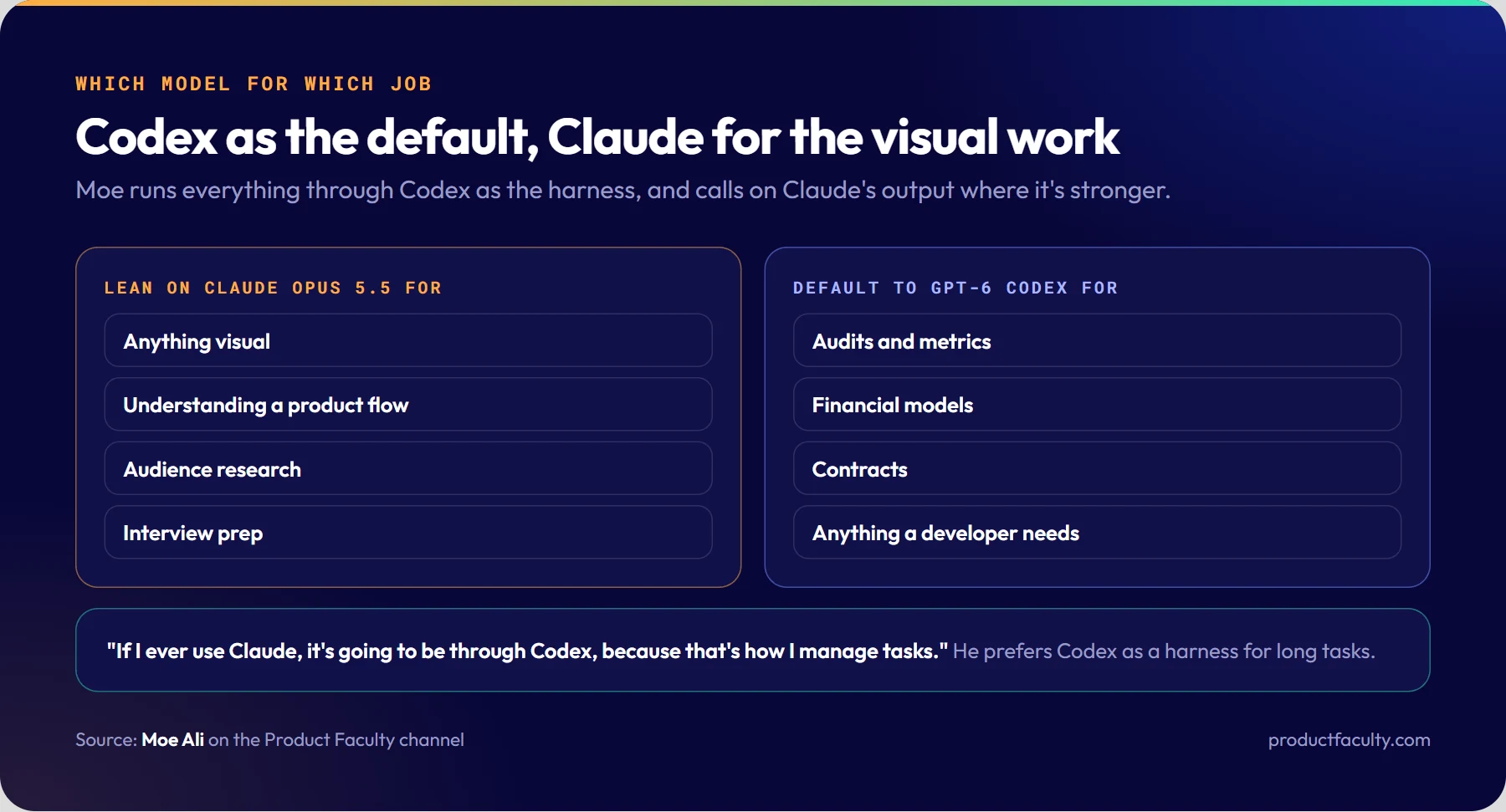
- Claude Opus 5.5 for anything visual, understanding a product flow, audience research and interview prep.
- GPT-6 Codex for audits, metrics, financial models, contracts and anything a developer would need.
His bigger message isn't about one model winning. "You can be as ambitious as you want." He doesn't want people creating slop, but he does want them to experiment with these tools and go far.
Which GPT-6 effort setting to pick
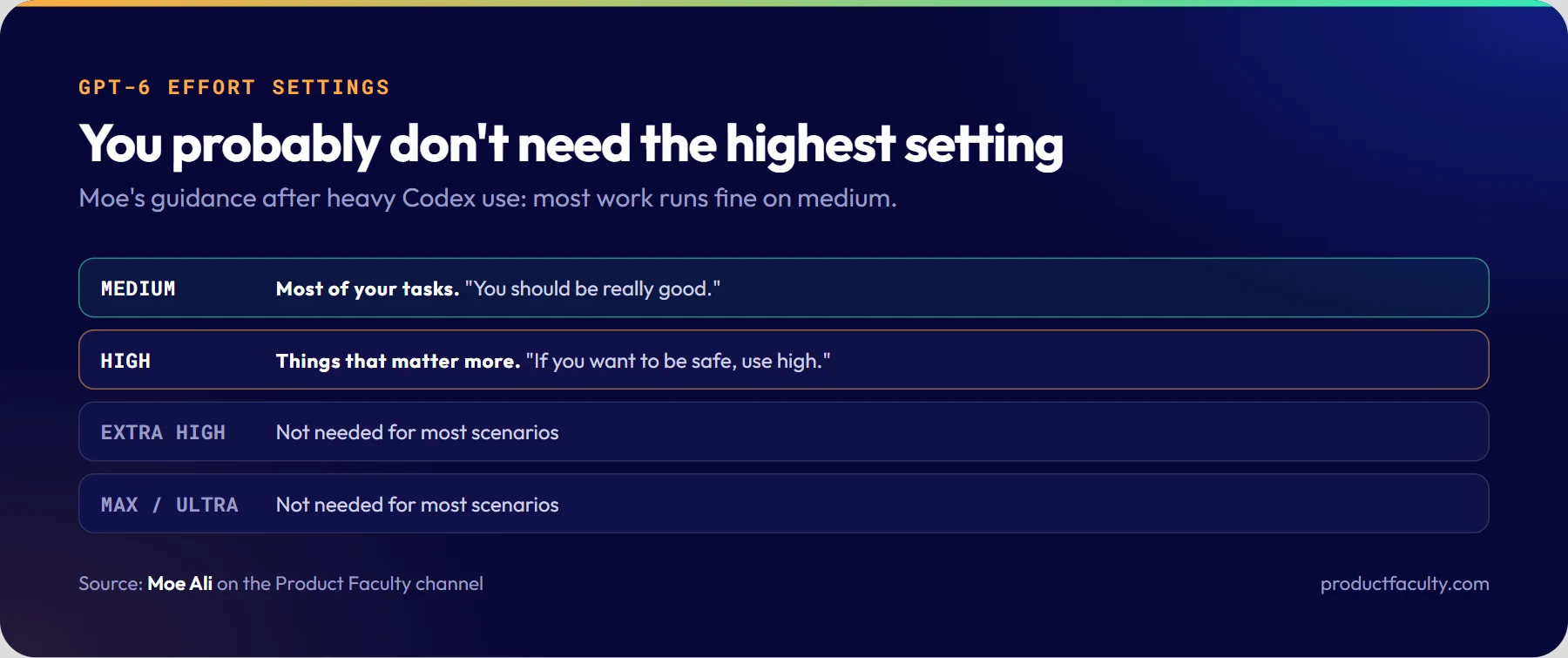
After a lot of Codex use, Moe's advice is that medium is enough for most tasks. Go to high for things that matter more; "if you want to be safe, use high." Extra high, max and ultra aren't needed for most scenarios.
Watch the full comparison
FAQ
Is Claude Opus 5.5 better than GPT-6 Codex?
It depends on the task. In Moe Ali's test on ten real tasks, GPT-6 in Codex won six and Claude Opus 5.5 won four. Claude was better at visual and product work, while Codex was better at long, exhaustive jobs like video editing and developer handoffs.
Which is cheaper, Claude Opus 5.5 or GPT-6?
In Moe Ali's comparison, Opus cost about 60% less for the same number of tokens. He suggests weighing that alongside output quality when choosing a model.
When should you use Claude instead of Codex?
Moe Ali leans on Claude Opus 5.5 for anything visual, for understanding product flows, for audience research and for interview prep, and defaults to GPT-6 Codex for audits, metrics, financial models, contracts and developer work.
What GPT-6 effort setting should I use?
Medium is enough for most tasks. Use high for more important work if you want to be safe. Extra high, max and ultra are not needed for most scenarios.
How can AI help plan a renovation to scale?
Give a coding agent your permit drawings and ask it to build the space to spec in Blender, a free 3D tool, without needing to learn Blender yourself. Images rendered from that model are far more accurate and in proportion than images generated from a text prompt.
Can you use Claude inside Codex?
Yes. Moe Ali runs his tasks through Codex as the harness and has it call Claude Code when he wants Claude's output, which lets him manage long tasks in one place.
Learn to work with AI models
Product Faculty's AI-Native PM with Claude course teaches you to build real workflows with Claude. To judge AI output the way Moe does here, take AI Evals, or see the full AI Builder Fellowship.