How to Become a Claude Certified Architect: The Professional Exam, Domains and How to Prepare
Carmelo Iaria passed Anthropic's Claude Certified Architect, Professional exam on his first attempt. He breaks down what the exam covers, how the five free prep courses map to its seven domains, sample questions, and why it's really a test of owning AI solutions in the enterprise, not coding.

What is the Claude Certified Architect exam?
The Claude Certified Architect, Professional is Anthropic's certification for people who design, build and own Claude-based solutions inside enterprises. It's a 63-question, 120-minute proctored exam across seven domains, from solution design and integration to evals, safety, stakeholder management and handoff.
Carmelo Iaria runs the AI consultancy Synaptic AI, teaches a course on becoming an agentic architect and works as a subject matter expert for Pearson, the company behind many major tech certifications. He took the Professional exam around the end of August and passed on his first attempt.
Having helped build certification exams himself, he stresses this isn't "a bunch of questions with a badge attached." Exams like this take experts and psychometric assessment, typically three to four months to build, and a lot of money, which shows Anthropic is serious about it.
"Don't assume that the entire solution is going to be done by AI. Especially don't try to use AI when there's an existing solution that is cheaper, faster, and is 100% accurate."
Carmelo Iaria
The exam in numbers
Who can take it, and why it exists
Anthropic launched its certifications in stages in 2026: the architect foundations exam in March, then in July an associate foundations exam, a developer exam and the professional tier for architects. For now, the exams sit inside Anthropic's partner portal, open to organizations in the Claude Partner Network. Even a small company can register, and partners with more certified people are better qualified to build on Anthropic's models.
The reason, Carmelo explains, is that it's one thing for an enterprise to buy Claude licenses so staff can be more productive, and another to build real solutions on top inside an enterprise's constraints. That needs a lot of knowledgeable people. Anthropic has committed about $100 million to its partner programs to build that capacity, including with large consulting firms.
Foundations vs Professional: which exam is for you?
| Feature | Foundations | Professional |
|---|---|---|
| Core question | Can you design and build Claude agents and workflows? | Can you own and defend a Claude solution across its full lifecycle in an enterprise? |
| Focus | The API, SDK, Claude Code and MCP connections | Discovery, integration, evals, governance, stakeholders and handoff |
| Best for | Solution architects, AI engineers and tech leads who build with code | Senior architects who own production solutions end to end |
| Domains | 5 domains, 30 tasks | 7 domains |
| Questions | 60 in 120 minutes | 63 in 120 minutes |
| Pass mark | 720 out of 1,000 | 720 out of 1,000 |
The Professional exam assumes you already know the technical material. Its higher bar is the full process: from discovery with stakeholders and understanding the business problem, all the way to monitoring the solution in production and proving it delivers value. You also have to be able to defend your decisions "when somebody else has got different ideas in the room."
Exam format and logistics
- Register through Pearson VUE and pick a date and time. If you fail, you pay again. Some employers reimburse the $175.
- It's proctored online. You need an empty room with no notes or extra devices, and a proctor checks your surroundings before you start.
- Two hours. Carmelo finished in about 90 minutes, but says you definitely need to prepare.
- Valid for 12 months, which is a long time in AI years.
- Read the exam guide. It's a downloadable PDF with the blueprint and how much each domain weighs.
The seven domains and five free prep courses
Anthropic's free prep courses mix video, text and exercises. There are five courses but seven domains, so Carmelo mapped one to the other.
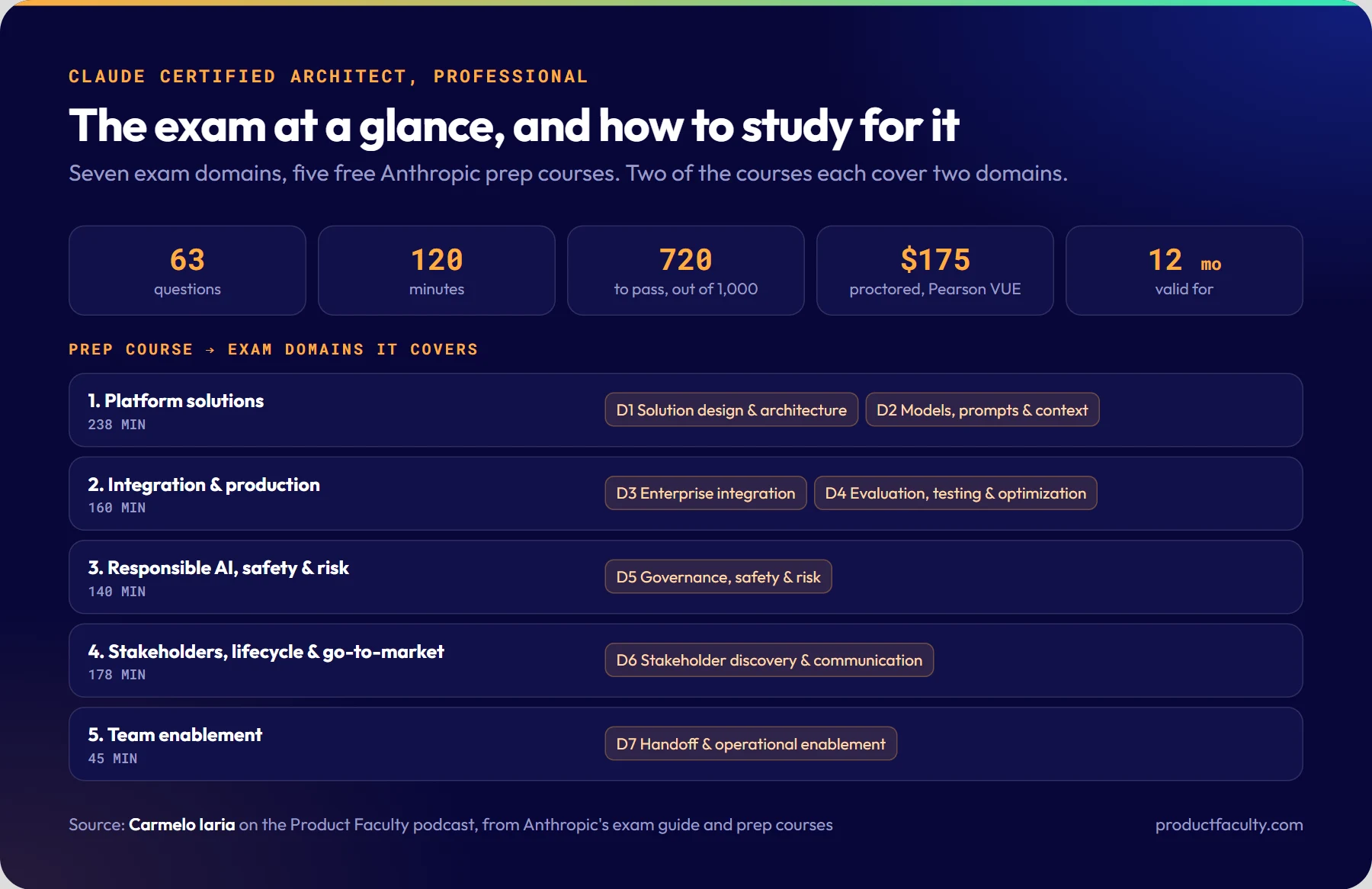
Integration is the biggest domain, at about 19% of the exam. Governance, safety and risk is about 14%, and team enablement about 7%, matching its short 45-minute course.
Domain 1: decide who owns each piece of the solution
Carmelo's favourite idea in the whole syllabus is decomposition. Break a big solution into smaller pieces, then ask of each one: who owns it? Claude, a system the enterprise already has, or a human?
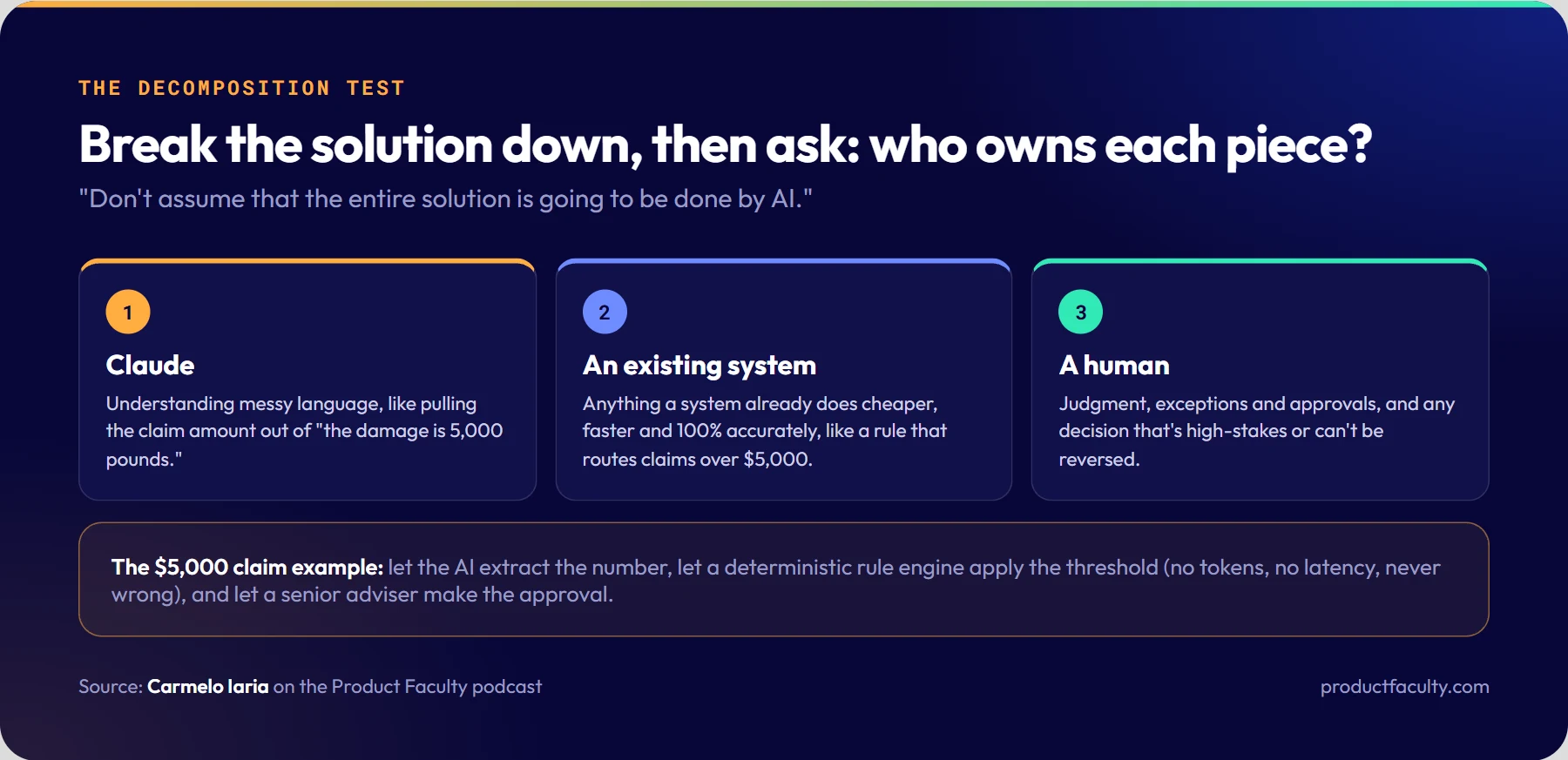
His example is an insurer that routes every claim over $5,000 to a senior adviser. You could ask the AI to apply that rule, and in a demo it would probably work. But months later someone writes "the damage is 5,000 pounds," and occasionally the model misreads it. At millions of claims a month, that's a liability and a cost. Better: let AI extract the number, let a deterministic rule engine apply the threshold (no tokens, no latency, 100% accurate), and let a person own the approval. Anything involving judgment, exceptions or decisions that can't be reversed should stay with a human, at least at today's level of AI maturity.
Domain 2: models, prompt caching and context engineering
- Start with a mid-range model, such as Sonnet, then move up to Opus or down to Haiku based on evals, not gut feeling.
- Stay in the "smart zone." Agents perform worse once a large share of the context window is used, so manage context outside the window on bigger projects.
- Put static content first. Prompt caching only works if the unchanging part of the prompt comes before the parts that change. A dynamic element at the front "kills the cache gains."
- Weigh cost against latency. Using the top model all the time with caching off makes the bill much larger.
Domains 3–5: integration, evals and safety
Integration (domain 3) starts with understanding how the enterprise already works with AI: an on-premises deployment, a contract with a particular cloud, compliance rules. Learn those first, or you'll build a solution compliance won't let you deploy. Two architectural must-knows:
- Least privilege for tools. Every tool you give an agent is an attack surface, and too many tools make the agent pick the wrong one and waste tokens.
- RAG chunking and indexing are architecture decisions that depend on your content, and a refreshed document that isn't re-indexed leaves stale chunks.
Evaluation and testing (domain 4). Design your eval strategy before the first line of code, with a golden dataset that includes edge cases from real logs. A common mistake is a suite that goes stale: the prompt changed, the evals didn't, and great scores were testing something else. Also optimize for latency, tokens and performance.
Governance, safety and risk (domain 5). Screen inputs and outputs, decide when to escalate to a person, and test for bias, fairness and transparency. Models are trained to avoid generic problems, but your company's specific policies were never in any model's training data, so you have to build them in.
Domains 6–7: stakeholders and handoff
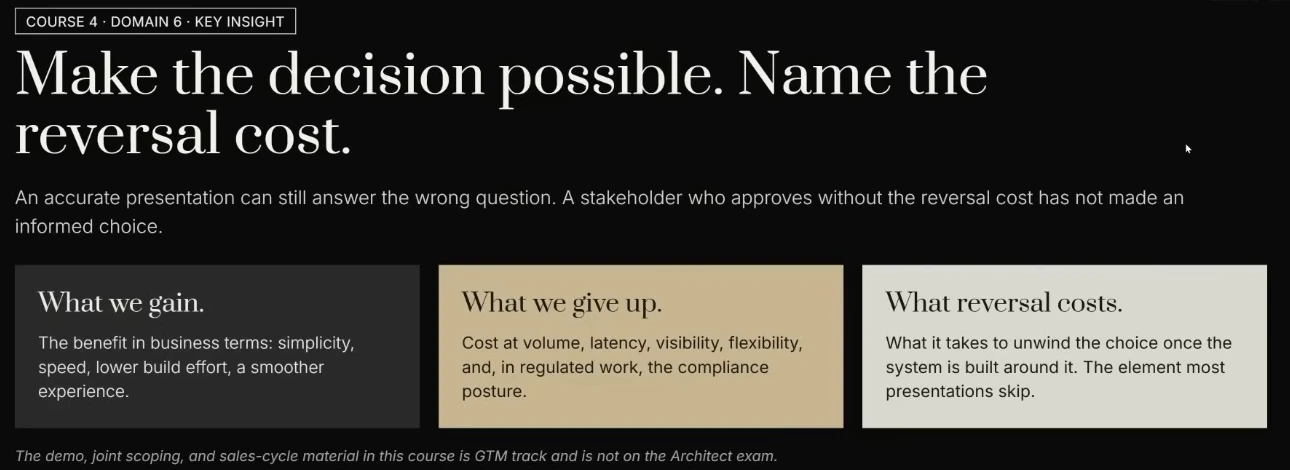
Stakeholder discovery and communication (domain 6) covers running a structured discovery, turning a thin brief into real requirements, and making sure the person who says "go" understands the consequences. For every decision, tell stakeholders three things: what you gain, what you give up, and what it costs to reverse. A CTO who approves "4 cents a call" may not realize that at volume it's a five-figure monthly bill, especially if caching was never set up correctly.
Handoff and operational enablement (domain 7) asks: "What happens when you leave the room?" Leave enough documentation and training that the team can run the solution without calling you to put out fires, and decide how to share productivity tools across the team, such as skills, plugins or organization-wide settings.
Sample questions and a free mock exam
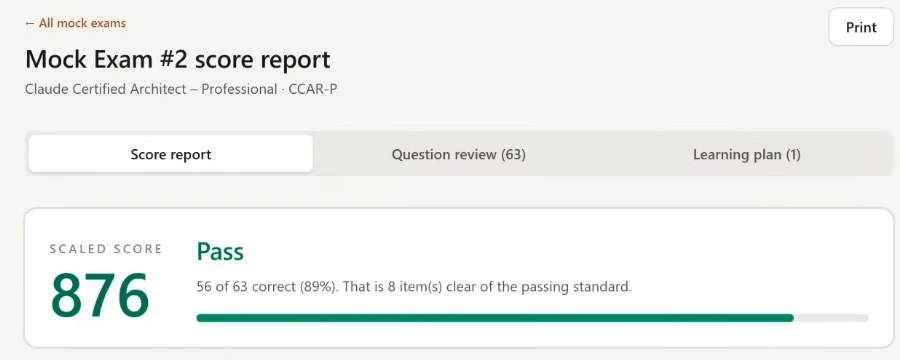
When Carmelo couldn't find a practice test for the Professional exam, he built his own mock exam tool. It has a question bank, timed or untimed attempts, a report by domain, explanations for each answer, and a learning plan that links to the relevant Anthropic course for weak domains. He's made it free with a newsletter sign-up.
A few questions from the episode:
- A support agent can read tickets, draft replies, issue refunds and delete accounts, but staff only ever read and draft. Best fix? Remove the refund and delete tools entirely. Logging only helps after the damage; a confirmation prompt can't enforce rules; a bigger model doesn't fix permissions.
- Every request sends the same 8,000-token system prompt and policy, then a short varied user message. What cuts both cost and latency? Put the static prompt and policy first and enable prompt caching.
- After a document refresh, a RAG system gives confident but wrong answers, with no change in model or latency. What do you check first? Whether retrieval is returning stale or irrelevant chunks because the index wasn't refreshed.
Some questions ask for one answer, others for two or three, which is harder because you need every pick right.
How Carmelo applies it with clients
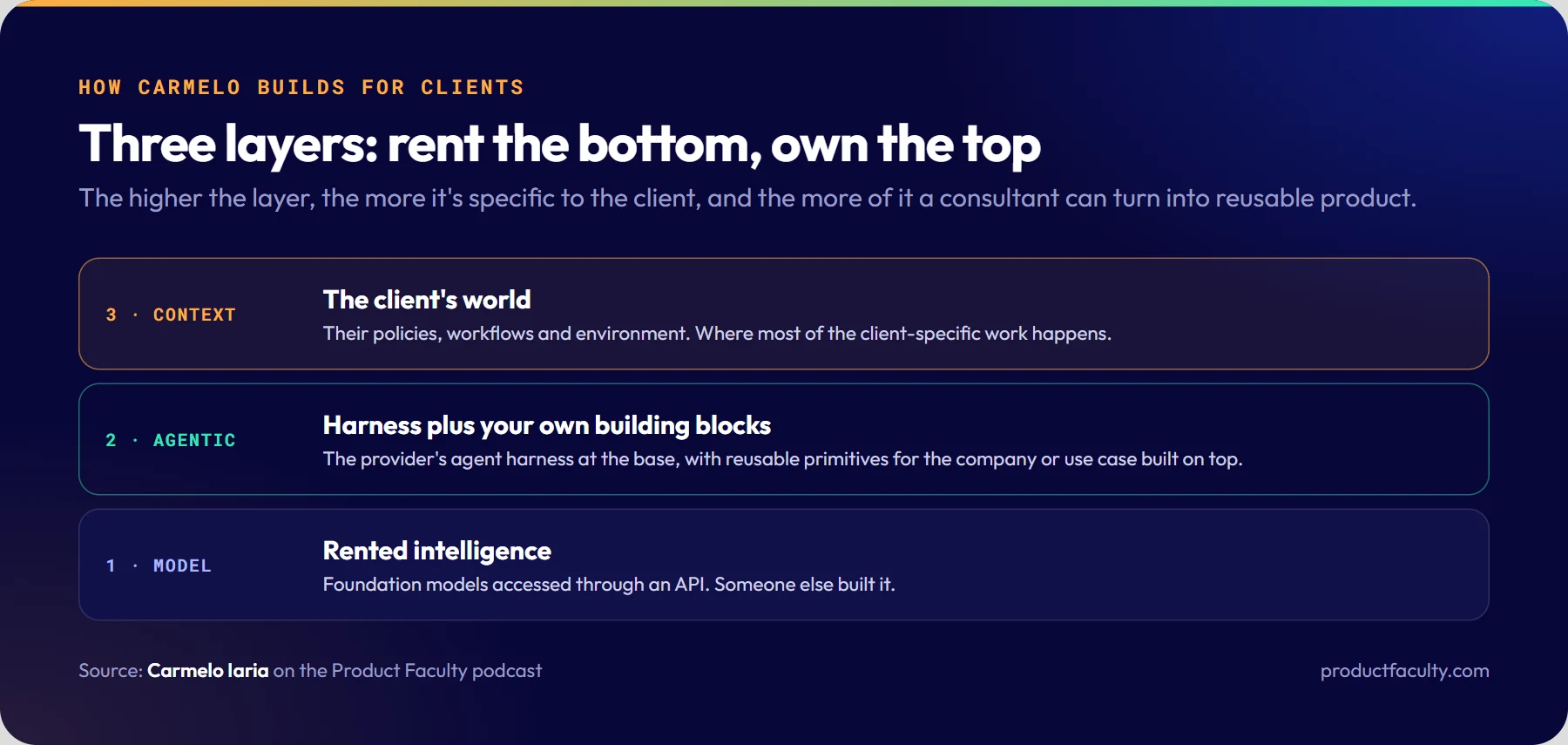
With enterprise clients, Carmelo thinks in three layers. You rent the model layer. The agentic layer starts with the provider's harness, and on top you build reusable building blocks for the client or use case. The context layer holds the client's policies and workflows. For a consultant, building reusable primitives means you can productize more of each engagement and reuse it with the next client.
His own work has mostly been in heavily regulated industries like banking and finance, often in Brazil, as well as telecommunications. He says the job goes far beyond the technical: culture, relationships and getting past blockers with very different stakeholders.
Agentic architect vs forward deployed engineer
Students often ask whether an agentic architect is the same as a forward deployed engineer (FDE), the role Palantir made famous. There's a lot of overlap. Both need client relationships, stakeholder management and the ability to bring lessons back so knowledge compounds across clients. But the architect typically comes in earlier, to define the solution, the eval strategy and risk management, while the engineer focuses more on code, integrations and making the solution work.
Carmelo's rule of thumb: the Professional exam trains you as an architect; to work as an FDE, you'll want the Foundations exam's hands-on skills too. He sees firms like Deloitte hiring, which fits Anthropic's partnerships with large consultancies. "In order to win big in the enterprise," that's a strategic move, not a nice-to-have.
Watch the full episode
FAQ
What is the Claude Certified Architect exam?
It is Anthropic's certification for people who design and build solutions on Claude. The Professional tier tests whether you can own a Claude solution across its full lifecycle in an enterprise, from discovery and design to integration, evals, governance, stakeholder communication and handoff.
How many questions are on the Claude Certified Architect Professional exam?
63 questions in 120 minutes, with a passing score of 720 out of 1,000. It costs $175, is proctored online through Pearson VUE and the certification is valid for 12 months.
Who can take the Claude Certified Architect exam?
At the time of the episode, the exams were available through Anthropic's partner portal to organizations in the Claude Partner Network. Even small companies can register as partners.
What is the difference between Foundations and Professional?
Foundations tests whether you can design and build Claude agents and workflows with code, across five domains and 60 questions. Professional assumes that knowledge and tests whether you can own a production solution end to end in an enterprise, across seven domains and 63 questions.
How do you prepare for the Claude Certified Architect exam?
Read the exam guide, complete Anthropic's five free prep courses, which map to the seven exam domains, and practice with mock questions. Carmelo Iaria built a free mock exam tool with domain reports and a learning plan.
Is an agentic architect the same as a forward deployed engineer?
They overlap, but an architect usually defines the solution, eval strategy and risk management early in a project, while a forward deployed engineer focuses more on code and integrations. The Professional exam leans toward the architect role.
Build these skills
Product Faculty's Claude Architect Mastery course is built around the skills in this episode. For hands-on agent work, see Agentic Engineering and Forward Deployed AI Engineering, and to design evals before you build, take AI Evals.