How to Build a Solo AI Business: Sabrina Ramonov's Playbook From Idea to Millions in ARR
No team, no funding, built in public. The founder of Blotato shares how she validated an idea with a 30-second TikTok, reached $10K in monthly revenue ten days after launch, and runs her whole content operation in one day a week.
Can you build an AI business solo?
Yes. With AI tools, one person with a product or technical background can now validate an idea, build the first version in days, find paying customers and grow to millions in annual revenue without a team or outside funding.
Sabrina Ramonov has done it both ways. Her first company, Qurious, built real-time speech recognition, raised venture money, hired a team and was sold to Pegasystems. After that she was burnt out and had no plans to start another company. She just wanted to teach people AI for free.
Then her own problem got in the way. Her audience was growing fast, and turning one video into posts for every platform was eating her week. Less than two years after launching Blotato to fix it, she had grown it to millions in annual recurring revenue. She hired her first full-time person only a few months ago.
"You don't need someone's permission to build a successful multi-million dollar business solo."
Sabrina Ramonov
The episode in numbers
Validate the idea with a 30-second video
The idea came from her own audience. Sabrina made YouTube videos showing her make.com automation for repurposing content, and the comments kept saying the same thing: this is too hard to set up, is there an app that just does it?
On 1 August 2024 she filmed a TikTok, about 30 seconds and no retakes, describing an app that turns your videos and blog posts into ready-to-publish social posts, and asked viewers to comment if they had the problem. Lots did. But as she says, "as we know in the product world, that doesn't necessarily mean anything." So she DM'd 10 to 20 of the commenters and got on calls to learn what tools they used, what they paid for and how they duct-taped it all together.
For her, the risk was low. If the app failed, she would give the code to her audience for free and turn the whole thing into content.
Cut the MVP to one feature
Next, she filmed herself building the MVP: a seven-part YouTube series, from planning and the tech stack to the UI, user login and AI image generation, all coded in Cursor. In mid-2024 there was very little content showing how to vibe code a product from idea to launch.
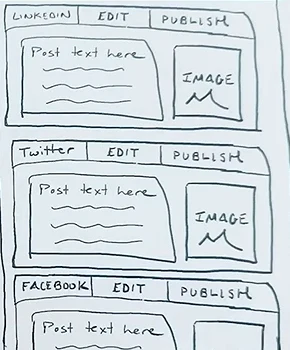
The most important part of that first episode was removing features. Because AI can build almost anything, first-time builders try to build everything. Sabrina did the opposite. Instead of LinkedIn, Twitter and Facebook posts, version one made Facebook posts only. It couldn't even publish to social media; she connected Zapier to do that. You pasted in a blog or newsletter, picked a platform and got a post back.
"Really disgusting, but it worked." That version was enough to reach her first $10K in monthly recurring revenue.
The launch: a month lost, a broken link, $10K MRR
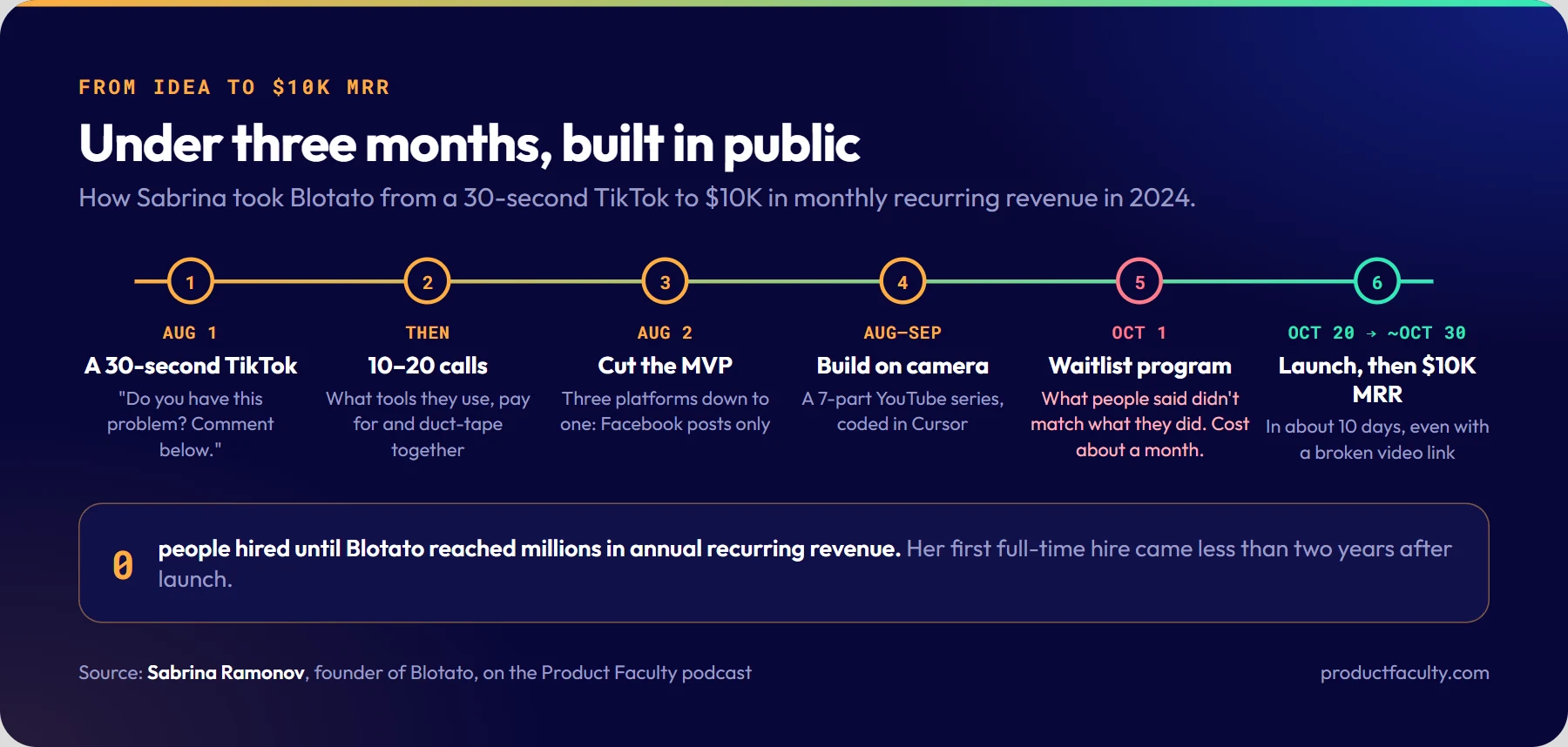
On 1 October she opened a waitlist to her newsletter and TikTok audience. Hundreds applied, and she picked 50 for an early adopter program. It was a mistake. In PostHog she could see what each of them actually posted and where, "and it does not match at all like anything that they said." Fifty people with fifty different use cases just confused her. Product people call this the say-do gap. Her lesson: skip it and launch sooner.
Launch day was 20 October: one newsletter and one TikTok. The newsletter, sent to tens of thousands of readers, was meant to include a five-minute demo video. She kept making last-minute changes, uploaded a new version, deleted the old one and pasted the old link. Everyone who clicked saw "video not found."
It didn't matter much. The link still led to the website, people signed up anyway, and about ten days later Blotato hit $10K in monthly recurring revenue. That's what an audience that already trusts you can do. She then turned the mistakes into more marketing: a video called "10 things I learned launching my app."
Fix onboarding by watching sessions, not dashboards
After launch, the most useful thing she did wasn't building funnels or metrics. It was sitting for two hours at a time watching PostHog session recordings: where people got stuck, where they rage-clicked, what they were trying to do.
- Sign-up: some payment methods failed, so she added more ways to pay.
- Onboarding: new users were dropped into the full interface and didn't know where to click. She replaced it with three guided steps: paste a YouTube or TikTok link, choose up to five platforms, get your draft posts.
Early churn was over 30% in the first month or two. It was alarming, but she wasn't worried. With a low-priced, self-serve product and a steady flow of sign-ups from her audience, every day brought new data to fix activation, and churn came down. Compare that with her first startup, where enterprise sales were slow and every deal was painful.
Vibe coding vs AI-assisted coding
Sabrina doesn't buy the idea that AI kills software developers. In her view, the point of vibe coding is to validate your idea quickly, get paying customers and then hire a developer with high conviction. Five years ago an MVP cost $5,000 to $15,000 and took three to six months. Now it takes days. Editing her build videos took longer than the build.
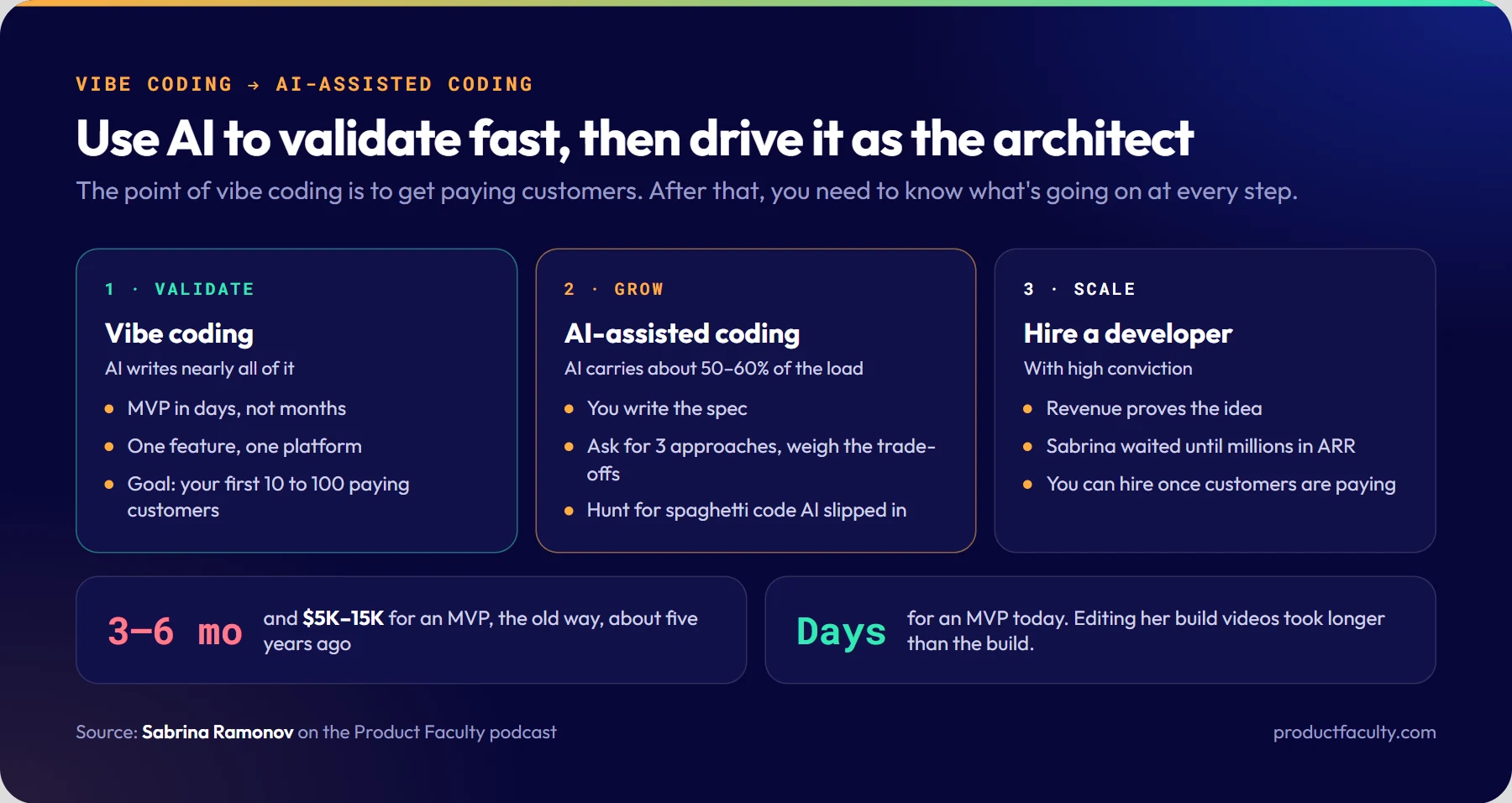
She coded Blotato herself all the way to millions in ARR, but it was harder than she expected. When she relaxed and let Claude run, "it changed something else and exploded all the queues" in production. So she moved from 100% AI coding to AI-assisted coding, where AI carries about 50 to 60% of the work.
| Feature | Vibe coding | AI-assisted coding |
|---|---|---|
| Who drives | The AI | You, as the architect |
| AI's share | Nearly 100% | About 50–60% |
| Your job | Describe what you want and test it | Write the spec, compare three approaches, pick the trade-offs, review the code |
| Best for | Validating an idea and winning your first paying customers | A product real customers depend on |
| Main risk | Spaghetti code and surprise changes in production | Slower, and you still need to understand every step |
Today Claude Code helps her plan the architecture, write tests, name variables and implement features. But she provides the spec first: what will this change affect, what are three ways to do it, which trade-offs are acceptable? "I know what's going on at every single step. I have to be the architect driving it."
How to pick a market worth entering
Her first rule is to solve your own pain. Her second: look for a space where people already pay for a solution. If people are paying for tools like Buffer, Hootsuite, Metricool and Later, the market exists. You don't need to beat them everywhere, just be clearly better in one dimension. Because Sabrina is her own user, she can be honest about where Blotato falls short and where it is really good.
She also sees a big opening as AI agents push businesses to rethink SaaS pricing toward outcome-based pricing. "Any space where people are already paying for a solution is going to be ripe for disruption."
Build distribution from zero
Sabrina calls an audience "kind of a cheat code to improving your product": a constant stream of new users brings constant feedback. If you don't want to build one, partner with someone who understands distribution. And it isn't too crowded. There are few credible people with real product or technical experience building personal brands. "You will rise above the noise."
- Start on TikTok. It is the most generous platform to new creators. Her first video to pass 100,000 views came about six weeks in. She posted once a day for three or four weeks, then three times a day, and that's when it took off.
- Teach the basics. Her AI agent videos flopped. Simple ChatGPT prompts took off. Outside the tech bubble, most people are still learning to write a prompt.
- Copy the hook. Find the top-performing posts in your niche and copy the hook and the structure, then fill it with your own content. Her first viral LinkedIn post used a Justin Welsh template. "Millions of people have already voted that this hook works."
The one-day-a-week content system
Sabrina calls herself "the laziest content creator you'll ever meet." She likes building, learning and teaching, not making content. So she built a system to batch it.
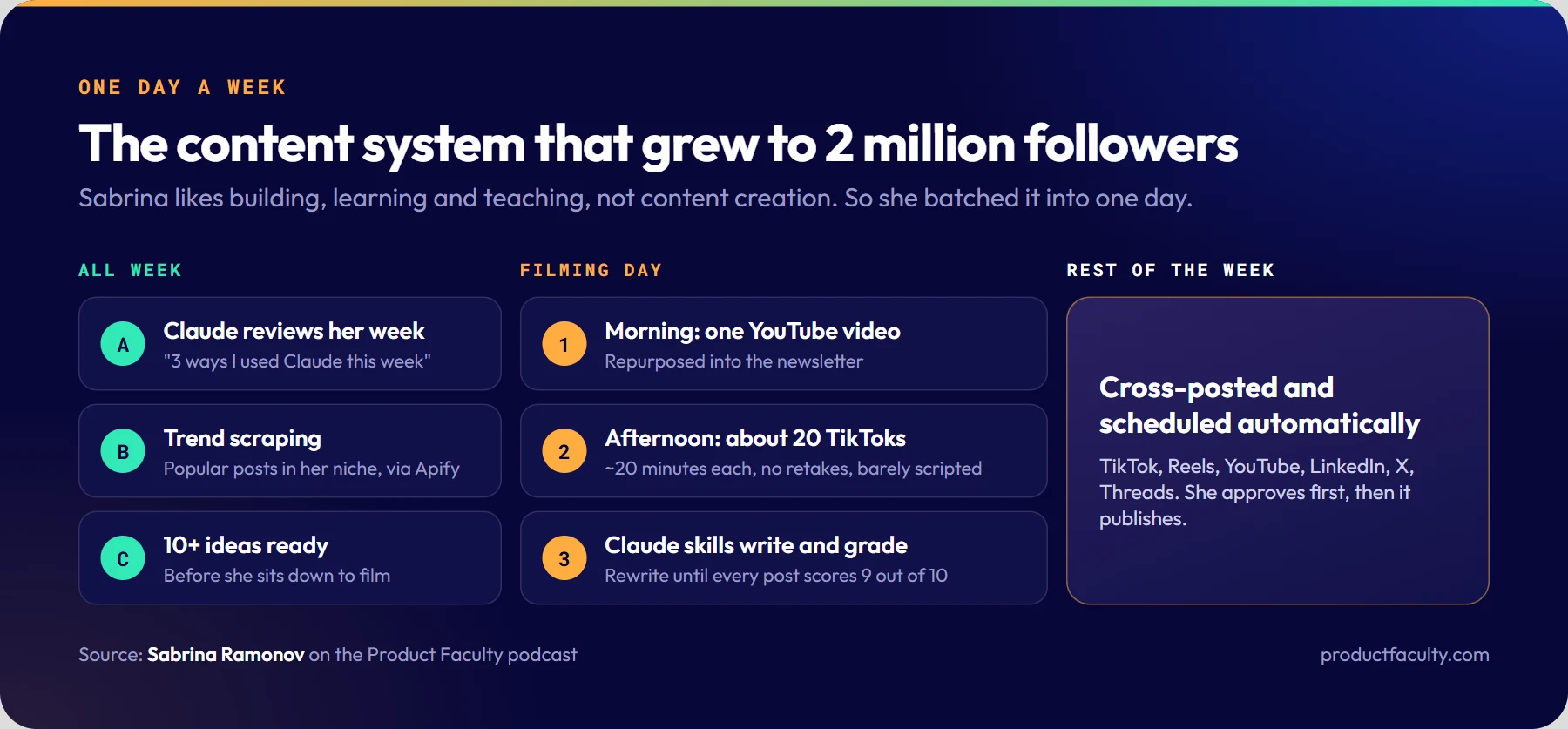
During the week, ideas pile up. She asks Claude to look at three different ways she used Claude that week, since it has the logs of her sessions, and uses Apify to scrape trending posts in her niche. By filming day she has at least ten ideas ready. She films one YouTube video in the morning, turns it into the newsletter and records about 20 TikToks after lunch, roughly 20 minutes each with no retakes. Claude and Remotion now handle much of the editing, including B-roll and animations.
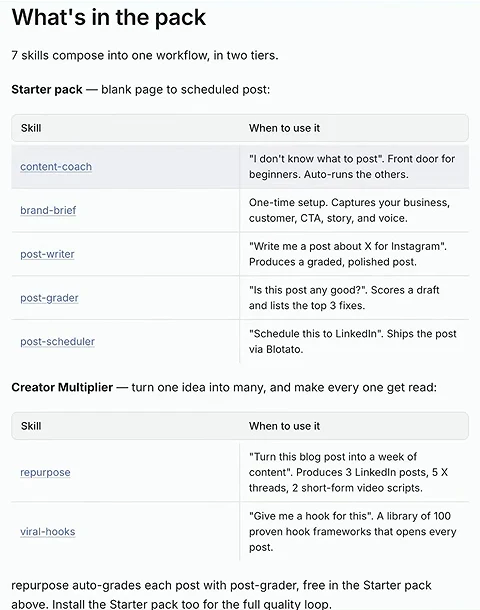
The writing runs on free Claude skills she shares publicly. A content coach asks what you're building and selling. A brand brief remembers your business, offer and voice. A post writer drafts, and a post grader scores each draft against a viral rubric: hook strength, curiosity, specificity, shareability, platform fit. Her favourite trick is a loop: "Write me a full week of content. Don't stop until every single post scores nine out of ten." That usually takes three to five revisions per post, mostly swapping hooks.
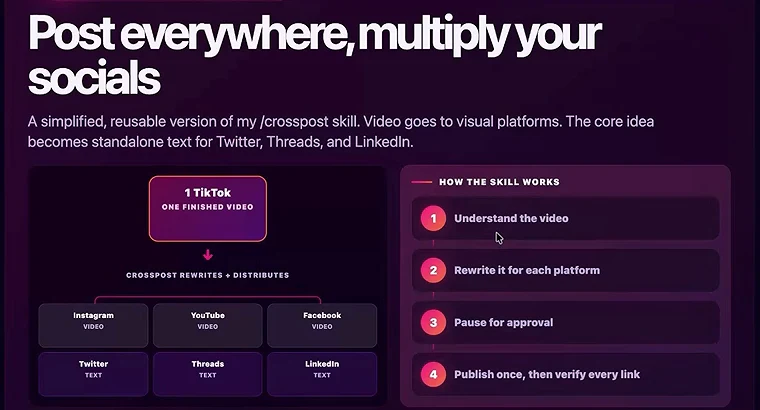
Finally, a cross-post skill transcribes each video locally with Whisper, rewrites the caption for each platform, turns the idea into text posts for X, Threads and LinkedIn, waits for her approval and schedules everything across the week. One tip from her playbook: warm up new social accounts for several weeks before you automate posting to them.
Bootstrapping vs fundraising
In San Francisco, Sabrina couldn't imagine building without raising money. Away from Silicon Valley, she saw how many ways there are to build a business. Many founders would be very happy with a solo, bootstrapped "micro SaaS" making $1 to 2 million a year.
It isn't either-or. Bootstrapping first buys you optionality: cash flow, security and the choice to raise later, for this company or a new one. "Cash flow is really fun too." Her advice to people with product or technical backgrounds: you have an unfair advantage with today's AI tools, so go for it.
Try this week
- Post your idea as a 30-second video and ask people to comment if they have the problem.
- Call 10 of the commenters. Ask what they use and pay for today, not whether they'd buy.
- Cross out features until your MVP does one thing for one platform or user.
- Watch 10 session recordings of real users before you build any dashboard.
- Copy one proven hook in your niche and post it with your own content.
Watch the full episode
FAQ
Can one person build an AI business alone?
Yes. Sabrina Ramonov built Blotato to millions in annual recurring revenue with no team and no outside funding, hiring her first full-time employee less than two years after launch. AI tools now let one person with a product or technical background build, launch and run a software business.
How do you validate a startup idea quickly?
Describe the problem in a short video or post and ask people who have it to comment. Then talk to 10 to 20 of them about the tools they use and pay for today. Sabrina did this with a 30-second TikTok before writing any code.
What is the difference between vibe coding and AI-assisted coding?
In vibe coding, AI writes nearly all of the code from your descriptions. It is good for validating an idea fast. In AI-assisted coding, you act as the architect: you write the spec, compare approaches and review the code, while AI does about half the work. It suits a product real customers rely on.
When should a solo founder hire a developer?
Use vibe coding to get your first 10 to 100 paying customers, then hire a developer with high conviction. Sabrina coded Blotato herself until it reached millions in annual revenue, but she recommends most founders hire once paying customers prove the idea.
What is the best platform to build an audience from zero?
Sabrina recommends TikTok because it is the most generous to new creators. She posted once a day, then three times a day, taught simple AI tips and copied proven hooks from top posts in her niche.
How can you create a week of social media content in one day?
Collect ideas during the week, then batch everything into one filming day. Sabrina films one YouTube video and about 20 TikToks, uses Claude skills to write and grade posts until each scores 9 out of 10, and uses a cross-post skill to adapt and schedule them across platforms for the rest of the week.
Build your own AI product
Product Faculty's AI Builder Fellowship teaches product people to build and ship with AI, alongside practitioners from frontier AI companies. To go from idea to working product with Claude, see AI-Native PM with Claude. To learn how to judge AI output before you ship it, take AI Evals.