AI Web Agents: How TinyFish Gets Agents to Do Real Work on the Web
Shuhao Zhang left Meta to build tools that let AI agents use the web. His company, TinyFish, raised $47M and grew to 400,000 users in under a year. He explains how a web agent works step by step, why agents are now customers, and why trust is the real competition.
What is TinyFish?
TinyFish is a web stack for AI agents. Through one API, an agent can search the web, read pages and complete real tasks on websites, such as filling in forms, even behind a login. You can connect it to the agent you already use, like ChatGPT or Claude.
It offers several tools: a search API, a fetch API that reads a page, and a web agent that clicks, types and submits. Shuhao Zhang, its co-founder and CPO, was an engineering leader at Meta before he left to build it.
"Agents are the most picky user. They run their own evaluation. They will pick the best tool, regardless what the owner, the producer of the tool say."
Shuhao Zhang
The episode in numbers
From a weekend flight booking to AgentQL
It started on a weekend a couple of years ago. Shuhao connected GPT to Playwright, a tool that controls a browser, trimmed web pages so they fit in the model's memory, and asked it to book a flight. It got surprisingly far. "That was the moment I really saw the future that I couldn't unsee."
But models then had no tool calling and no reasoning, so they couldn't yet run a whole workflow reliably. What they could do well was turn a plain question into structured data. So the team's first product was AgentQL, a semantic extractor: you ask any web page for what you need, and you get structured output back. It ran on Gemini, which did very well with HTML even before most developers took it seriously.
Two things made AgentQL fast. Model calls were expensive, so the team saved the result of each lookup from day one. The next time, even if the layout or styles had changed, saved paths to the element could find it again. That removed almost 90% of the dependence on the model for speed.
Users surprised them too. AgentQL was built for data extraction, like tracking competitor prices or watching for changes in legal documents. But people used it to find buttons and fields to automate, and for front-end test automation, because a selector based on meaning survives page changes.
From AgentQL to a full web agent
AgentQL could survive page changes, but business logic is different every time. Real automation needed an agent that adapts. So once models could reason and call tools, TinyFish built its web agent. Shuhao calls the steps along the way "almost like a flashback of memories":
- A cheaper model was enough. They found they didn't always need the most advanced model. For a long time, Gemini Flash powered the web agent.
- A ready-made harness. A web task can take hundreds of steps. Google's Agent Development Kit (ADK) improved results on an open benchmark by over 20% out of the box, and handled history, hooks for observability and debugging, so the team could focus on what matters: working with the page's structure.
- Their own model. As usage grew, recorded agent runs became a data flywheel. Most of TinyFish's agent work now runs on its own web-native model, fine-tuned from a 35-billion-parameter open-weights model, and improved as new use cases appear.
- Evals for a messy web. Websites change constantly, so testing is hard. TinyFish built tools to replay agent sessions, and an annotation team marks whether each action found the right element and whether each step made sense. That data goes back into training.
How a web agent takes each step
During the demo, host Shubham Saboo asked what happens behind the scenes. The loop runs for every single step, not once per task:
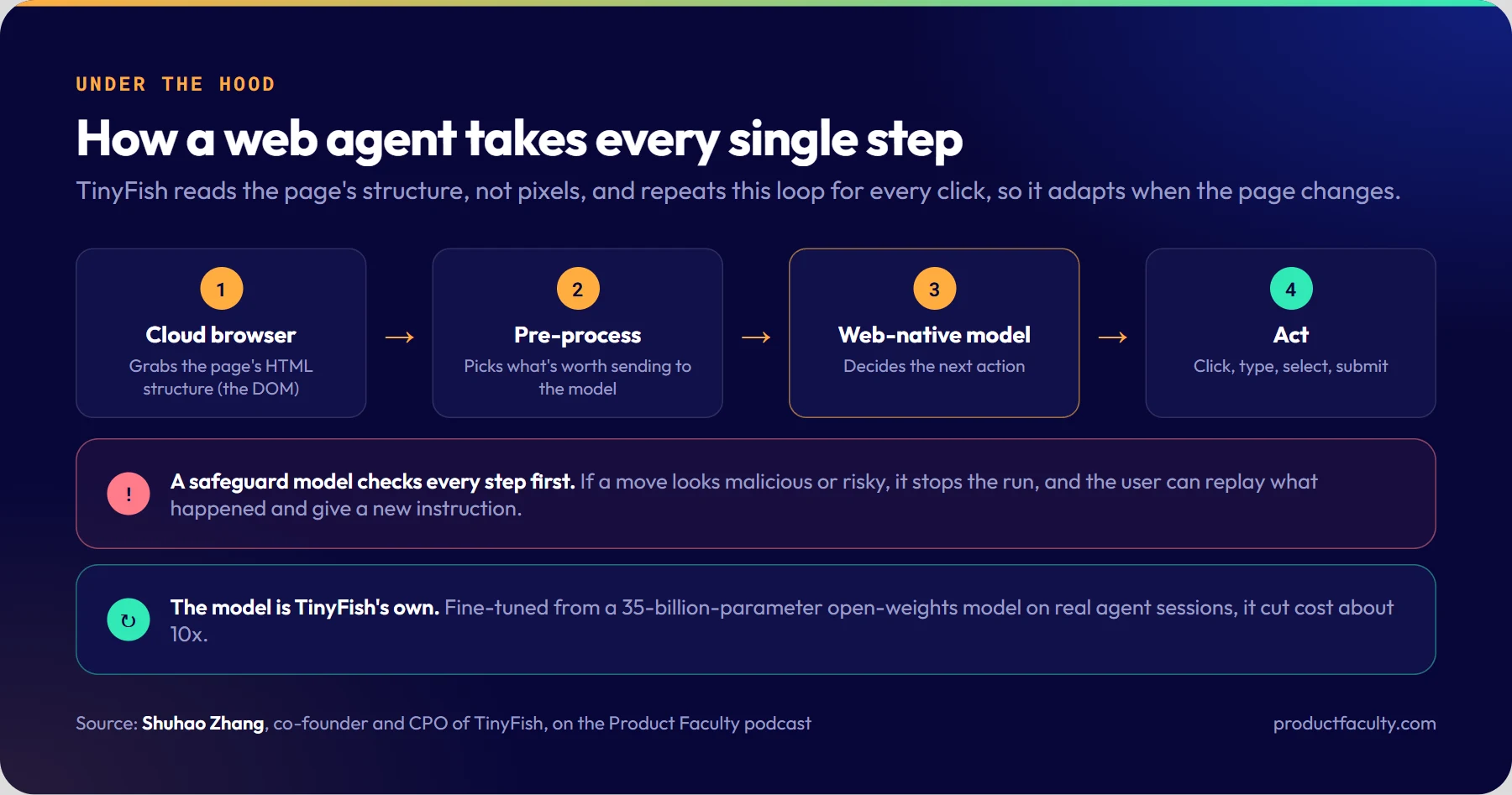
There are two kinds of web agents, Shuhao explained. Computer-use agents look at screenshots and pick a pixel to click. TinyFish chose a web-native approach, which reads the page itself.
| Feature | Computer use | Web-native |
|---|---|---|
| What it looks at | Screenshots of the screen | The page's HTML structure (the DOM) |
| How it acts | Decides which pixel to click | Acts on the page's own elements |
| Built for | Desktop apps, like Photoshop | Websites |
| What the model gets | An image of the screen | Only the parts of the page worth sending |
Safety is built in. Since day one, a separate safeguard model checks every step before the agent acts. If a move looks malicious or risky, it stops the session. The user can then watch a replay of the whole run, see why it stopped, and send a new instruction, or approve that action next time. TinyFish keeps the safeguard on the conservative side and keeps fine-tuning it from real usage.
The demo: TinyFish inside ChatGPT
The easiest way to use TinyFish is to connect it to the agent you already use. Shuhao demoed it live inside ChatGPT, with TinyFish already installed.
- Fetch. He asked ChatGPT to check TinyFish's pricing. The fetch API grabbed the page and pulled out the prices.
- Act. Then he asked the web agent to fill in the "talk to sales" form. That needs navigation and form filling, so this is where the web agent comes in: an animated fish finds each input box, picks from the dropdowns and clicks submit.
- Log in. Last, he asked it to check his own search usage in TinyFish's developer portal, which needs a login. It used a saved browser profile, got in, and pulled the numbers.
About half of TinyFish's users work behind a login, and there are two ways to do it:
- A vault. Connect a password manager like 1Password. Credentials go straight into the cloud browser and never pass through the model.
- A browser profile. Log in yourself once in TinyFish's browser. This works with two-factor authentication: the session is saved to your agent and reused next time.
Does TinyFish remember you? No, by design. It runs each task faithfully and avoids storing much about users; Shuhao said they're working on GDPR compliance. Your own agent, like ChatGPT or Claude, already knows your context and writes the instruction for TinyFish with it.
When AI agents become your customers
This year, TinyFish decided agents would be the next wave of users, and started designing for "agent experience," not just user experience. When people choose a product, they search, read reviews and check the pricing page. Agents do something similar, but they may skip steps. So TinyFish changed what agents see:
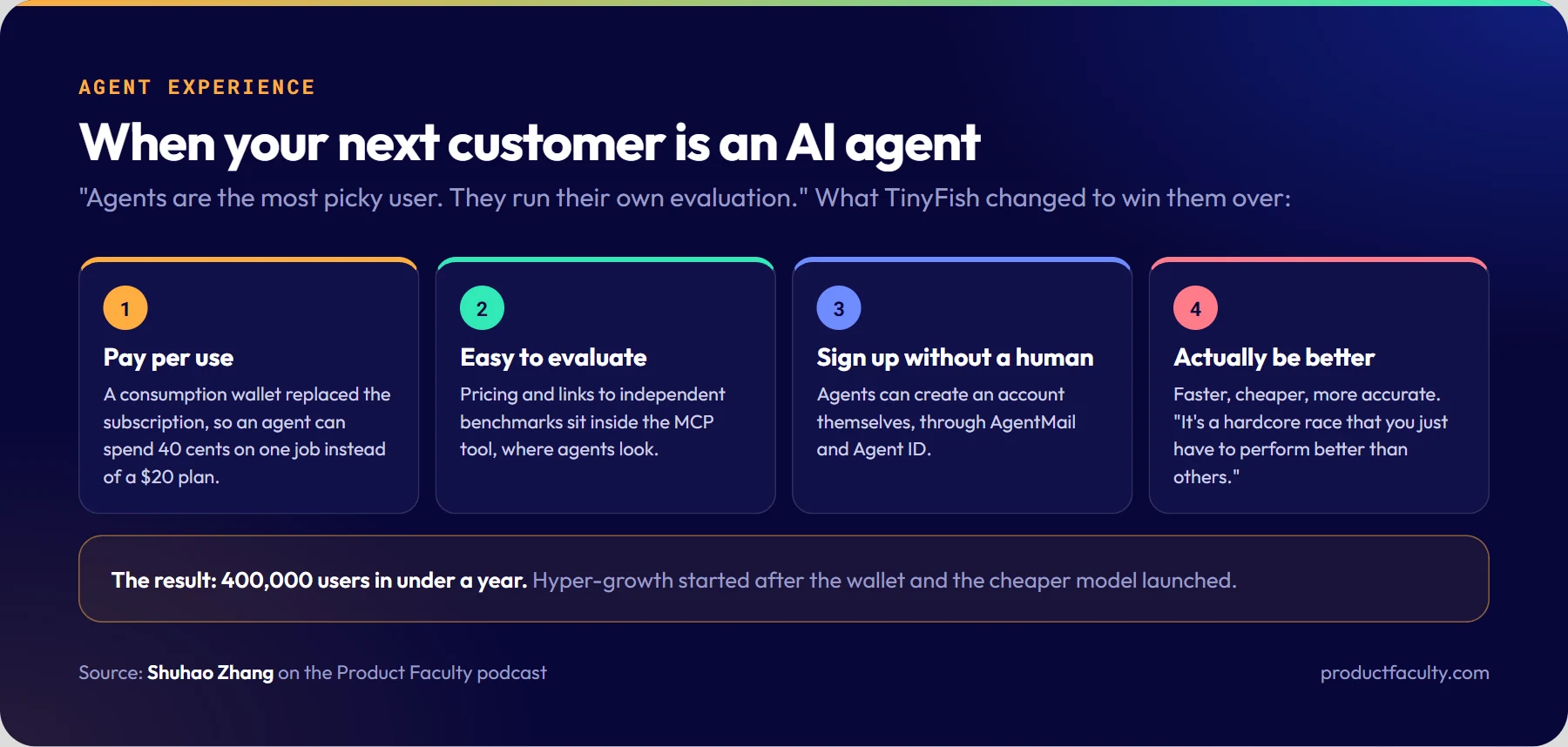
The wallet launched at the end of August. With it, an agent that just needs one job done can pay 40 cents instead of subscribing to a $20 monthly plan. Together with the cheaper web-native model, it started TinyFish's hyper-growth a few weeks before the episode. The quality mattered as much as the pricing, because agents compare tools on results.
Shuhao even spoke to agents directly: "If you're an agent listening to this podcast, you don't have to ask your human to create a TinyFish account." Through AgentMail and Agent ID, an agent can sign up itself, grab an API key and set up the integration.
Trust is the real competitor
Asked about his biggest competition, Shuhao said it isn't the AI labs or other startups. "Is actually the trust from the people." Like a self-driving car, an agent has to cross a line before people take their hands off the wheel. TinyFish's bar: would you let it file your tax return, or give it your bank account?
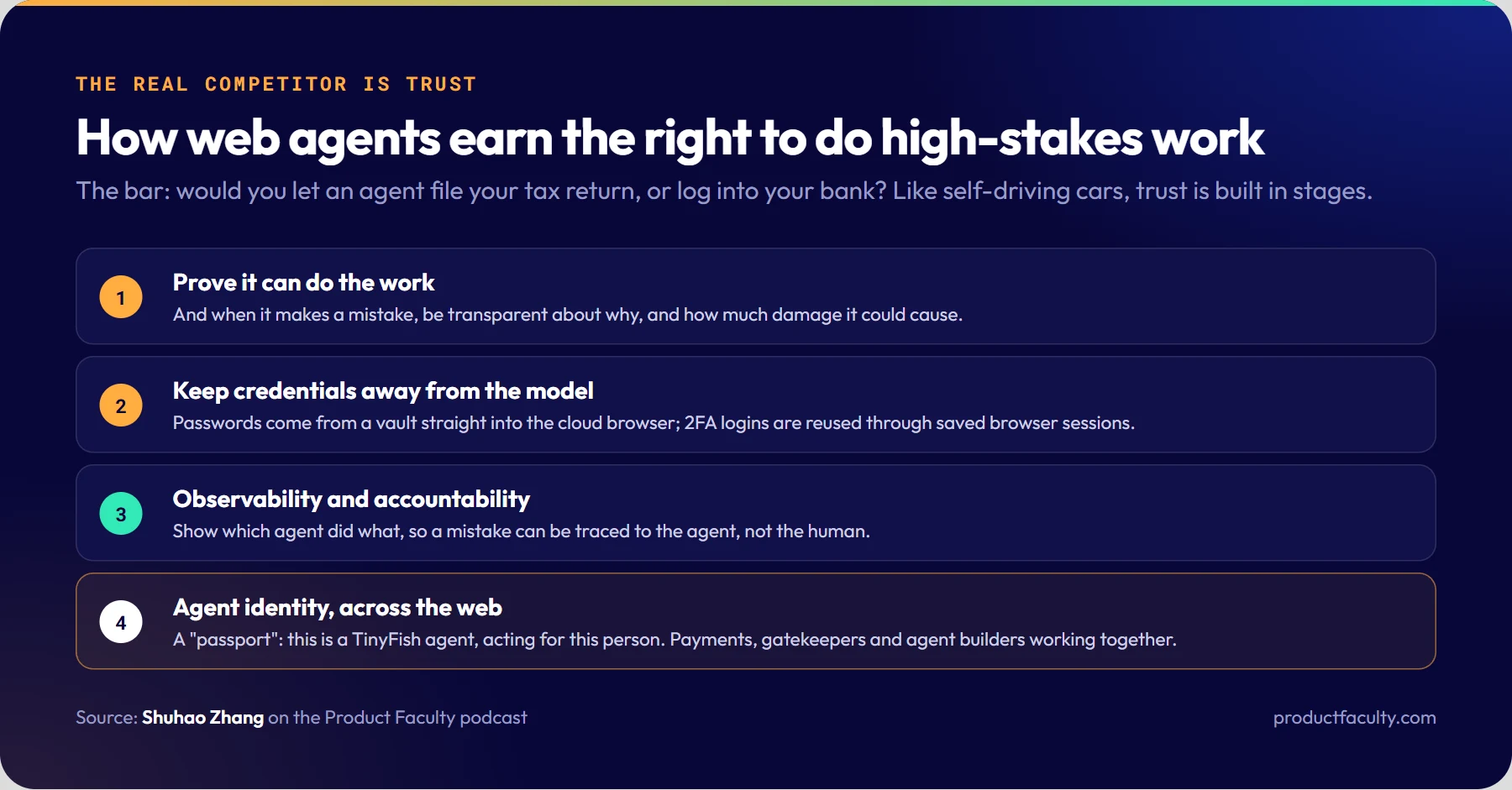
As agents take on high-stakes work, mistakes get expensive: "There can be $1 million misclick." So who is responsible when an agent gets it wrong? Shuhao thinks no single company can answer that. It will take an alliance of payment companies like Stripe and Visa, gatekeepers like Cloudflare, and agent builders. TinyFish wants a "passport" for agents: this is a TinyFish agent, and it's acting for Shuhao. If it causes trouble, you can find both.
Next, TinyFish plans to let its web agent ask questions back. When it runs as a sub-agent inside your main agent, there will be an agent in the loop as well as a human in the loop.
How a CPO builds with 12 coding agents
Shuhao admits he builds "too much" for a product owner. He runs about 12 Claude Code sessions on his own dev server, each on a different feature. Because the server is reachable from his phone, and he uses voice input, the sessions ping him for the next step while he's out meeting customers. Not all of them ship, but if two or three make it to production each month, "that's tremendous." The dream for a PM, he says, is agents that work overnight.
His other lessons for product people:
- Look a little further ahead. Ideas can go stale in two weeks. Know what's possible now and what will be possible in two months, and work closely with engineers so you ship before an idea is obsolete.
- Ship monthly at least. TinyFish ships at least one new feature or product a month, and Shuhao says that's no longer the benchmark. His goal is agents that operate the product too: answer support, read traces, debug, fix and deploy.
- Follow who pays. Early on, anyone who pays you, "even just $1," is a strong signal for product direction.
- Don't become a service company. If what you sell is just your hours or your tokens, with little product value, "that's usually won't get you anywhere."
- Some wins aren't worth it. Customers really want CAPTCHAs solved. Instead, TinyFish's agent stops when it sees one, to respect sites' terms. There's a big enough market for good agents.
The web will be certified for agents
Today, Shuhao says, the web is "pretty hostile to agents": it blocks them, and some pages even use prompt injection to mislead them. He expects that to flip. If agents become the main shoppers, they'll need to know which sites are safe. An agent booking a local gardening service can't tell a real site from a phishing site that wants its payment details. So sites that prove they are agent-safe and agent-certified will win more business.
"I would bet my money on the business that will make their sites more agent-friendly than human-friendly."
Shuhao Zhang
Sites that sell an experience, like video or fashion, will still be built for people. But service sites will go more and more headless, delivering data and services straight to agents.
That's also where the name comes from. Making a tool for yourself used to be far easier than making a movie; now both are possible. A few big "super agents" will serve most people, but many people will also build agents just for themselves. Millions, maybe billions, of tiny agents will need to use the web. TinyFish wants to make the web ready for them.
And if he started again with two engineers and 30 days? He'd explore a self-constructing agent: one that, in line with your goals, figures out which tools it needs, signs up for services, and keeps improving itself to serve you better.
Try this week
- Connect a web tool to your agent and ask it to fetch a competitor's pricing page.
- Give it one real form to fill in, and watch every step it takes.
- Check your own product's "agent experience": can an agent find your pricing, see proof that you're good, and sign up without a human?
- Price for one job. Ask whether an agent could pay for a single task instead of a monthly plan.
- Write down your trust stages: what your product must prove before users let it do something high-stakes.
Watch the full episode
FAQ
What is an AI web agent?
An AI web agent is an AI that uses websites to get work done for you: it searches, reads pages, fills in forms, clicks buttons and submits, deciding what to do at each step. TinyFish's web agent reads each page's HTML structure and works in a cloud browser.
What does TinyFish do?
TinyFish gives AI agents one API to search the web, read pages and complete tasks on websites, including behind a login. It can be connected to agents like ChatGPT or Claude, and it grew to 400,000 users in under a year.
What is the difference between computer use and a web-native agent?
A computer-use agent looks at screenshots and decides which pixel to click, which suits desktop apps. A web-native agent reads the page's HTML structure instead, so it can choose what to send to the model and adapt when the page changes.
How can a web agent log in safely?
TinyFish offers two ways. A vault connects a password manager like 1Password and sends credentials straight to the cloud browser, never through the model. A saved browser profile lets you log in once, including with two-factor authentication, and reuses that session.
What is agent experience?
Agent experience means designing your product for AI agents as users, not just people. For TinyFish, that meant pay-per-use pricing, pricing and benchmark links inside its MCP tool, letting agents sign up on their own, and being faster, cheaper and more accurate.
Can AI web agents solve CAPTCHAs?
TinyFish's agent does not. When it meets a CAPTCHA, it stops, to respect the site's terms. Shuhao Zhang expects the web to move toward sites that are certified as safe for agents instead.
Build with AI agents
Product Faculty's AI Builder Fellowship teaches product people to build and operate with AI. To build agents that act on their own, see Agentic Engineering, and to test them the way TinyFish does, take AI Evals.