AI Product Strategy Examples: 20 Lessons From 15 Companies
How OpenAI, Anthropic, Amazon, Shopify, Uber and 10 more build AI products, with the numbers behind each lesson and a source for every claim.
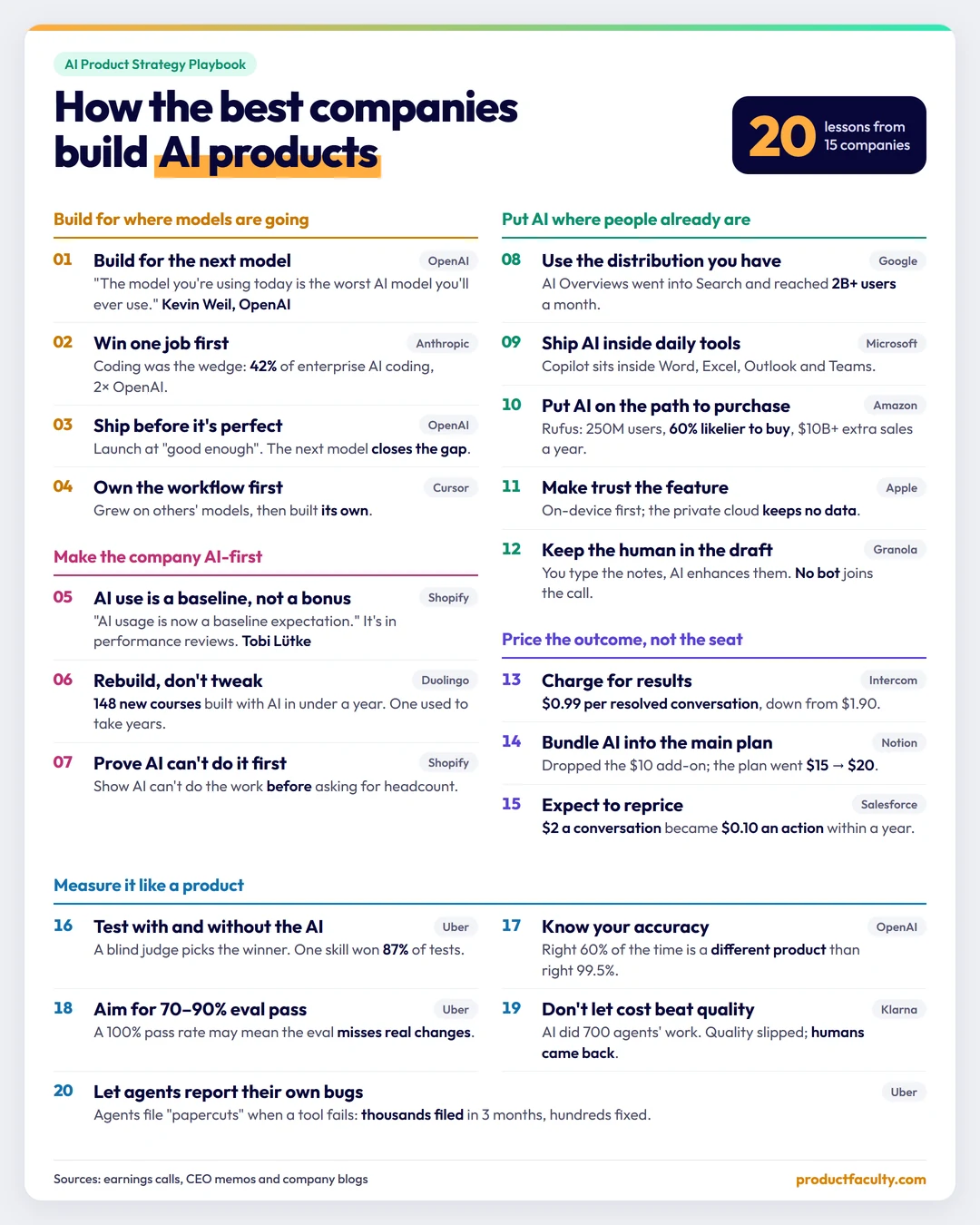
Short answer: the companies winning with AI do five things. They build for where models are going, make the whole company AI-first, put AI where people already are, price the outcome instead of the seat, and measure AI like a product. Below are 20 concrete examples from 15 companies, each with the evidence, what it means for your product, and links to the original sources.
The numbers behind the lessons
What is an AI product strategy?
An AI product strategy is the set of choices about where AI goes in your product, what it must be good at, how you charge for it, how your team works with it, and how you know it's working. The examples below come from the companies' own earnings calls, CEO memos, announcements and engineering blogs, plus press coverage of them. We grouped them into five themes.
1. Build for where models are going
AI models get better in big steps every few months. These lessons are about building a product that improves as the models do, instead of one that has to be rebuilt each time.
01Build for the next model OpenAI
Kevin Weil, then OpenAI's Chief Product Officer, said on Lenny's Podcast (April 2025) that the model you use today is the worst model you will ever use.
Weil's point is that capability moves fast: something a model can't quite do today is often easy a release or two later. A product designed only around today's limits ends up rebuilt; one designed for where models are heading gets better on its own as new models arrive.
For your product: design for what models will do in six months, not only what they do today, and make it easy to swap in a newer model.
02Win one job first Anthropic
Menlo Ventures' mid-2025 survey put Anthropic at 32% of enterprise AI model usage (OpenAI 25%, Google 20%), and at 42% in coding, more than double OpenAI's 21%.
Coding was the wedge. It is a valuable job, it is easy to tell whether the output works, and developers spread the tools they like inside their companies. Being clearly best at that one job helped make Claude the most-used model in enterprise overall in that survey.
For your product: pick one valuable use case and be clearly the best at it before you widen.
Sources: Menlo Ventures, 2025 mid-year LLM market update · TechCrunch
03Ship before it's perfect OpenAI
In the same interview, Weil described shipping products that work only part of the time, because the next model, a few months later, makes them much better.
Waiting for a feature to be perfect costs months of learning from real users, and the gap often closes by itself when the next model ships. Shipping early also tells you which failures matter to users and which don't.
For your product: launch at "good enough" when the model trend is on your side, be honest with users about limits, and plan for the upgrade.
04Own the workflow first, build your own model later Cursor
Cursor grew as a code editor built on other labs' models. With Cursor 2.0 (October 2025) it launched Composer, its own coding model, plus a way to run up to eight agents in parallel.
Cursor didn't start by training a model. It won developers with the workflow: the editor, the shortcuts, the way the AI fits into daily coding. Once it had the users and the usage data, building its own model became an option rather than a starting requirement.
For your product: the workflow and the users are the moat; the model can be swapped, or built later.
Source: Cursor blog, Cursor 2.0
2. Make the company AI-first
Teams that use AI every day build better AI products. These lessons are about how leaders made that the norm, and what it cost them.
05AI use is a baseline, not a bonus Shopify
Tobi Lütke's April 2025 memo, "AI usage is now a baseline expectation", added AI use to performance and peer reviews.
By putting AI use into reviews, Shopify turned it from an optional experiment into part of everyone's job. The people designing AI features use AI every day, so they know where it helps and where it gets in the way.
For your product: make daily AI use part of how your team works, so the people building AI features understand them as users.
Source: TechCrunch
06Rebuild, don't tweak Duolingo
After Luis von Ahn's "AI-first" memo ("making minor tweaks to systems designed for humans won't get us there"), Duolingo launched 148 new courses built with AI in under a year, doubling its catalog.
A single course used to take years to build. Duolingo didn't speed up the old process; it redesigned course creation around AI. The move also drew public criticism over replacing contractors, which shows the people side needs as much planning as the technology.
For your product: redesign the process around AI instead of adding AI to an old process, and handle the people side openly.
Sources: Duolingo investor release · TechCrunch
07Prove AI can't do it before you ask for headcount Shopify
The same Shopify memo: "Before asking for more headcount and resources, teams must demonstrate why they cannot get what they want done using AI."
This flips the default. Instead of hiring first and adding AI later, teams have to try AI first and explain why it falls short. It forces a real test of what AI can do in each team's work.
For your product: make AI the first option for new work, and hiring the deliberate choice.
Sources: TechCrunch · Fortune
3. Put AI where people already are
The biggest AI launches didn't ask people to open a new app. They added AI to a product people already used every day, at the moment it was useful.
08Use the distribution you have Google
Sundar Pichai said on the Q2 2025 earnings call that AI Overviews in Search reached more than 2 billion monthly users, up from 1.5 billion in May. Later reports put it at 2.5 billion.
Google didn't need people to download anything: it put AI answers at the top of the search page billions already used. Few standalone AI apps reach that many people.
For your product: put AI inside the product people already use daily instead of launching a separate one.
Source: TechCrunch
09Ship AI inside the tools people already open Microsoft
Microsoft launched 365 Copilot in 2023 as an assistant built into Word, Excel, PowerPoint, Outlook and Teams, following each company's existing security settings.
People don't have to change how they work: the AI appears inside the document, spreadsheet or meeting they already have open. Respecting existing security settings also made it easier for IT teams to approve.
For your product: meet users in their existing workflow, and fit your customers' existing rules, so adopting your AI doesn't mean switching tools.
10Put AI on the path to purchase Amazon
Andy Jassy said on the Q3 2025 earnings call that Rufus, Amazon's shopping assistant, is on track for more than $10 billion in extra yearly sales, with 250 million customers using it, and that shoppers who use it are 60% more likely to buy.
Rufus sits where the buying decision happens: on product pages and in search, answering questions shoppers would otherwise leave to look up. That ties the AI directly to Amazon's core metric, sales. The $10 billion is Amazon's own estimate.
For your product: place AI at the moment of decision, where it moves your core metric.
Source: Fortune
11Make trust the feature Apple
Apple Intelligence (June 2024) runs on the device first. Bigger tasks go to Private Cloud Compute, which Apple says doesn't store data, can't be accessed by Apple, and can be checked by outside researchers.
Apple turned privacy, often a reason people hesitate to use AI, into the reason to choose its AI. Letting outside researchers check the claims makes them more than marketing.
For your product: if your users worry about their data, make privacy a headline feature, not a footnote, and make it checkable.
Sources: Apple Newsroom · Apple Security blog
12Keep the human in the draft Granola
Granola is an AI notepad. You type notes in the meeting and the AI enhances them with what it heard, so it works alongside you, not instead of you. It doesn't join calls as a bot.
Because you write the first draft, the summary reflects what you thought mattered, not just what the AI picked out. And with no bot joining the call, other people in the meeting aren't put off.
For your product: let users steer the AI with their own input; it keeps quality and trust high.
Sources: Granola blog · Granola, What is an AI notepad?
4. Price the outcome, not the seat
When AI does the work a person used to do, charging per seat stops making sense. These companies are trying new pricing models, and changing them often.
13Charge for results Intercom
Intercom's Fin AI agent charges $0.99 per outcome, such as a resolved conversation, down from $1.90 at launch. Customers aren't charged when Fin hands off or fails.
Customers pay only when the AI actually does the job, so the price is easy to compare with the cost of a human handling the same conversation. It also puts the risk on Intercom: if Fin doesn't resolve it, Intercom doesn't get paid.
For your product: if AI does the work instead of a person, price the work done, not the seats.
Source: Intercom, Fin AI agent pricing
14Bundle AI into the main plan Notion
In May 2025 Notion stopped selling AI as a $10 add-on and included it in the Business plan, which rose from $15 to $20 per member a month.
An add-on asks every customer to decide whether AI is worth extra, and many say no. Bundling it puts AI in front of everyone on the plan, and the higher plan price pays for it.
For your product: when AI becomes core to the product, make it part of the main plan and raise that plan's price.
Sources: Engadget · Notion blog
15Expect to reprice Salesforce
Agentforce launched at $2 per conversation. In May 2025 Salesforce added Flex Credits at $0.10 per action, and later a per-resolution option. The pricing changed several times in its first year.
Nobody knows yet what customers will pay for AI agents, not even Salesforce. It treated pricing as something to test and adjust rather than a one-time decision.
For your product: plan to test your AI pricing and change it, and tell customers up front that it may change.
Source: Salesforce press release
5. Measure it like a product
An AI feature isn't done when it ships. These lessons are about proving it works, and noticing when it stops working. Uber's engineering team runs agent skills more than a million times a month, and how they test them applies to any AI feature.
16Test with and without the AI Uber
Uber replays real prompts with and without a skill, and a blind judge picks the better answer. One data-query skill won 87% of comparisons. Without it, sessions had 13% more tool calls, six times the tool errors, and took 31% longer.
The question isn't whether the AI feature works; it's whether it works better than not having it. A blind comparison against the version without it answers that directly.
For your product: prove each AI feature beats the version without it before you call it a win.
Source: Uber Engineering, How Uber Evals 1 Million Agent Skill Invocations a Month
17Know your accuracy OpenAI
Kevin Weil explained that a model that is right 60% of the time leads to a very different product than one that is right 95% or 99.5% of the time.
At 60%, a person has to check every answer, so the AI is a draft. At 99.5%, it can act on its own. The same model can power very different products depending on that number, which is why evals come first.
For your product: measure accuracy first, then design the experience around it: human review at 60%, full automation at 99%. New to this? Read What Are AI Evals?
18Aim for a 70–90% eval pass rate Uber
Uber finds evals that pass 70–90% of runs more useful than ones that pass 100%, because a perfect score may mean the eval misses real changes. Their eval mix is 5% golden cases, 80% real prompts and 15% author-judged cases.
An eval that always passes can't tell you when something got worse. Keeping some hard cases in the set means a regression shows up as a drop in the score.
For your product: treat a perfect score as a warning sign, and make evals hard enough to catch regressions.
Source: Uber Engineering, How Uber Evals 1 Million Agent Skill Invocations a Month
19Don't let cost beat quality Klarna
Klarna said in 2024 that its AI assistant did the work of 700 agents. In 2025 its CEO said cost had been given too much weight and quality suffered, and Klarna began hiring human agents again so customers can always reach a person.
Cost saved is easy to measure; customer frustration is not. Klarna's change shows that a measure of quality needs to sit next to the cost savings. Klarna describes the change as a rebalance, not a reversal.
For your product: track quality and satisfaction, not only cost saved, and keep a way to reach a human.
Sources: Entrepreneur · TechCrunch
20Let agents report their own bugs Uber
An always-on skill lets Uber's agents file "papercuts" when a tool or skill fails: what they tried, what they expected, what they got. Thousands were filed in three months, and hundreds fixed.
The agents hit problems far more often than people report them. Letting the agent file the report means small failures get fixed instead of ignored, and Uber also turns rejected agent pull requests into new eval cases.
For your product: build feedback loops so the AI itself shows you where it struggles.
Source: Uber Engineering, How Uber Evals 1 Million Agent Skill Invocations a Month
All 20 lessons in one table
| Company | Strategy | Key number |
|---|---|---|
| OpenAI (01, 03, 17) | Build for the next model, ship early, know your accuracy | 60% vs 99.5% right: different products |
| Anthropic (02) | Win one job, coding, first | 42% of enterprise AI coding (mid-2025) |
| Cursor (04) | Own the workflow, then build a model | Own model, up to 8 agents in parallel |
| Shopify (05, 07) | AI use as a baseline expectation | Prove AI can't do it before hiring |
| Duolingo (06) | Rebuild the process around AI | 148 courses in under a year |
| Google (08) | Use the distribution you have | 2B+ monthly AI Overviews users |
| Microsoft (09) | AI inside everyday tools | Word, Excel, PowerPoint, Outlook, Teams |
| Amazon (10) | AI on the path to purchase | $10B+ extra yearly sales (Amazon's estimate) |
| Apple (11) | Privacy as the feature | On-device first, Private Cloud Compute |
| Granola (12) | Human-led, AI-enhanced | Your notes plus AI, no meeting bot |
| Intercom (13) | Price per outcome | $0.99 per resolution |
| Notion (14) | Bundle AI into the main plan | Business plan $15 → $20 |
| Salesforce (15) | Keep changing the pricing | $2 a conversation → $0.10 an action |
| Uber (16, 18, 20) | Measure AI like a product | 87% blind-test win; 70–90% eval pass |
| Klarna (19) | Quality over cost | AI did the work of 700 agents; humans back |
How to apply this to your product
Take one AI feature you own and answer five questions, one per theme:
- Models: what will this feature do when the model is twice as good, and what can you ship now at "good enough"?
- Team: does your team use AI every day, and do they try AI first before asking for more people?
- Distribution: is the AI inside the screen people already use, at the moment they decide?
- Pricing: are you charging for seats while the AI does the work? What outcome could you price instead?
- Measurement: how accurate is it, have you tested it against having no AI at all, and are your evals hard enough to fail?
For the leadership side, from moats to pricing to leading AI adoption, read How to Build an AI Product Strategy and the Product Strategy Playbook.
Notes on the numbers
- Amazon's $10 billion figure for Rufus is the company's own estimate.
- Menlo Ventures, the source for Anthropic's market share, is an investor in Anthropic.
- Klarna describes its return to human agents as a rebalance, not a reversal of its AI strategy.
- Pricing for Intercom, Salesforce and Notion changes often; check their current pricing pages before quoting them.
FAQ
What is an AI product strategy?
The set of choices about where AI goes in your product, what it must be good at, how you charge for it, how your team works with it, and how you measure whether it works.
What are good examples of AI product strategy?
Google put AI Overviews into Search and reached 2 billion+ monthly users; Amazon put its Rufus assistant on the path to purchase; Intercom charges $0.99 per resolved conversation; Shopify made AI use a baseline expectation; Uber tests every agent skill with and without it.
How should you price an AI product?
When AI does work a person used to do, consider pricing the outcome, as Intercom does at $0.99 per resolution, or bundling AI into the main plan, as Notion did. Expect to change it: Salesforce repriced Agentforce within its first year.
How do you measure whether an AI feature works?
Test it against the same task without the AI, using a blind judge, and build evals that pass 70–90% of the time rather than 100%, as Uber does with its agent skills.
Should you build your own AI model?
Usually not first. Cursor grew on other labs' models by owning the workflow, and only later launched its own coding model.
Where can I learn to build an AI product strategy?
Product Faculty's AI Product Strategy for Leaders certification is a live course on building AI strategy for your product and company, and it is part of the AI Builder Fellowship.
Build your own AI product strategy
Turn these lessons into a strategy for your own product in AI Product Strategy for Leaders, or learn to measure AI features properly in AI Evals. Both are part of the AI Builder Fellowship.